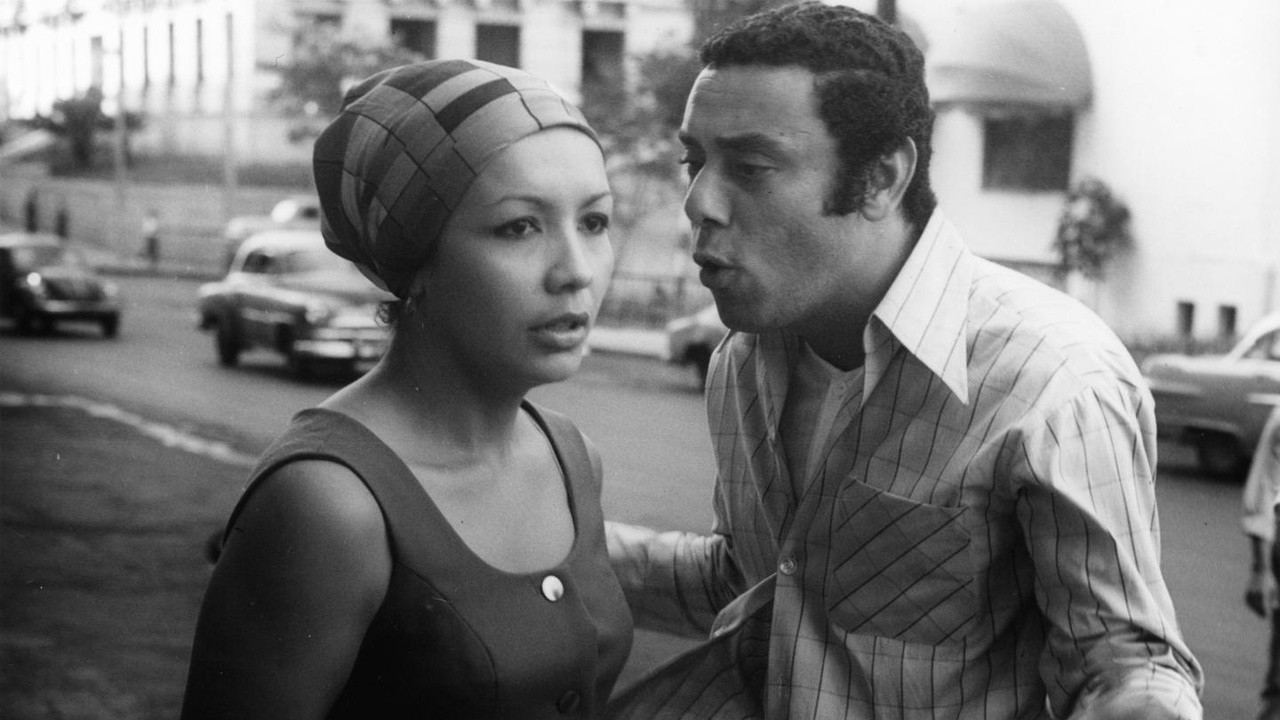
Yolanda, a female teacher, cannot find the best methods to teach the marginalized children of the slums because of their different origin. Mario, a worker in a bus factory and a typical macho man, is confronted by Yolanda’s instinct for emancipation. The two nonetheless become lovers. Their relationship portrays the idea that racism, sexism, and class-based prejudices must be demolished in order to succeed. —wikipedia
Julio Garcia Espinosa was born in Havana on September 5, 1926. As a young man worked as director and actor at the Theatre Vernáculo, and later directed programme on radio. He was President of the Section of Cinema of the Cultural Society: “Our Time”.
Co-Author; together with other filmmakers made a film that was called “El Mégano”, considered the historical precedent of the New Cuban Cinema. He was also one of the founders of the Group “Teatro Estudio”. At the Triumph of the Revolution he became Head of the Art Section of the Cuban Culture Direction of the Rebel Army.The first documentaries made after the Revolution were released there: “Esta tierra nuestra y La Vivienda”. He is also recognized as a Film theorist, among his work highlight the essay “For an imperfect cinema”.
He studied cinematographic direction at the Experimental Cinematographic Center in Rome. He was a founder of the ICAIC and the UNEAC as well as Vice-minister of Culture. In the ICAIC, he has assumed… read more
Tomás Gutiérrez Alea came from a progressive middle-class family. Born in Havana in 1928, Alea experienced a vivid career, one closely tied to the history of his country. Fidel Castro was his classmate when he studied Law at the University of Havana, where he was already engaged in making films for the Communist Party. In 1951, he enrolled at Italy’s Centro Sperimentale di Cinematografia, one of the first international film schools. There he received exposure to films from around the world. He returned to Cuba to make the Neorealism-influenced El Megano; a film about the exploitation of charcoal burners. The film was seized by the authorities of Fulgencio Batista’s government after a screening at the University campus. In the years leading to the Cuban Revolution, Alea was employed making short documentaries for Television. Upon Castro’s victory, Alea was placed in charge of building Cuba’s national film institute – ICAIC (The Cuban Institute of Cinematographic Art and Industry). read more
We shall never know all that Sara Gómez might have given to us. We have her one feature film, the marvelous De cierta manera , and a few short documentaries to indicate what might have been had she lived beyond the age of thirty-one. But we will never really know all that this prodigiously talented black woman was capable of.
Sara Gómez could be seen as prototypical of the new Cuban directors. Entering the Cuban Film Institute (ICAIC) at an early age, she worked as assistant director for various cineastes, including Tomás Gutiérrez Alea, whose influence marked her work as it has so many young directors. During a ten-year period (1964–74) she fulfilled the usual apprenticeship among Cuban cineastes by directing documentary films. Documentaries are seen as an important training ground for Cuban directors because they force them to focus on the material reality of Cuba and thus emphasize the use of cinema as an expression of national culture. As Gutiérrez Alea noted, “the kind of… read more