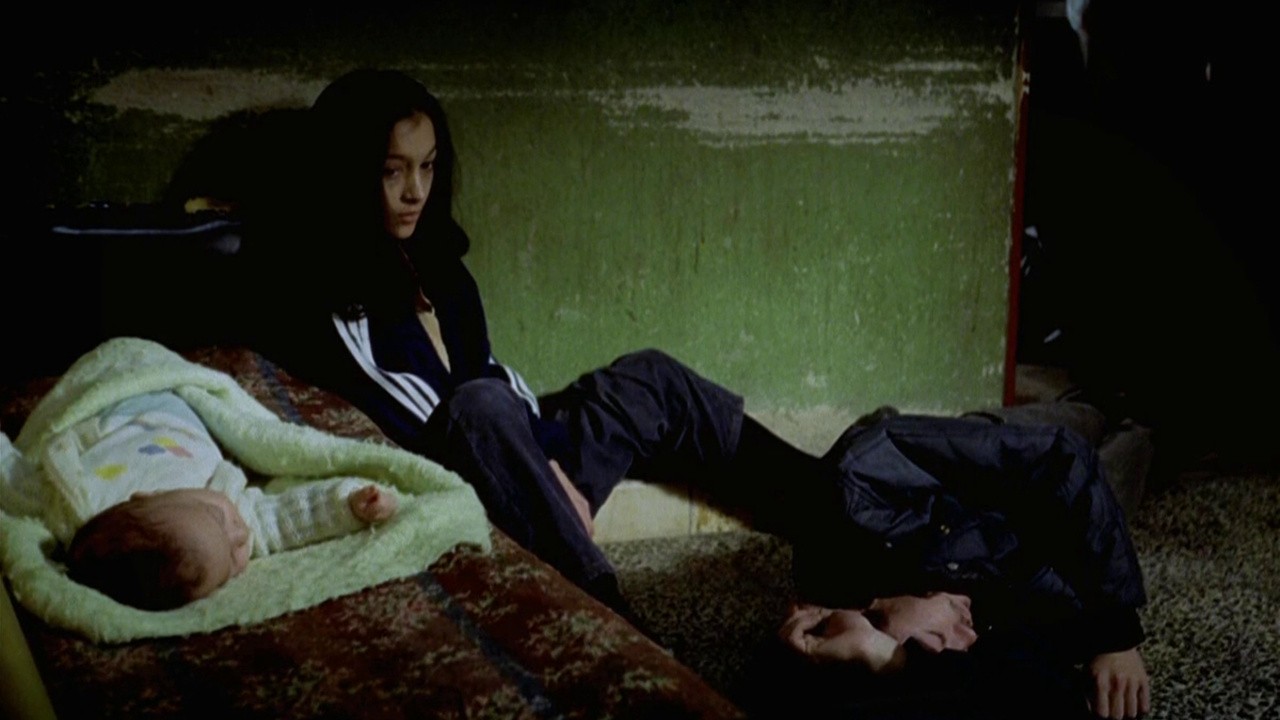
The first film in Pedro Costa’s transformative trilogy about Fontainhas, an impoverished quarter of Lisbon, Ossos is a tale of young lives torn apart by desperation. After a suicidal teenage girl gives birth, she misguidedly entrusts her baby’s safety to the troubled, deadbeat father, whose violent actions take the viewer on a tour of the foreboding, crumbling shantytown in which they live. With its reserved, shadowy cinematography by Emmanuel Machuel (who collaborated with Bresson on L’argent), Ossos is a haunting look at a devastated community. —The Criterion Collection
Pedro Costa (born 1959) is a Portuguese film director. He is acclaimed for using his ascetic style to depict the marginalised people in desperate living situations. Many of his films are set in a district of Lisbon inhabited by the socially disadvantaged and shot in a natural and low-key way that makes them resemble documentaries. While studying history at University of Lisbon, Costa switched to film courses at School of Theatre and Cinema (Escola Superior de Teatro e Cinema). After working as an assistant director to several directors such as Jorge Silva Melo and João Botelho, he made a first feature film O Sangue (The Blood) in 1989. He collected the France Culture Award (Foreign Cineaste of the Year) at 2002 Cannes International Film Festival for directing the film No Quarto da Vanda (In Vanda’s Room). Juventude em Marcha (Youth on the March, known as “Colossal Youth” in Anglophone countries, and “En avant, jeunesse” – “Onward, Youth” – in Francophone countries) was selected for… read more
Maybe some people said this film was empty. I know why they said like that. The story is average, but I love the ambience, color tone of this film. The people in this film are depressed,lack of ambition, and you called it. The nurse, the baby,Tina, and her boyfriend seems like has reality in their own life.
Les misérables. Ascetic, though rarely by choice - largely removed of gloss (cf. Biutiful vis-à-vis Barcelona) let alone hope, or many remnants of feeling. A concision that arises in Costa’s narrative and in his actors’ consigned gestures grant an immediacy to the social malaise - at first heightening the pitiful (pitiless?) transfixion on its state of affairs, while balancing the monotony of the anaemia, but yet within which even squalid politics ultimately - and banally - transplant; a dramatic atrophy of sorts, rather. Another viewing, perchance.
Amazing film which offers no bonbons in the form of pop psychology to the viewer. People are opaque not decipherable (either as class representative or symptom of a primal scene). What does provide the momentum is a Wordsworthian sense of epiphanic moment; though here the epiphany need not be of newborn knowledge but of shared being. A film whose resistance to interpretation I treasure & look forward to reencounters
This coming Saturday, Not Coming to a Theater Near You presents Jia Zhangke's rarely screened 2007 documentary, Useless, at the 92Y Tribeca
"For a small group of diligent cinephiles, Criterion's Letters From Fontainhas: Three Films by Pedro Costa is one of the most anticipated
Porquê tanto distanciamento?! Os intérpretes durante o filme NUNCA olham-nos nos olhos.
O que é que leva Vaz e companhia a serem tão introspectivos? O que lhes vai na alma? Nunca o saberemos… read review
This film is a bleak image-scape featuring three tired-looking young adults in a ghetto of Lisbon. Disaffected perspectives seem to be harder and harder to fend off in today’s world. Or maybe it’s… read review
All in all, this flick probably has five-to-seven pages of dialogue, if that. The entire movie is carried forward through extremely small details, facial expressions, and sounds. Which to me, is what… read review