MUBI brings you a great new film every day.  Start your 7-day free trial today!
Watch a new film every day for $4.99.
Try MUBI for FREE.
 

Othon

Les yeux ne veulent pas en tout temps se fermer, ou Peut-être qu'un jour Rome se permettra de choisir à son tour

West Germany, Italy, France

1970

88 Min
Color
French
  • Currently 4.4/5 Stars.
  • 1
  • 2
  • 3
  • 4
  • 5

   |   

DIR Danièle Huillet, Jean-Marie Straub

PROD Klaus Hellwig

SCR Pierre Corneille

DP Renato Berta, Ugo Piccone

CAST Adriano Aprà, Anne Brumagne, Ennio Lauricella, Olimpia Carlisi, Anthony Pensabene, Jean-Marie Straub, Jean-Claude Biette

ED Danièle Huillet, Jean-Marie Straub

SOUND Louis Hochet, Lucien Moreau

Cannes (Quinzaine des Réalisateurs), Berlinale (Forum)

Synopsis

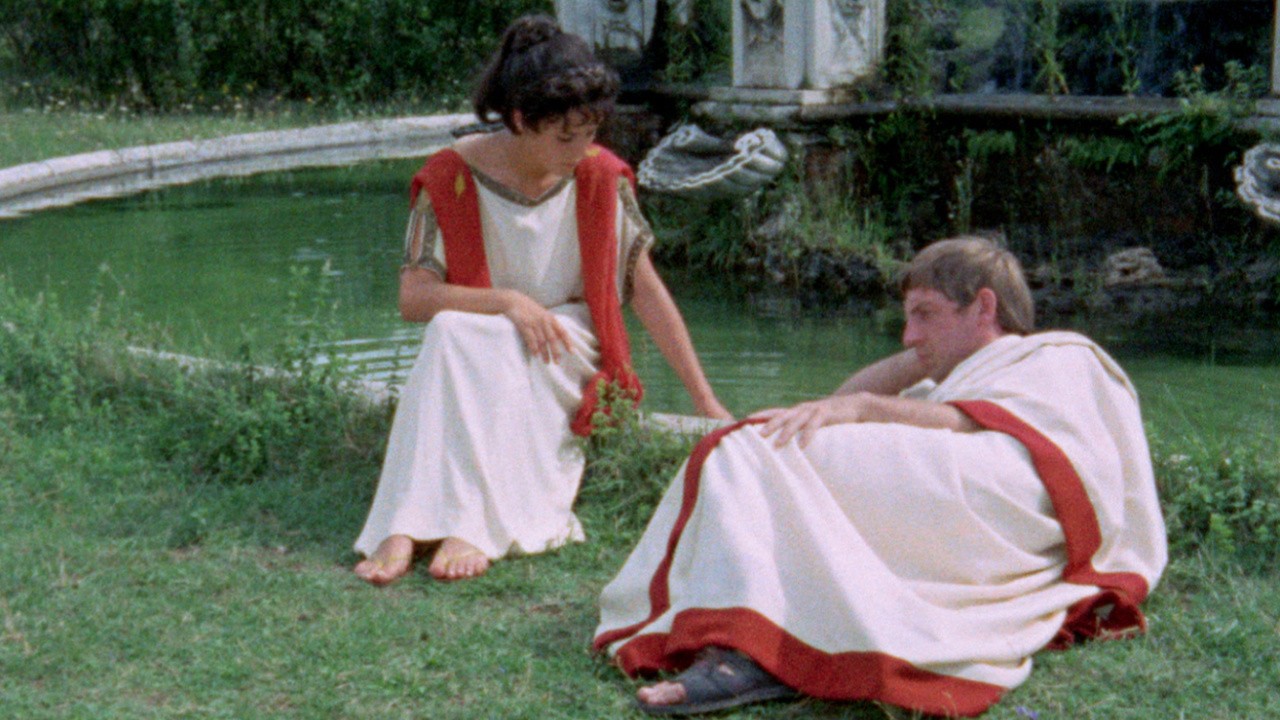
Straub examines the process by which events enter our cultural mainstream, and the process by which their use as part of a communications system is transformed into Culture. Corneille’s play of political intrigue in Late Empire Rome is used as a base. The text speaks of individual power games outside any social context. Straub perches his actors in togas on the Capitoline Hill in broad daylight. He treats Corneille’s words as an undifferentiated block of sound (the actors gabble expressionlessly), and interweaves it with birdsong, traffic noises, the loud splashing of a fountain. A dialectic is set up between the abstraction of the actors’ speech and the intimacy of their presence on screen; and between the actors as actors and the actors as play characters, between the actuality of the past and our use of it, with light and colour changes taking on some of the functions of intonation in speech. The film can be mesmeric or irritating: irritating if one tries to force it into fulfilling preconceived notions of plot and character, mesmeric if one trusts the film-maker to lead one into fresh areas of perception. —Time Out

Director

Original

Danièle Huillet

Danièle Huillet was born on May 1, 1936 in France. After she had just finished high school in the 1950s, she met Jean-Marie Straube and both their professional and private lives have been closely intertwined ever since.
In 1958 they moved to Germany, and their 1965 production Not Reconciled (Nicht versöhnt, based on a novel by Heinrich Böll) caused a scandal at the Berlinale. This film was followed by adaptations of works by Corneille (Othon, 1969) and Bertolt Brecht (History Lessons or Geschichtsunterricht, 1972) and Arnold Schönberg’s opera Moses und Aron (1974/5), each in the somewhat unpopular manner of austere exercises. A great deal of attention was aroused by the Kafka adaptation Class Relations (Klassenverhältnisse, 1983, based on the unfinished Amerika/Der Verschollene). These films were followed by others dealing with literary greats such as Hölderlin and Sophocles. Since the 1970s Danièle Huillet and Jean… read more

Original

Jean-Marie Straub

Filmmaker Jean-Marie Straub and Daniele Huillet, his wife and co-director, have become leading figures in New German cinema. Their films are not for passive viewers seeking light entertainment; films such as Not Reconciled or Only Violence Helps Where Violence Rules (1965) are intellectually demanding, and yet are among the most haunting films of German cinema. Prior to teaming up with Huillet, the French born Straub worked as an assistant to French directors such as Abel Gance, Jean Renoir, and Robert Bresson. He met and teamed up with Huillet in 1954. To avoid the draft, he fled to Munich, Germany in 1958 where they got involved with radical theater groups. By the early sixties he and his wife had become a prominent directors. They made their debut with the short Machorka-Muff in 1963. In 1968, their long-time friend Fassbinder appeared in The Bridegroom, the Comedienne and the Pimp. Straub and Huillet’s most famous film is Chronicle of Anna Magdalena Bach (1968). By the late ’60s… read more

Wall

Displaying 4 of 5 wall posts.
Picture of Neil Bahadur

Neil Bahadur

16Jun13

http://www.elumiere.net/exclusivo_web/internacional_straub/textos/othon_biette_eng.php

Picture of Neil Bahadur

Neil Bahadur

29May13

an explosion.

Miguel Ferreira likes this

Picture of Jerry Johnson

Jerry Johnson

15May13

Overwhelming seething&angry emotional power. Othon is introduced as Ford introduced Wayne in Stagecoach.

Picture of Miguel Ferreira

Miguel Ferreira

5May13

PUNK-CINEMA. Violence of language + a certain 'yesterday as today' feeling - in a direct way, traffic passing by, the noises, buildings; indirectly the games of power, relationships of hatred. Each shot falls upon the viewer with a strenght completely different of that from the shock-films. It captivates you, doesn't make you look away. Othon is mystic as only few movies are.

Jerry Johnson and Neil Bahadur like this

Related Films

Fans

Displaying 5 of 13 fans.

Articles

Our roundup of essays and articles on this film.
W184

Politics and Aesthetics in the Straubs’ Films

By Ted Fendt on November 7, 2011

Jacques Rancière, Philippe Lafosse and the public in conversation about Straub-Huillet after a screening of their films.

read article

Lists

Displaying 4 of 4 lists.

Reviews

No reviews yet — Write the first

Forum

Displaying 0 discussion topics.