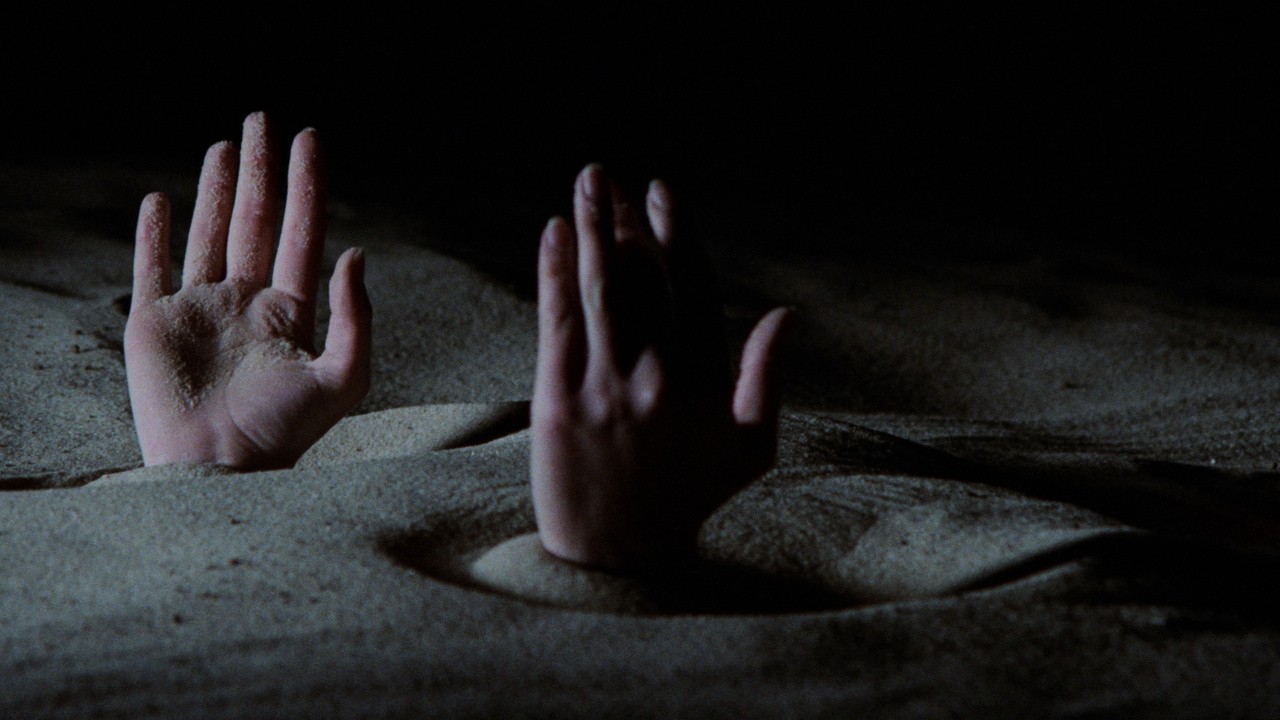
Due to some unknown cosmic event, listed in “phases”, ants have undergone rapid evolution and developed a hive mind. A scientific team begins investigating strange towers and geometrically perfect designs that the ants have started building in the desert. The ant colony and the scientific team, along with a rural family, make war with each other, with the ants being the more effective aggressors. The narrative uses the scientific team as the main protagonists, but also an ant “heroine” going about her duties in the colony. The film concludes with the last of the cosmic “phases,” Phase IV, which promises a new future for all life on Earth.
Despite the lurid tone of its poster art based on one of the shocking images from the film, Phase IV approaches its subject matter naturalistically, with relatively little melodrama. The film contains relatively little dialogue, mainly relaying the storyline visually.
Saul Bass (May 8, 1920 – April 25, 1996) was an American graphic designer and filmmaker, but he is best known for his design on animated motion picture title sequences.
During his 40-year career he worked for some of Hollywood’s greatest filmmakers, including most notably Alfred Hitchcock, Otto Preminger, Stanley Kubrick and Martin Scorsese. Amongst his most famous title sequences are the animated paper cut-out of a heroin addict’s arm for Preminger’s The Man with the Golden Arm, the text racing up and down that eventually becomes a high-angle shot of the United Nations building in Alfred Hitchcock’s North by Northwest, and the disjointed text that races together and apart in Psycho (1960).
Saul Bass designed the sixth AT&T Bell System logo. He also designed AT&T’s “globe” logo after the breakup of the Bell System. Bass also designed Continental Airlines’ 1968 “jetstream” logo which became the most recognized airline industry logo of the 1970s. —Wikipedia read more
As might be expected from Mr. Bass, this film is at its best when dealing with miniature drama. The insect scenes are rather astonishing; surprisingly moving and lacking the documentary feel which, to me, seemed inevitable. The human scenes resemble something between The Thing and Solyaris, reflective and resigned yet desperate and mournful. Hardly, to my mind, a masterpiece, but check it out if it intrigues you.
Also: Saul Bass’s sole directorial effort. Bertolucci in Melbourne. Berlinale 2012 retrospective. Elvis and Nixon and more.