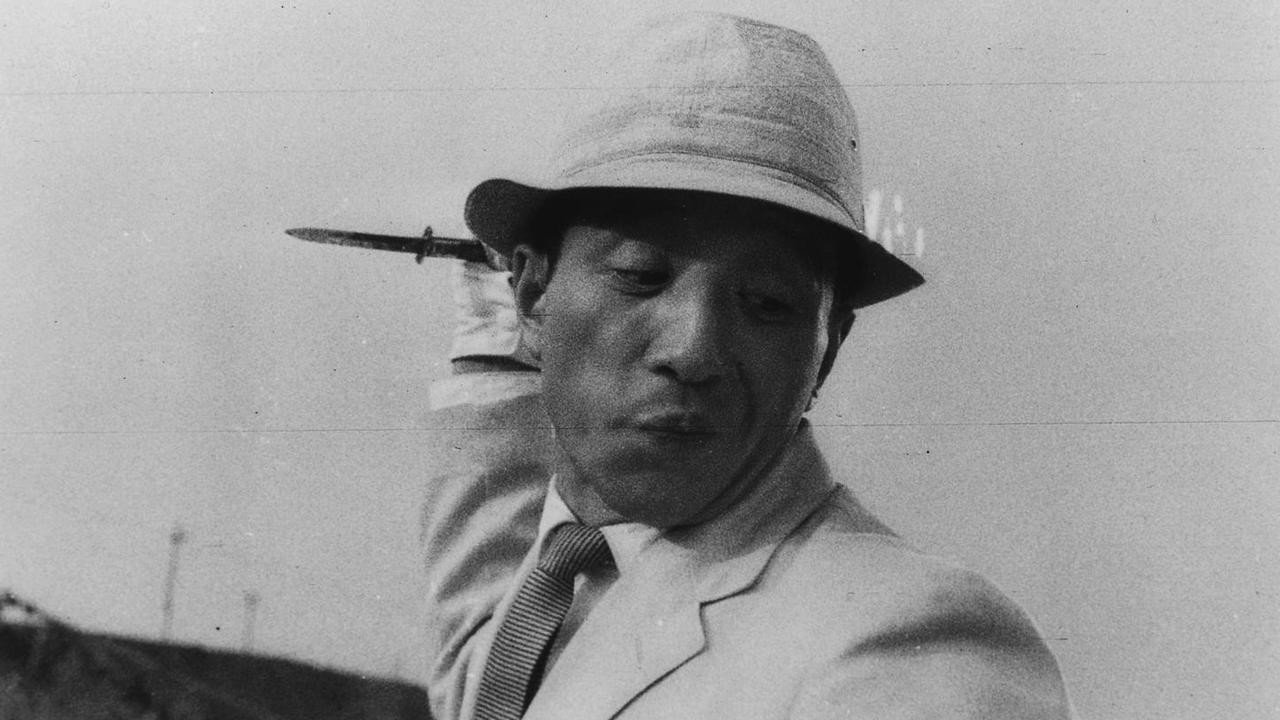
When a miner leaves his employers and treks out with his young son to become a migrant worker, he finds himself moving from one eerie landscape to another, intermittently followed (and photographed) by an enigmatic man in a clean white suit, and eventually coming face to face with his inescapable destiny. Hiroshi Teshigahara’s debut feature and first collaboration with novelist Kobo Abe, Pitfall is many things: a mysterious, unsettling ghost story, a portrait of human alienation, and a compellingly surreal critique of soulless industry, shot in elegant black-and-white. —The Criterion Collection
Hiroshi Teshigahara (勅使河原 宏, Teshigahara Hiroshi?, January 28, 1927 – April 14, 2001) was an avant-garde Japanese filmmaker.
He was born in Tokyo, son of Sofu Teshigahara, founder and grand master of the the Sogetsu School of ikebana. He graduated in 1950 from the Tokyo National University of Fine Arts and Music and directed his first film, Pitfall (1962), in collaboration with author Kōbō Abe and musician Tōru Takemitsu. The film won the NHK New Director’s award, and throughout the 1960s, he continued to collaborate on films with Abe and Takemitsu while simultaneously pursuing his interest in ikebana and sculpture on a professional level.
In 1965, the Teshigahara/Abe film Woman in the Dunes (1964) was nominated for an Academy Award and won the Special Jury Prize at the Cannes Film Festival. In 1972, he worked with Japanese researcher and translator John Nathan to make the movie Summer Soldiers, a film set during the Vietnam War about American deserters living on the fringe… read more
I'm not sure how I feel about this one. I liked the ghost story, but the political portions of the film were pretty boring. It has some great moments, but it doesn't reach the level of intensity or artistry that the two other films in the box set do. But for a debut, damn, is this some good stuff.
To me it was very reminiscent of Herk Harvey's 'Carnival of Souls'. Similar juxtapositions of existence and non-existence, enigmatic omniscient presence haunting the protagonists, leading them to their demise. The experimentally thematic use of sound.. ..had the same mesmerizing effect in both films, made worlds apart, in the same year, exploring similar themes in a similar fashion. It's quite amazing.
As many have stated before me -- an amazing first feature. There are moments throughout this film which, intentional or not, will be repeated in the best and most humble way possible for years to come.
Also: Teshigahara’s Pitfall in Chicago, news and great reads.
This movie is tough to review because it essentially is supposed to be vague and strangely that is the strongest reason for anyone to watch it. Another way to describe this movie is that its a kind… read review