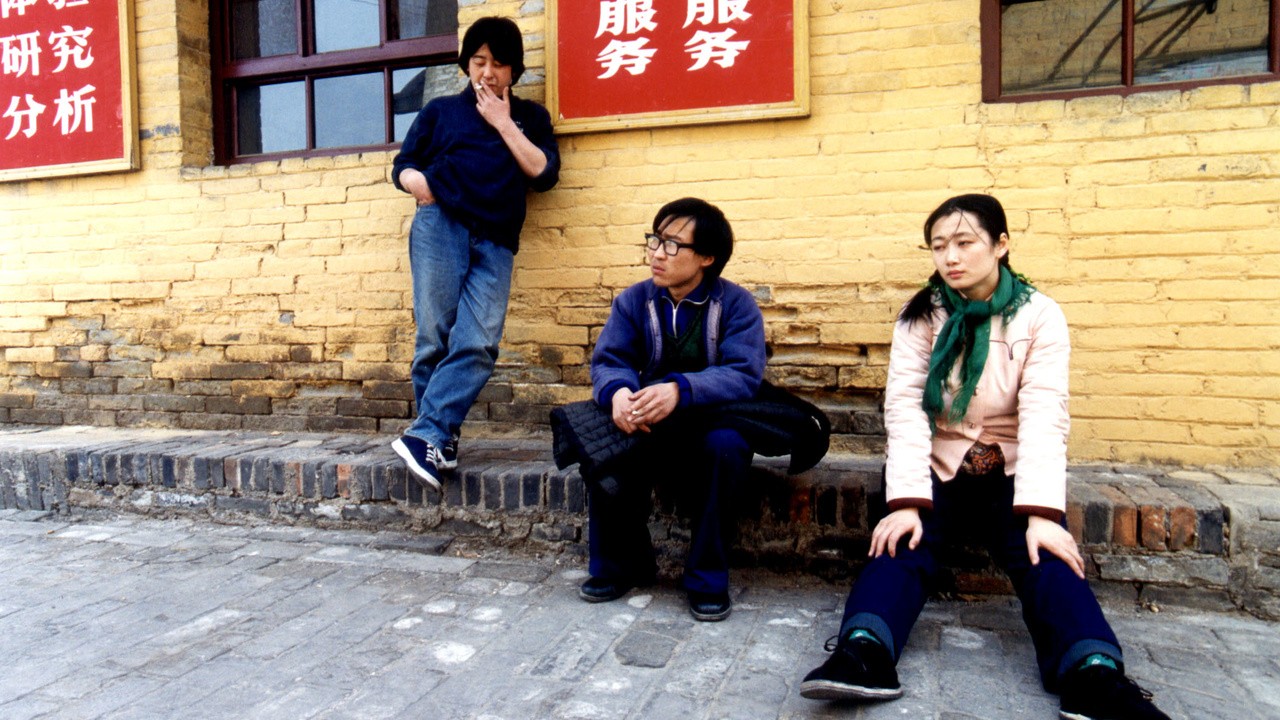
Platform, Jia Zhang-ke’s second feature, established Jia as a major player in world cinema, and “might be the greatest film to come out of Mainland China” (Jonathan Rosenbaum). Set in Jia’s native Fenyang in Shanxi Province, the film offers an epic social history of China in radical cultural and economic transformation from Maoism to market capitalism. This transition is charted through the trials and tribulations of a troupe of young performers who, in the years between 1979 and 1989, themselves transform from the Fenyang Peasant Cultural Group, performing rousing propaganda songs, into the All Star Rock and Breakdance Electronic Revue, playing cheesy ’80s synth pop. Jia’s narrative approach is episodic and elliptical; his visual style rigorous, distanced, and observant. “One of the richest films of the past decade …It’s Pop Art as history… Jia has a strong visual style (based on long fixed-camera ensemble takes) and a powerful set of concerns” (J. Hoberman). “Jia presents a startling precise definition of globalization” (Richard Brody). “This is a colossal achievement” (Tony Rayns). –Pacific Cinematheque
Early Work
While a student at the Beijing Film Academy, Jia would make three short films to hone his skills. The first, a ten minute short documentary on tourists in Tiananmen Square entitled One Day in Beijing, was made in 1994 on self-raised funds. Though Jia has referred to his first directorial effort as inconsequential and “naive”, he also described the short day and half shoot as “excitement…difficult to express in words.” But it was Jia’s second directorial effort, the short film Xiao Shan Going Home (1995), that would bring him to the attention of the film world. It was a film that helped establish Jia’s style and thematic interests and, in Jia’s words, was a film that “truly marks the beginning of my career as a filmmaker.” Xiao Shan would eventually to screen abroad where it won a top prize at the 1997 Hong Kong Independent Short Film & Video Awards. More significantly, the film’s success brought Jia in contact with cinematographer Yu Lik-wai and… read more
It reminded me of Edward Yang's "Brighter Summer Day" and of Hou Hsiao-hsien's films (some of my favourite films ever). It was a really complex and emotional experience. I was blown, and now I have to get out for a walk to think about it. Great, great film and director.
Worth seeing for the history lesson it provides, but the narrative could be a bit tighter - the characters were difficult to distinguish from each other and the years blended together. The cinematography was quite rich despite the print I saw being VHS quality, but my biggest problem with the film is that it drifts by - one feels that one has not seen it after it ends.
The decision to make the narrative and characters a little opaque was an intentional decision. The original cut of the film was over an hour longer, the festival cut was 193 minutes and the more readily available cut is the 150 minute version. Jia intentionally cut out huge pieces of narrative and character details to make the overall feel of the work more understated and culturally powerful.
Word. I hope a complete cut emerges someday, or at least as close to complete as possible with existing materials.
Amazing shots and use of sound, in particular music. Alternately very funny ("Pushkin"), chilling (the discussion of Piggy while learning to smoke), heart breaking (Cui's miner cousin), moving (the two bookending haircuts) and so much more. I've never seen a film better capture how much of life is determined by where (and to whom) you happen to be born. Never heavy handed. An absolute masterpiece.
A self described homage to King Hu and Chang Cheh reveals itself to be strongly rooted in the consistency and strength of Jia’s film world.
This coming Saturday, Not Coming to a Theater Near You presents Jia Zhangke's rarely screened 2007 documentary, Useless, at the 92Y Tribeca
The Festival del film Locarno (August 4 through 14) has announced that it will award the Pardo d’onore Swisscom (Leopard of Honour) to Jia Zhangke
"I hate compiling lists, and I hate polls," announces Mark Peranson, introducing Issue 42 of Cinema Scope, the centerpiece of which is
"Syndromes and a Century by Apichatpong Weerasethakul heads the tally of more than 50 films chosen as the best of the 2000s by TIFF Cinematheque
If you're going to talk about cinema at present, even if you're not talking very thoroughly, it's inevitable that Yu Lik-wai's work, if not
Industri film di Cina Daratan telah ada semenjak zaman film bisu, dengan bakat seperti Ruan Ling-yu yang banyak membintangi film-film melodrama yang banyak dipengaruhi oleh film-film Hollywood. Namun… read review
“The long and empty platform,
Lonely we can only wait.
All my love is outbound,
Nothing on the inbound train…”
This trite Chinese pop song from the 1980’s serves as metaphor for… read review