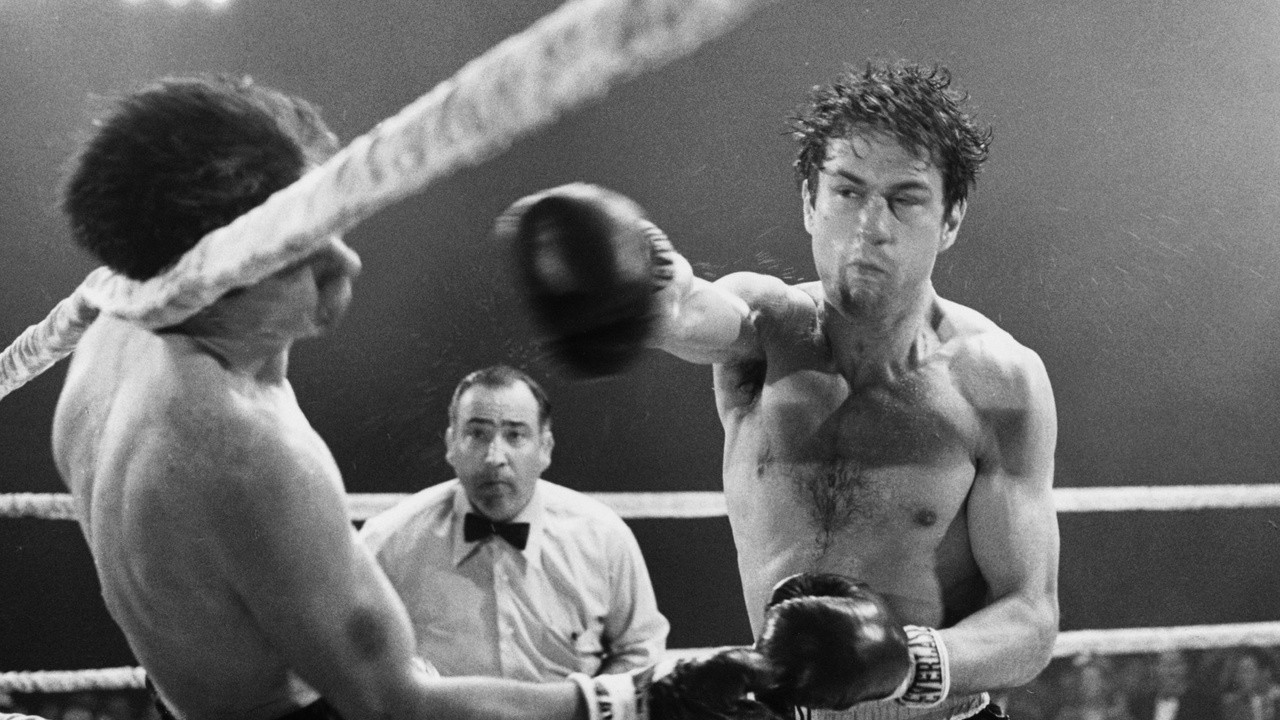
Nominated for eight Academy Awards and boasting some of the best fight scenes on film, Robert DeNiro (who won Best Actor honors and famously gained 50 pounds for the role) plays the self-destructive middleweight champion Jake LaMotta. His increasing paranoia leads to professional and personal devastation as his manager brother Joe Pesci and teenaged wife Cathy Moriarty grapple with his violence outside the ring. Bristling with energy and shot in crisp black-and-white, this is a must see on the big screen. –AFI
Martin Scorsese was born in New York City and soon developed a passion for cinema and a particular admiration for neo-realist cinema which inspired him and influenced his view or portrayal of his Sicilian heritage. After graduating from NYU Film School in 1966 and making a number of shorts, he shot his first feature-length film Who’s That Knocking at My Door (1968) with fellow student, actor Harvey Keitel, and editor Thelma Schoonmaker both of whom were to become long-term collaborators. Mean Streets followed in 1973 and provided the benchmarks for the ‘Scorsese style’. After Scorsese directed Alice Doesn’t Live Here Anymore, the trio was reunited for the dark journey of Travis Bickle in Taxi Driver. After New York, New York Scorsese released Raging Bull. The acclaimed biography of middleweight fighter Jake LaMotta was followed by exploration of fans as pariah in The King of Comedy, dark-comic dreams in After Hours and pool sharks in The Color of Money. Scorsese outraged some religious… read more
Aristotle once said that for someone to live in isolation, a place LaMotta perpetually finds himself in one sense or another, he must be either a god or a beast. LaMotta's brutish and immoral behavior makes him not only difficult to understand or tolerate, but also led me to constantly question why I should care about what happens to him at all. His self-proclaimed "stupidity" seemed disingenuous but accurate.
Every scene is directed with one end-goal: penis envy. This makes for a focused, although narrow, scope of emotion. LaMotta derives his identity, or better, his moral compass from the ring. Breaking the fighter's code shatters the value he sees in life (and leads to one of the best set of scenes put to film). This is a movie about a raging bull and when his castration is complete, he can only live in the past.
Mondo’s new Taxi Driver poster, Richard Brody & James Gray remember Ric Menello, Rosenbaum is Moving Places again & more.
Another big Criterion Tuesday. Also: The Tree of Life, Joan Didion, Martin Scorsese and more.
"No sort of motion picture is more stylized, utopian, or fun to theorize than the musical," writes the Voice's J Hoberman. "As an exercise
{In memoriam Nika Bohinc and Alexis Tioseco, a couple who loved both Manny Farber and Manny Pacquiao} "My life story is now on film," Jake
"Without places like LACMA and other museums, archives, and festivals where people can still see a wide variety of films projected on screen
Raging Bull is essentially Martin Scorsese capturing lightning in a bottle. If the golden era of an American renaissance, responding to the Nouvelle Vague, began in 1967 with Bonnie and Clyde, then… read review
What makes Raging Bull as brilliant as it is is the film’s brutal and silent honesty. On the outside of Raging Bull, it’s imagery gives the feel of a boxing movie and that’s obviously true with the… read review
La biographie de Jake La Motta portée sur grands écrans par Scorsese. Semi-échec commercial, boudé par les Oscars (hormis l’acteur De Niro et le montage) et une réputation qui tardera à se faire, mais… read review