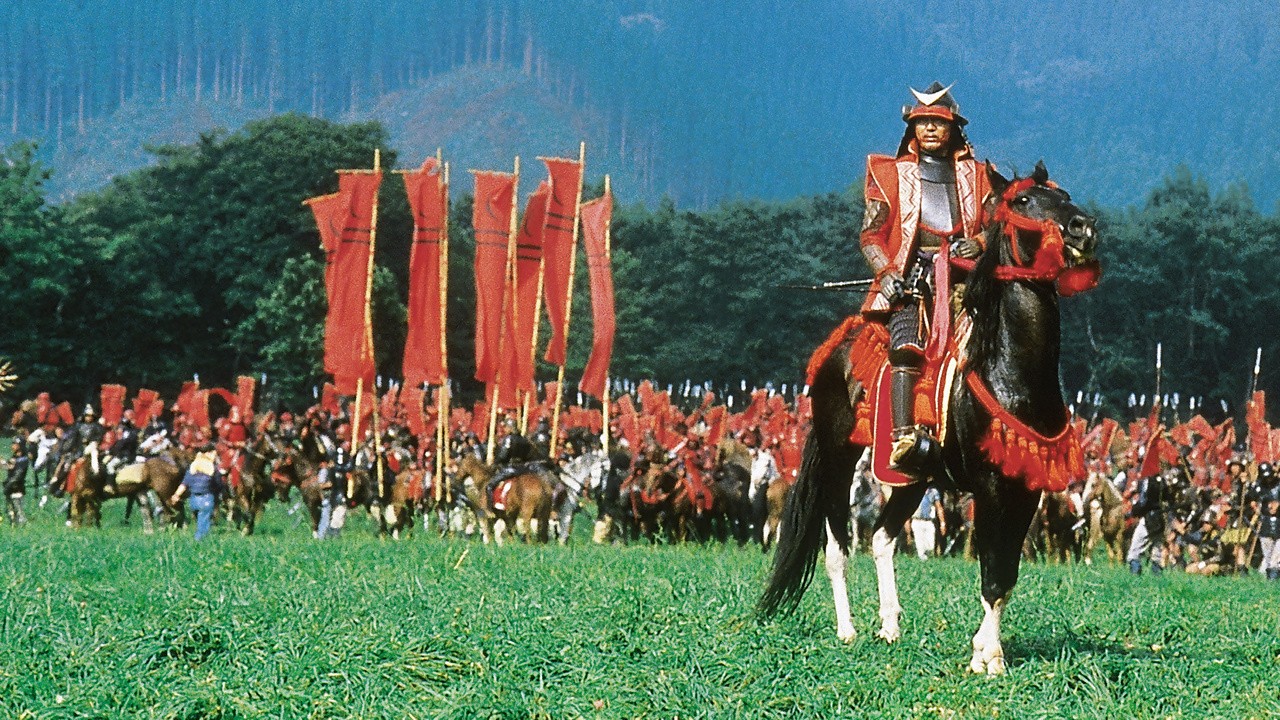
With Ran, legendary director Akira Kurosawa reimagines Shakespeare’s King Lear as a singular historical epic set in sixteenth-century Japan. Majestic in scope, the film is Kurosawa’s late-life masterpiece, a profound examination of the folly of war and the crumbling of one family under the weight of betrayal, greed, and the insatiable thirst for power. —The Criterion Collection
The son of an army officer, Kurosawa studied art before gravitating to film as a means of supporting himself. He served seven years as an assistant to director Kajiro Yamamoto before he began his own directorial career with Sanshiro Sugata (1943), a film about the 19th century struggle for supremacy between adherents of judo and jujitsu that so impressed the military government, he was prevailed upon to make a sequel (Sanshiro Sugata Part Two). Following the end of World War II, Kurosawa’s career gathered speed with a series of films that cut across all genres, from crime thrillers to period dramas. Among the latter, his Rashomon (1951) became the first postwar Japanese film to find wide favor with Western audiences. It was Kurosawa’s The Seven Samurai (1954), however, that made the largest impact of any of his movies outside of Japan. Although heavily cut for its original release, this three-hour-plus medieval action drama, shot with painstaking… read more
on the trailer, the confrontation between lady kaede and kurogane is from a different camera than in the film. interesting.
Also: The other Kurosawa, a forgotten “masterpiece” and the long, rather sad decline of Variety.
Takemitsu Toru's "End Credits" from his soundtrack to Akira Kurosawa's Ran (1985): Gustav Mahler's "Der Abschied" (The Farewell
Just a very quick Daily roundup from within the Rotterdam maelstrom. First and foremost, a new issue of Bright Lights Film Journal is up
In 16th century Japan, the Great Lord of a powerful samurai clan abdicates his power to his oldest son, causing a rift between two younger sons and their father, leading to much betrayal and warfare… read review
(Wednesday / March 17, 2010 / 11:30pm)
Master filmmaker Akira Kurosawa’s version of Shakespeare’s King Lear, that took ten years to arrive the screen, and was the most expensive film ever made… read review
El director japonés Akira Kurosawa solía afirmar que su mayor preocupación y el principal hilo argumental de toda su obra era el cuestionamiento de porque el hombre es incapaz de convivir con sus semejantes… read review
I would like to say that Ran is Akira Kurosawa’s best film but that wouldn’t really be fair to the 6 or 7 other Kurosawa films that deserve that title. I’ll just say that it is a great film, one of… read review