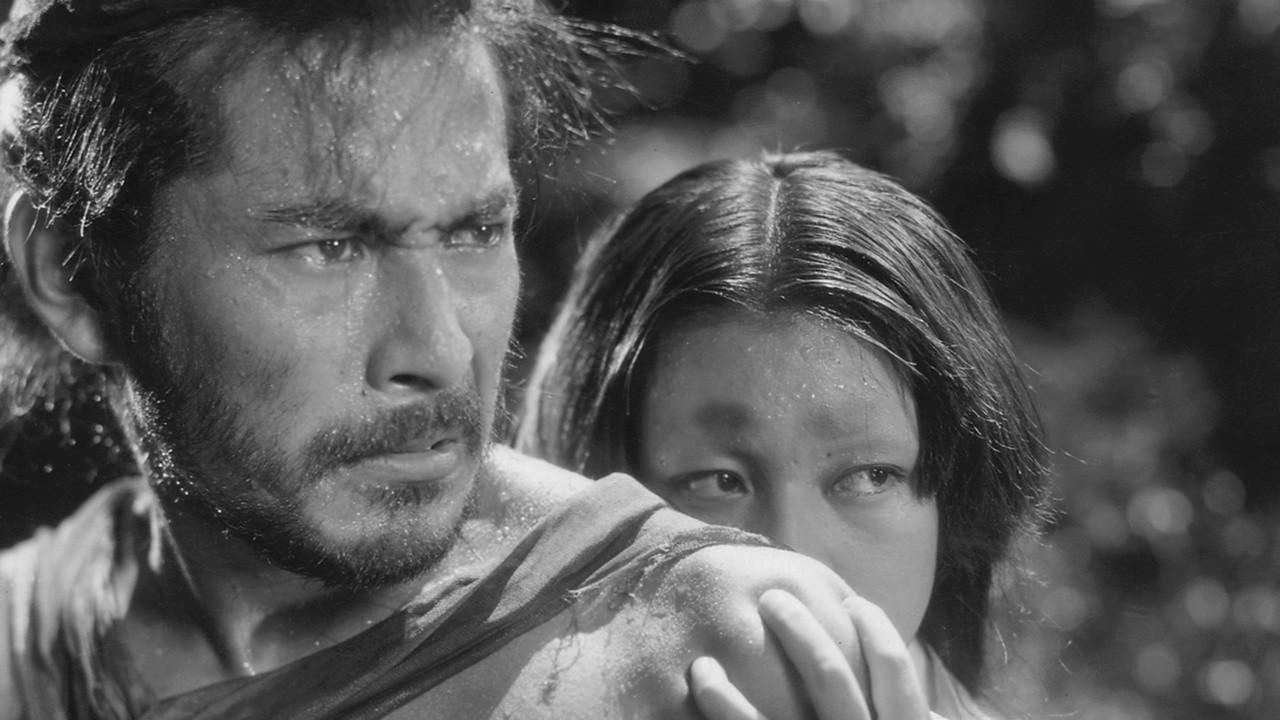
Brimming with action while incisively examining the nature of truth, Rashomon is perhaps the finest film ever to investigate the philosophy of justice. Through an ingenious use of camera and flashbacks, Kurosawa reveals the complexities of human nature as four people recount different versions of the story of a man’s murder and the rape of his wife. Toshiro Mifune gives another commanding performance in the eloquent masterwork that revolutionized film language and introduced Japanese cinema to the world. —The Criterion Collection
The son of an army officer, Kurosawa studied art before gravitating to film as a means of supporting himself. He served seven years as an assistant to director Kajiro Yamamoto before he began his own directorial career with Sanshiro Sugata (1943), a film about the 19th century struggle for supremacy between adherents of judo and jujitsu that so impressed the military government, he was prevailed upon to make a sequel (Sanshiro Sugata Part Two). Following the end of World War II, Kurosawa’s career gathered speed with a series of films that cut across all genres, from crime thrillers to period dramas. Among the latter, his Rashomon (1951) became the first postwar Japanese film to find wide favor with Western audiences. It was Kurosawa’s The Seven Samurai (1954), however, that made the largest impact of any of his movies outside of Japan. Although heavily cut for its original release, this three-hour-plus medieval action drama, shot with painstaking… read more
Kurosawa's style is indeed something to behold, but man did he have Something to Say with this one. The whole framing device is frankly disrespectful to the viewer, not to mention the fact that even without it, the whole conceit isn't nearly as insightful as so many have said over the years. 3/5
this was my first experience with Kurosawa. the black and white was skillfully used, especially with the direct-sun scenes. the story was paced wonderfully too by using different perspectives of the same crime. the scene with the medium was very freaky. I don't think I'll shake that scene off for a while, and it was very enjoyable. I can't wait to see more Kurosawa. This film is a great exploration of men's faults
A new issue of Bright Lights Film Journal, an interview with Judd Apatow, David Lynch meets Vincent Price, Griffith in France & more.
One of the most-celebrated passages of Akira Kurosawa’s Rashomon is a sequence near the beginning of one of the main characters, the Woodcutter
THE WANDERING JULIEN During his American phase, exiled from France in the occupation, the great Julien Duvivier made an anthology film called
The camera techniques in this film are amazing. Rashomon is full of deep focus shots, and long takes. So not only do we get to see everything on screen in perfect clairvoyance, we get to watch the… read review
Kurosawa Akira’s Rashômon (1950), a jidai-geki or ‘period piece’, is both a profound examination of the human condition, and a phenomenological meditation about the nature of reality, perception, and… read review
As I somehow managed to miss seeing this film it was an amazing revelation to see a restored version recently. The multi viewpoint narrative clearly inspires Yimou’s ‘Hero’, and the sparkling black… read review
It seems that RASHOMON is a film that experiences some backlash from cinephiles. There was recently a 35mm print screened here in Memphis by Janus Films as part of the Indie Memphis Film Festival… read review