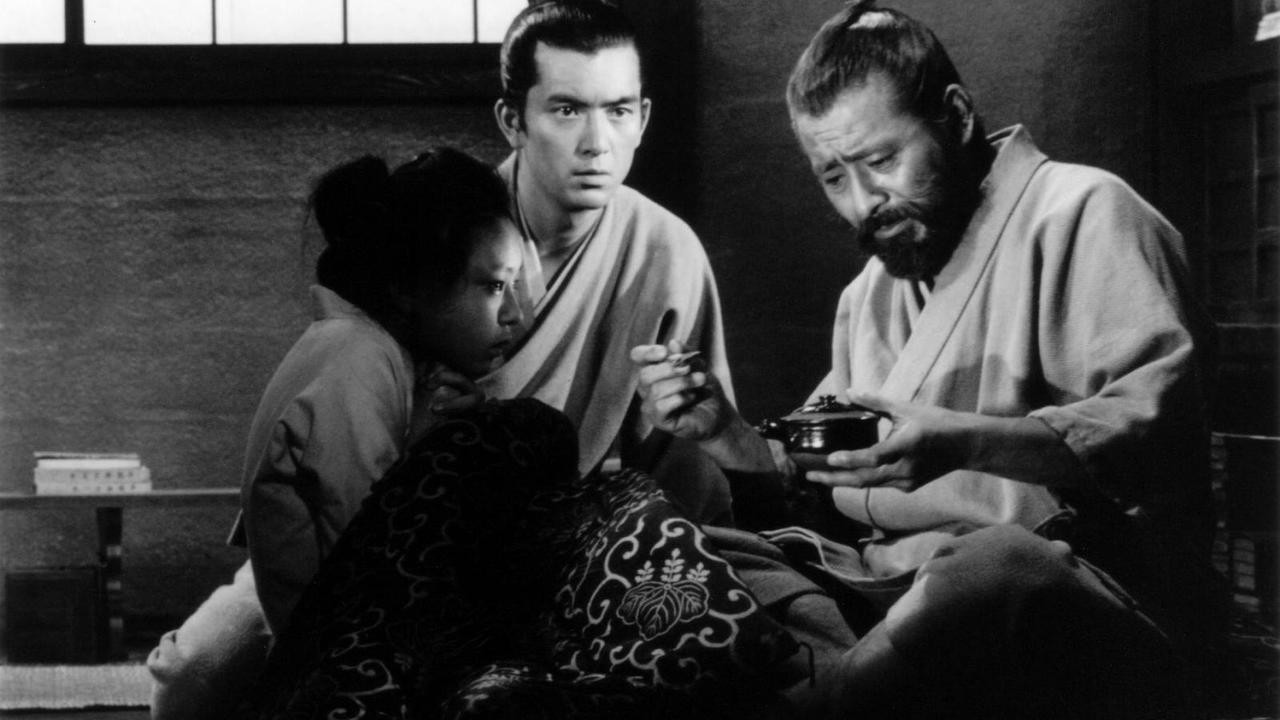
A testament to the goodness of humankind, Akira Kurosawa’s Red Beard (Akahige) chronicles the tumultuous relationship between an arrogant young doctor and a compassionate clinic director. Toshiro Mifune, in his last role for Kurosawa, gives a powerhouse performance as the dignified yet empathic director who guides his pupil to maturity, teaching the embittered intern to appreciate the lives of his destitute patients. Perfectly capturing the look and feel of 19th-century Japan, Kurosawa weaves a fascinating tapestry of time, place, and emotion. —The Criterion Collection
The son of an army officer, Kurosawa studied art before gravitating to film as a means of supporting himself. He served seven years as an assistant to director Kajiro Yamamoto before he began his own directorial career with Sanshiro Sugata (1943), a film about the 19th century struggle for supremacy between adherents of judo and jujitsu that so impressed the military government, he was prevailed upon to make a sequel (Sanshiro Sugata Part Two). Following the end of World War II, Kurosawa’s career gathered speed with a series of films that cut across all genres, from crime thrillers to period dramas. Among the latter, his Rashomon (1951) became the first postwar Japanese film to find wide favor with Western audiences. It was Kurosawa’s The Seven Samurai (1954), however, that made the largest impact of any of his movies outside of Japan. Although heavily cut for its original release, this three-hour-plus medieval action drama, shot with painstaking… read more
Tirar poesia da dor, doença e misérias humanas é só mesmo para alguns diretores. Kurosawa, em mais um de seus épicos que duram três horas, reconstrói a percepção de um jovem médico que, vindo da cidade grande, tem que servir num hospital público de um vilarejo pobre do Japão - comandado pelo barba ruiva do título. A cura nem sempre vem pelos remédios, mas tantas vezes pelas palavras, mesmo que sejam derradeiras.
The themes handled by Akira Kurosawa are universal and even more relevant nowadays. Highly recommended.
But I know the heart of life is good. Drama of the HIGHEST level. A true exploration into what we owe our fellow man, passion, abuse, justice, and death. The best dialogue of any Kurosawa and maybe the best acting. He frames closer for a reason. The story is minimalist but finitely arc-plot for each character: a journey of each lifetime wrapped into a handful of fleeting moments. Beautiful, honest and timeless.
City of Lights, City of Angels, Los Angeles' festival of new French films, is on through the weekend and Anna Karina will be there on
In more ways than one this three-hour drama from Akira Kurosawa marks an end to many staples in the director’s cinema, towards a more pessimistic, rigid cinema, away from the heroes of the past, away… read review