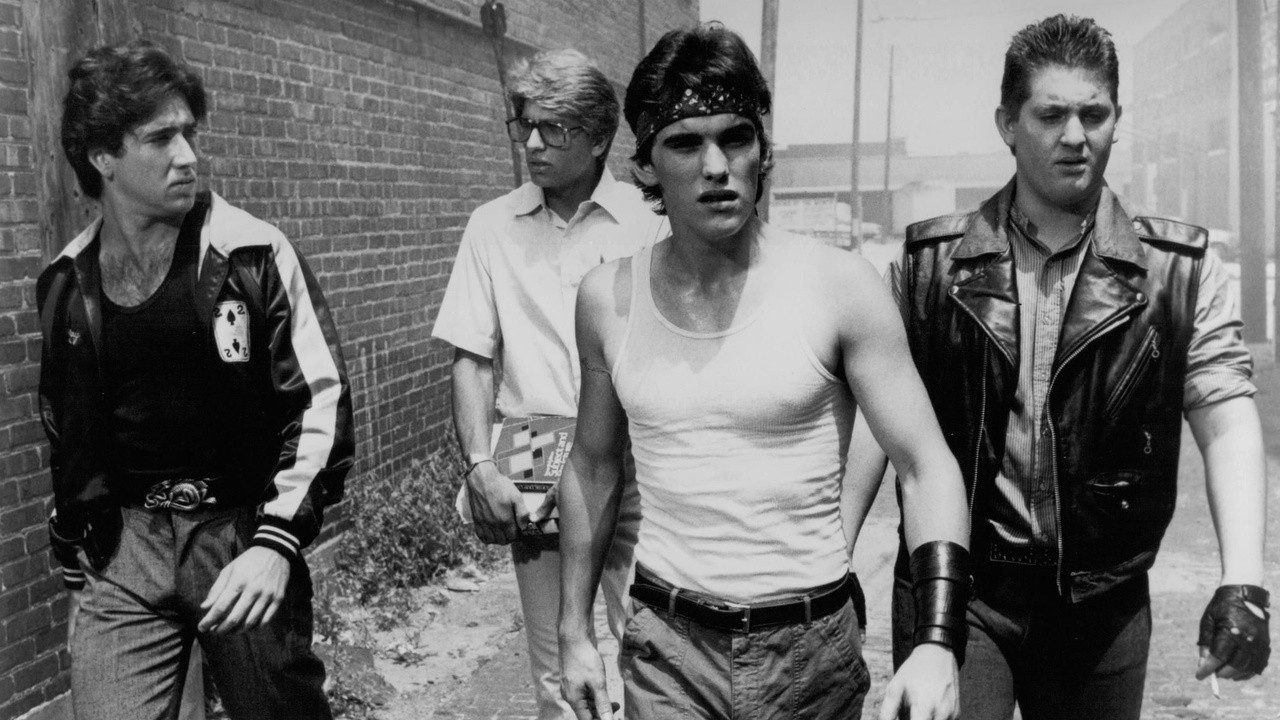
Rusty James is an up-and-coming street hoodlum, lamenting the salad days of the gangs when his older brother, The Motorcycle Boy, ran things as President of the Packers. Before disappearing two months earlier, Motorcycle Boy outlawed gang wars, or “rumbles,” by a treaty. When Rusty James breaks the treaty in a fight with Biff Wilcox, and gets seriously hurt, his brother suddenly appears. Distracted, delusional and enigmatic, his brother seems haunted and disinterested in his past as a “neighborhood novelty.” Over the next few days, James’ dead end life of posturing seems to fall apart; he loses his girlfriend, his friends, his own sense of confidence. The future looms like a dark, unknown wall locking James in. Through Motorcycle Boy’s example, he finally learns to break free from others’ expectations, and his own inner demons.
He was born in 1939 in Detroit, USA, but he grew up in a New York suburb in a creative, supportive Italian-American family. His father was a composer and musician Carmine Coppola. His mother had been an actress. Francis Ford Coppola graduated with a degree in drama from Hofstra University, and did graduate work at UCLA in filmmaking. He was training as assistant with filmmaker Roger Corman, working in such capacities as soundman, dialogue director, associate producer and, eventually, director of Dementia 13 (1963), Coppola’s first feature film. During the next four years, Coppola was involved in a variety of script collaborations, including writing an adaptation of This Property is Condemned, by Tennessee Williams (with Fred Coe and Edith Sommer), and screenplays for Is Paris Burning?, and Patton, the film for which Coppola won a Best Adapted Screenplay Academy Award. In 1966, Coppola’s 2nd film brought him critical acclaim and a Master of Fine Arts degree. In 1969, Coppola and George… read more
Coppola racconta una specie di mondo sommerso,in una sorta di limbo senza una collocazione temporale.é un mondo di ultimi,di ignoranti,di disadattati,saturo di un malessere esistenziale che dà fastidio perchè sembra senza scampo e porta verso l'autodistruzione.Carrellate avvolgenti,grande bianco e nero con una notevole colonna sonora,dialoghi mozzati e atmosfere sfumate,perfette per raccontare un vuoto imperante.4*
The film certainly has its flaws, and the first time I saw it I couldn't decide whether I loved or hated it. I noticed that I kept coming back to it, though, always trying to figure it out. It has never failed to keep me under a spell, and more importantly, entertain me. Arguably Coppola's most aesthetically pleasing film. Certainly, it is beautiful to look at, and it deserves multiple viewings.
Aesthetically riveting slice of Americana, and Coppola is shrewd enough to sidestep gang cliches in favour of realism of the magic kind. Rourke does his best Brando, as if Kurtz had grown up in the slums and realised his true calling at home, in a romantic landscape of decay: "He's like royalty in exile, ya know what I mean?"
A propulsive survey of scores focusing on the thriller: procedurals, bank heists, neo-noirs, spy films, giallos, and sci-fi mind-games.
In a way, it doesn’t matter what I say in a review of this film or what anyone else says, for that matter. There are as many people who find it incomprehensible, self-indulgent, or pretentious as… read review