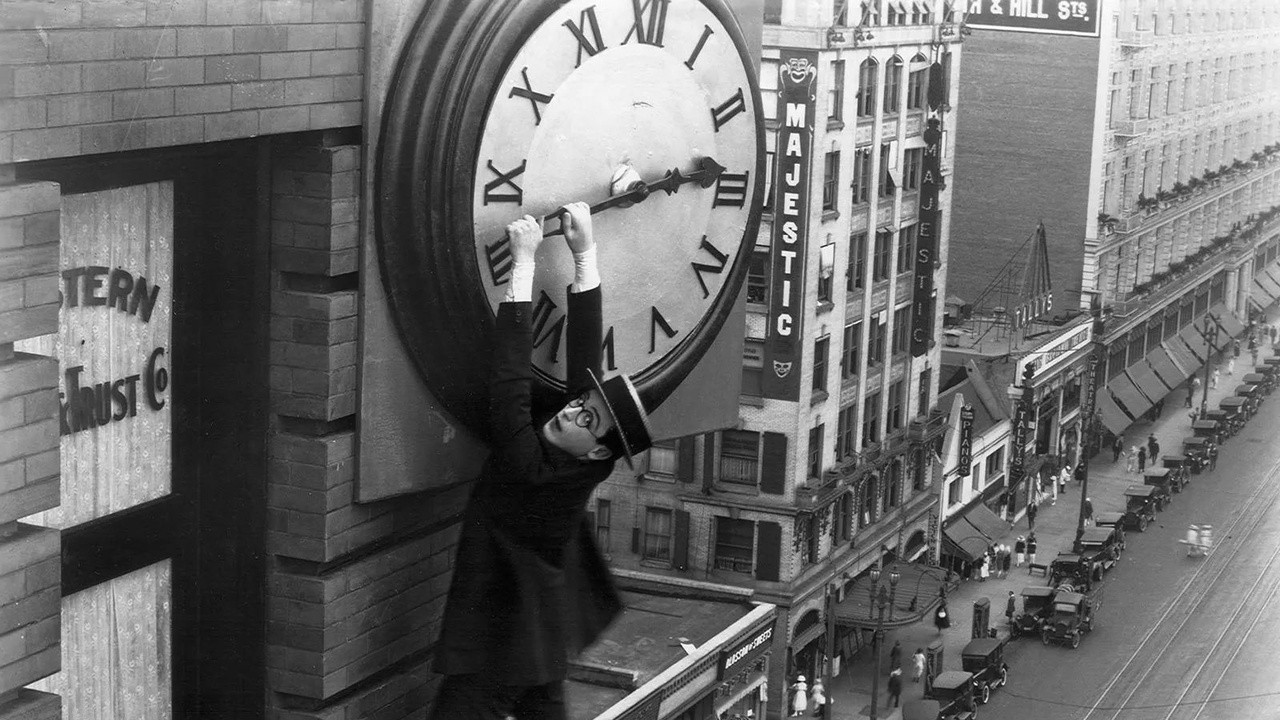
After Charlie Chaplin and Buster Keaton, the silent film era’s “third genius” was Harold Lloyd, who stars in this Horatio Alger-style story of an average country boy trying to make good in the big city. The Boy (Lloyd) leaves his sweetheart, The Girl (Mildred Davis, later the real-life Mrs. Lloyd) in Great Bend while he pursues his fortune in a teeming metropolis. The Boy lands a job as a clerk at a fabric counter of DeVore’s, a huge department store, but he lies in his letters home to his beloved, pretending to be the store’s manager and spending his earnings on lavish gifts. The Boy’s roommate, The Pal (Bill Strother) makes money as a “human fly,” performing attention-getting stunts. Promised $1,000 by DeVore’s real manager if he can devise a publicity gimmick, The Boy convinces his friend to climb the 12-story establishment and split the winnings with him. On the day of the event, however, The Pal is busy dodging The Law (Noah Young), forcing The Boy to make the arduous climb solo. Dodging a variety of obstacles, The Boy climbs higher and higher, eventually dangling from the store’s clock tower, in the film’s most memorable image.
New York-born writer and director with a penchant for comedy. He graduated from Fordham University, and, from 1916, worked at Kalem on the ‘Ham and Bud’ series (Lloyd Hamilton & Bud Duncan). When Kalem was taken over by Vitagraph, Taylor became feature continuity writer. Sometime after 1920, he joined Hal Roach as a full screenwriter, eventually becoming an integral part of Harold Lloyd’s writing staff. He often worked in tandem with Fred C. Newmeyer as co-director of such comedy classics as Safety Last! (1923) and The Freshman (1925). Among his important solo directing efforts were Harold Lloyd’s For Heaven’s Sake (1926), Exit Smiling (1926), with Beatrice Lillie; Tempest (1928), with John Barrymore and Ambassador Bill (1931),with Will Rogers.
In 1937, Taylor founded Chase Productions in conjunction with his writer-brother Matt and authored the Broadway play ‘Stopover’, which ran for 23 performances at the Lyceum Theatre. Taylor directed Laurel & Hardy in one of their… read more
Harold Lloyd's classic comedy about a young man who heads to the big city to make his fortune before getting married, is a textbook example of silent comedy. While not as famous perhaps as Charlie Chaplin and Buster Keaton, Lloyd's death defying stunts have left us with some of cinema's most iconic imagery. One of the marvels of the silent era.