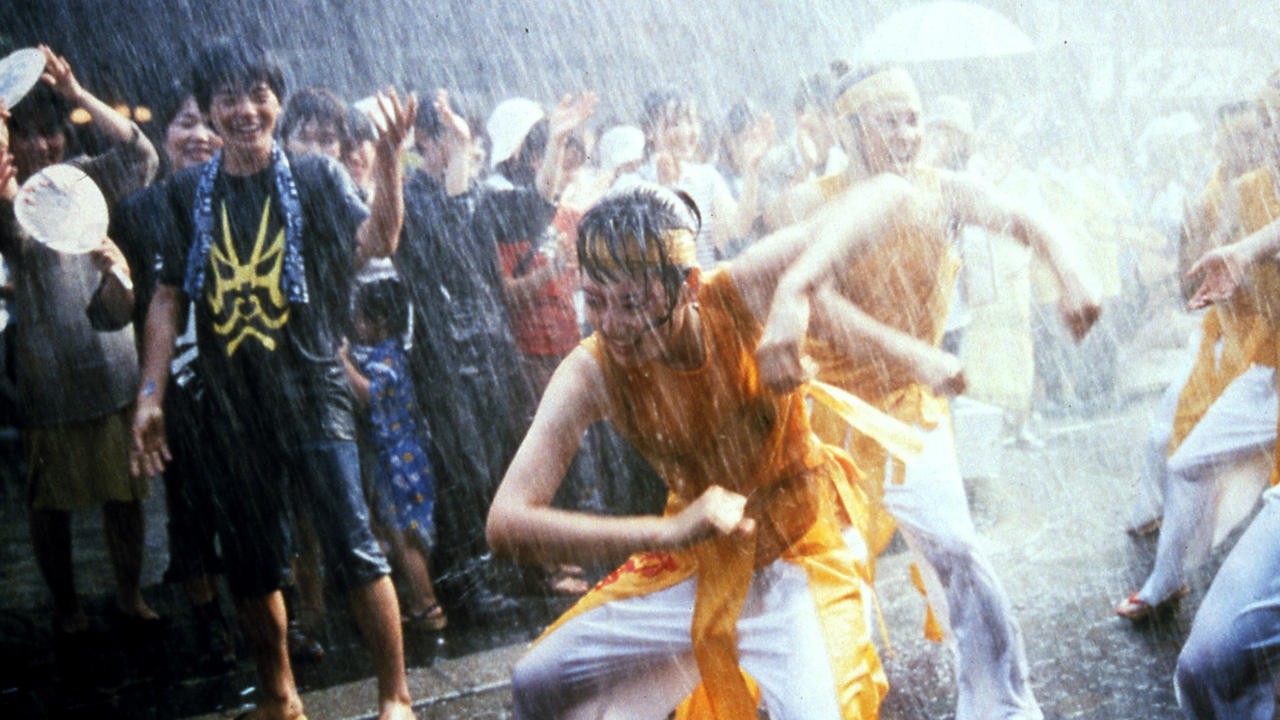
The Aso, a family of four, live in the old town of Nara. On the day of the Jizo Festival in the dizzying heat of midsummer, Kei, one of the Aso’s twin boys suddenly disappears, as if he had been spirited away… For the family left behind, the flow of time stopped on that day. Five years later. Seventeen-year old Shun, the remaining twin, is a high svhool student, a member of the art club. He is working on a life-sized drawing of his brother, who he has been unable to forget. He and his childhood friend, Yu, share a tentative atttraction, but they are awkward around each other. Shun and Yu and their families all carry emotions that have no release. Each of them is searching for a way out. Then, one day, Yu finds out the secret of her birth. Shun learns what became of his brother. With their losses concealed deep in their hearts, Shun and Yu are about to make a move forward with their lives. —Cannes Film Festival
Naomi Kawase was born in 1969, at a time when Japanese cinema was thriving with vigorous underground filmmaking, the initial streak in Kawase’s own young career. While studying photography at the Osaka School of Visual Arts, she started to make films as part of a workshop: “I focus on that which interests me” (1988), a personal symphony of the city, “The concretization of these things flying around me” (1989), a silent study of the homeless, "Presently (1989), a poetic piece visualising the 4 elements (water, air, fire and earth). After graduating in 1989, she taught for 4 years.
In 1992, she made Embracing, a medium length 16mm feature in which she sets up to find her biological father (Naomi was brought up by her grandparents after her parents’ marriage broke up). In 1993, she cast her documentary eye on a striking boy-meets-girl fiction in White Moon. She dedicated her following film Katatsumori (94) to her grandmother. This film and the next one… read more
This is an amazing film, and one of the deepest about the mystery and the sometimes crual beauty of life.
I've always found this to be one of the most beautiful films there are that speak of loss and mourning. Kawase's camera moves, follows and wanders through Nara and it's characters like a vigorous phantom with the curiosity of a child, discovering the visible and the invisible, since it's first awakened from the darkness to it's final flight of victory. A beautiful experience, it shouldn't be missed.
“Shara-Sojyu” is according to Buddhist tradition the garden in which Gautama Buddha died when the trees suddenly began to bloom. The white color of the flowers on the tree of Shara-Sojyu suggests that… read review