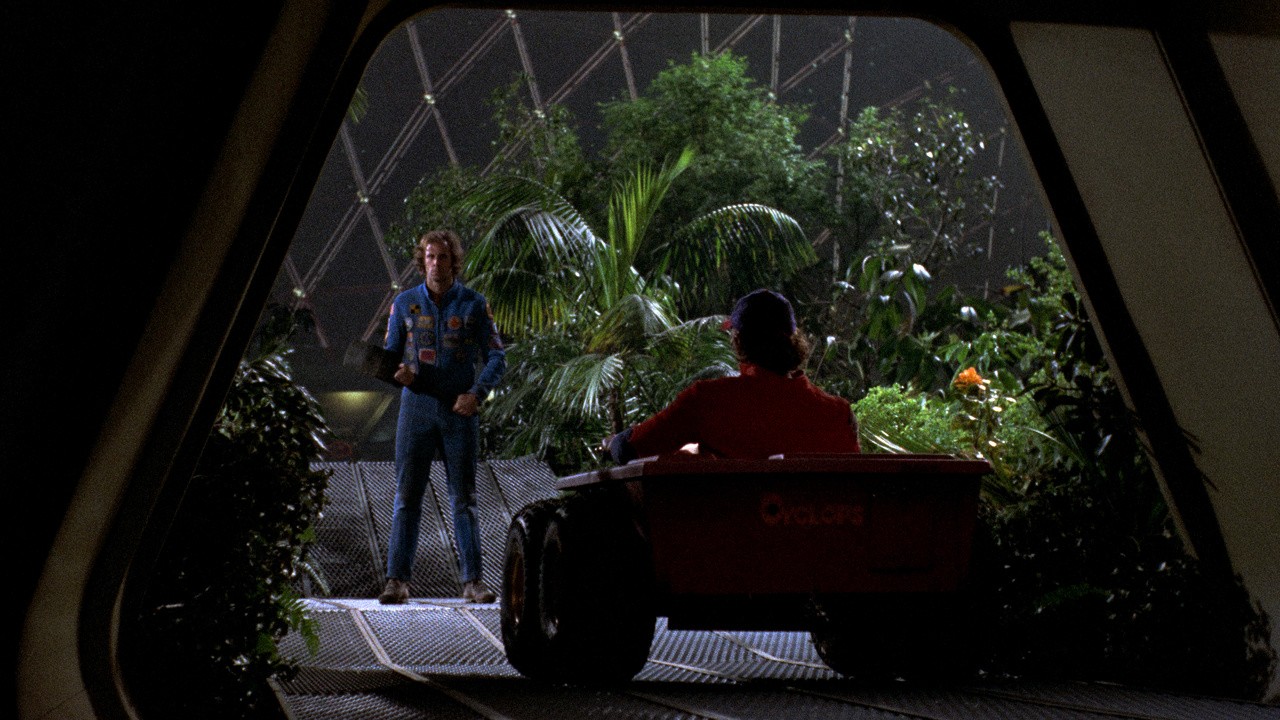
Douglas Trumbull started as an illustrator for Graphic Films, a small animation house that created a science-fiction film for the 1964 World’s Fair in New York. Stanley Kubrick saw the film and hired Trumbull’s colleague Con Pederson to work on 2001. Trumbull got Kubrick’s telephone number in England from Pederson and cold-called the director, who hired him for the film, a gig that lasted nearly four years.
Although Trumbull created and directed many of the film’s most spectacular moments (the “slit-scan” sequence at the end was purely his creation), Kubrick usurped the credit when he inserted a title card in the credits stating “Special Photographic Effects designed and directed by Stanley Kubrick.” Trumbull and Kubrick maintained an uneasy relationship for years thereafter as a result.
Nonetheless Trumbull was awed by the experience, and set about dedicating his life to making movies with the same grandeur as 2001 – movies that enveloped the audience.
He got his… read more
Contrary to what I expected, the handling of the environmental theme is neither particularly nuanced nor sophisticated. Dern's soliloquizing, along with the dated, heavy-handed message-music, is utterly black-and-white; and his crewmates just nature-hating, cardboard villains. Dern does become a kind of pitiable sad sack—his isolation as much a result of his social awkwardness as his actual predicament—but still ...
I disagree. His colleagues are not depicted as unambiguously 'evil' characters but more as your average blokes who don't really care. As they say themselves , they are just 'following orders'. About his social awkwardness: I think we are used to seeing people in films who do the 'right thing' unambiguously portrayed as great and likeable characters. That's unrealistic. The main character is a weirdo, but it is precisely his own weirdness (obsessiveness) that enables him to do the right thing, and even the right thing is not perfectly right, but instead involves killing others, social isolation and just generally being a bit of a nutjob. With regards to the environmental theme I agree partly with you, but I think that is maybe also because our attitude to nature has changed since the seventies. That being said, I agree with the argument that the film makes: full employment and perfect health are usually lazy rationalisations for the destruction humans cause to nature, especially as they are not inherently at odds with nature conservation - rather natural diversity should be seen as necessary part of human wellbeing. What is at odds with conservation, however, is economic shortsightedness and profiteering, because it neglects the most fundamental question: What world do we expect to live in if all the hypothetical benefits of economic development are finally realised?
Cheers for the comment, mate! For the record, I didn't call them 'evil'; I called them 'nature-hating, cardboard villains.' And I called them this because of their characterization (or lack thereof) in the film. Two of the three in particular are simply one-dimensional straw men set up only so the audience (the portion that's sympathetic to Dern at least) can have villains that are easy to look down on. They take obvious (very obvious) pleasure in needling Dern's character about his beliefs. They revel in trampling all over the grass and gardens like a cartoon embodiment of big, bad wasteful mankind. (Which is one of my major problems with the film: that their characterization is rendered at a level so cartoonish that it's impossible for me to take seriously.) There's a difference between agreeing with the argument of the film, and agreeing with the film *as a film*. I don't disagree with the film's argument; I do disagree with its artless and generic delivery of that argument.
Thanks for your reply. I thought about this, and I am conflicted whether I should agree or not. On the one hand, yes these guys are overly simplified caricatures, on the other hand I noticed that I somehow don't have as much of a problem with it as I would normally have. Maybe its because I am an environmentalist that I want to instantly sympathize with the film, but I also know from experience that many people turn into bullies really quickly when somebody is passionate about something, especially if they are in the majority. This is probably too subjective to prove a point, but I went to a boys boarding school, and to be honest, what the guys in the film are doing was pretty much what people were doing in my school when someone they considered to be whimsical was passionate about something (aka me about environmental issues). And, if you think about it, the environment these guys are in is pretty similar to a boarding school... a bunch of guys, no girls, locked up of a certain period of time. It's always the same dynamics. Back to your point: Yes, I believe that people are inherently more complex than the guys in the film, but I am perfectly fine with the way these guys are portrayed, precisely because of my own experience. Firstly, because protecting nature is hardly a big moral dilemma for most people, secondly there is a social point that is valid beyond environmental issues, and that is that people tend to be bullies when they think they are right. And I think that at least the 'Westernized' branch of mankind is inherently wasteful, self-absorbed etc., which is probably too simplified a view to communicate to a mainstream audience, but then again what isn't...
A beautiful film that envelopes your heart as you spend time with Bruce Dern and his robot companions in the solitude of outer space. Douglas Trumbull is renowned for his effects work on 2001: A SPACE ODYSSEY, which wowed with it's visual wonder. Here, Trumbull creates a movie that has a similar effect as 2001, but on an emotional level. The nuance given to the theme is rare in films with an environmental subject.