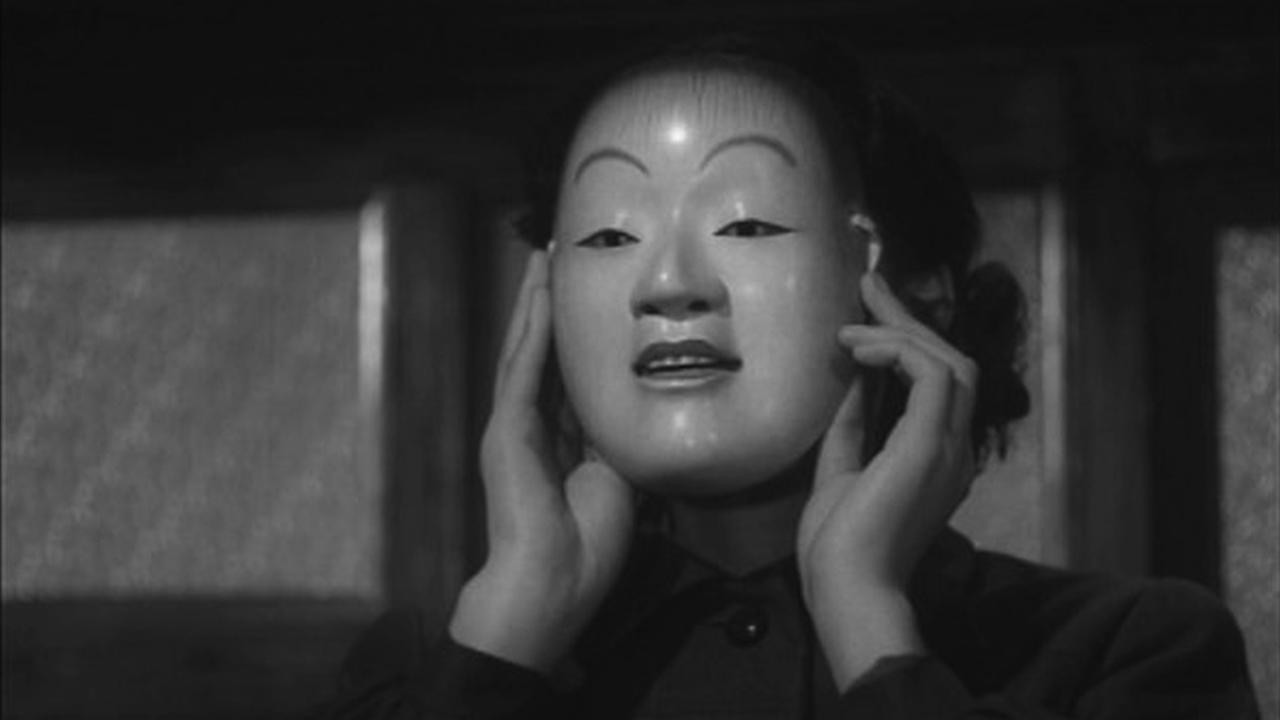
Set in the ancient seaside town of Kamakura, Sound of the Mountain depicts the increasingly close relationship between a childless young woman, Kikuko (Setsuko Hara), and her father-in-law, Shingo (So Yamamura), to whom she turns as her own marriage, to the neglectful and philandering Shuichi (Ken Uehara), disintegrates. A domestic drama of rare existential insight and emotional subtlety, Sound of the Mountain draws on the concerns of Naruse’s earlier marriage films to offer a profoundly moving account of the complex relationship that develops between an older man and a younger woman. —Eureka/MoC
Mikio Naruse is one of the least known of Japan’s early master directors, both in the West and in Japan, yet he created some of the most moving, darkly beautiful works in Japanese cinema. Like Kenji Mizoguchi, Naruse showed an uncanny understanding for the psychology of women. Like Yasujiro Ozu, he preferred subtle shifts of character over broad strokes of plot. Unlike either of these early greats, however, Naruse’s vision of humanity was much darker and more clinical. He stripped all vestiges of hope or acceptance from his films, what remains is only a willful struggle to endure. His relentlessly negative view of human existence has resulted in Naruse’s often being labeled a nihilist.
Born in Tokyo, in 1905, Naruse was the youngest of three sons of a desperately poor embroiderer. Although he excelled in elementary school, his family could not afford to further his education. He was instead enrolled in a two-year technical school. There, he spent virtually all of his free time… read more
A very interesting film, because it posits the idea that the "good" and "nice" people in a film (here Kikuko and Shingo) can be unintenionally troublesome to other characters (like Shuichi), who at first glance -but only at that level- appear "bad" and "cruel". It's a dichotomy that can be applied to many other films, and is a kind of schema -here done so well- that has really entirely changed how I look at films.
A great movie in its own right, and a fascinating interpretation of the novel - more brutal in some respects, more subtle in others.
Who keeps titling this the Thunder of the Mountain? It's pointless, as the Masters of Cinema set that includes this film has "Sound of the Mountain" written all over it. This disconnect is really unwanted and against reason.
“The pace of their rush toward destruction never lets up, pile upon pile of medium shots, thousands of fast cuts…”
Starting today, and for most of April, Film Forum in New York will be honoring five of Japan’s greatest actresses in a portmanteau retrospective
This is my third Naruse after Floating Clouds and When a Woman Ascends the Stairs, both of which I found extremely impressive. Expectations were hence pretty high from this film which unfortunately… read review
Kikuko is a married woman who, despite being beset by problems, always puts on an upbeat façade, particularly when talking to her caring parents-in-law. The biggest issue she faces is her crumbling… read review