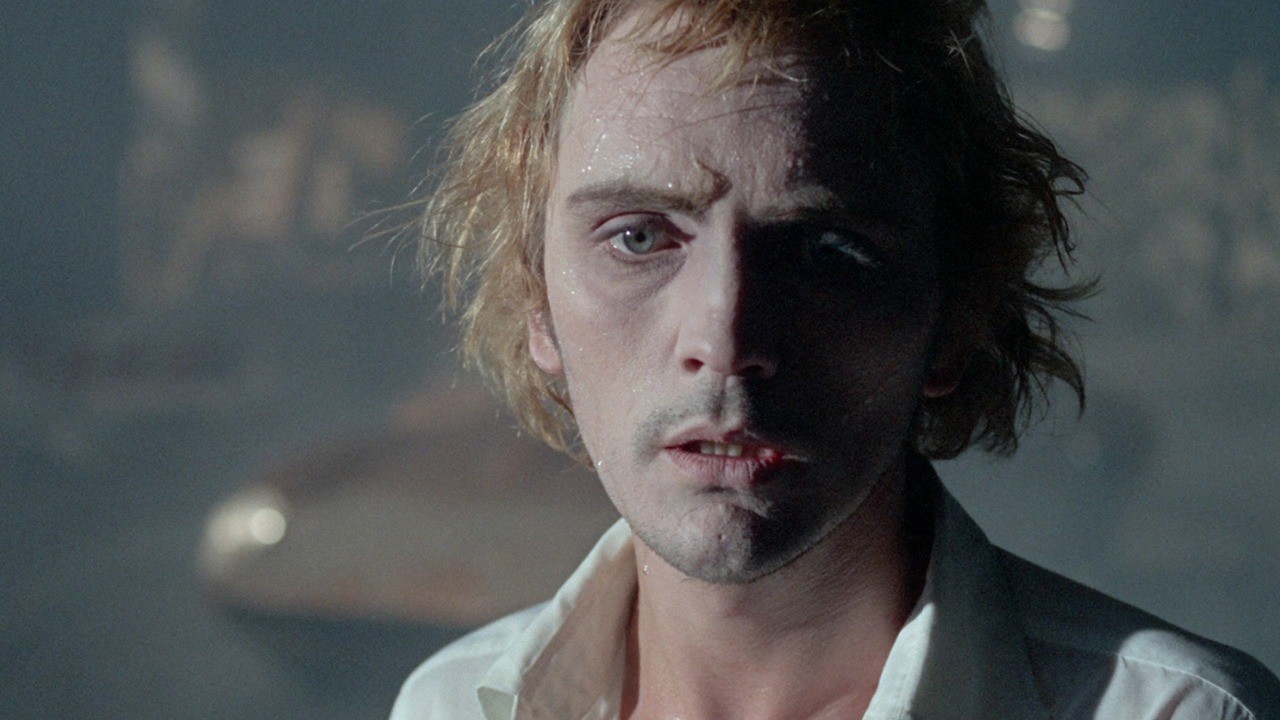
“Metzengerstein”: the bored and corrupt medieval countess Frederica spends her futile life in orgies and cruelties. When she moves with her friends to one of her castles nearby the lands of her poor cousin Baron Wilhelm, she desires him but is not corresponded. When one of her minions burns the stable, Wilhelm dies trying to rescues his stallion and Federica is haunted by her lost cousin. “William Wilson”: the sadistic and cruel soldier of the Austrian army William Wilson confesses to a priest the cruelties he committed along his sinful life and the participation of his double also called William Wilson in specific moments of his dreadful life. “Toby Dammit”: the cynical alcoholic and decadent English actor Toby Dammit travels to Rome to make a Catholic Western, but only interested in receiving the Ferrari promised by the production. —IMDb
Federico Fellini was born in 1920 to a provincial middle-class family in Rimini, a small town on the coast of the Adriatic Sea. The lack of available options to young men in provincial towns is an important theme in some of his films, most notably I Vitelloni and Amarcord. In fact, Orson Welles once described Fellini as “a small-town boy who’s never really come to Rome. He’s still dreaming about it. And we should all be grateful for those dreams.” He initially arrived in Rome as a law student but his career as a satirical cartoonist and gag writer was already well established by then. His childhood fascination with the circus and the Grand Guignol also governed his cinephilia in these early years. His favourite films were American comedies by Chaplin, Keaton, Harry Langdon and the Marx Brothers. It was only after he came into contact with the circle of Ettore Scola, Cesare Zavattini, Aldo Fabrizi and Roberto Rossellini, that he would seriously consider the cinema as a medium of expression… read more
Louis Malle (born October 30, 1932, Thumeries, France—died November 23, 1995, Beverly Hills, California, U.S.) French motion-picture director whose eclectic films were noted for their emotional realism and stylistic simplicity.
Malle’s wealthy family resisted his early interest in film but allowed him to enter the Institute of Advanced Cinematographic Studies in Paris in 1950. After studying at the institute, he worked as an assistant to filmmaker Robert Bresson and codirected the documentary Le Monde du silence (1956; The Silent World) with underwater explorer Jacques-Yves Cousteau.
Malle’s first feature film, Ascenseur pour l’échafaud (1957; Frantic), was a psychological thriller. His second, Les Amants (1958; The Lovers), was a commercial success and established Malle and its star, Jeanne Moreau, in the film industry. The film’s lyrical love scenes, tracked with exquisite timing, exhibit Malle’s typically bold and uninhibited treatment of sensual themes. Social alienation… read more
Originally a stage actor, and also a part-time journalist and screenwriter, Roger Vadim came to film as an assistant to movie director Marc Allegret, and subsequently married Allegret’s most well known discovery, Brigitte Bardot, whom he also starred with in numerous films of the 1950s. Vadim became internationally known for his 1956 debut film And God Created Woman, which trod new ground in eroticism during the 1950s, and also starred Bardot. His later films luxuriated in their lushness and decadence, a process that continued with Vadim’s subsequent marriage to Jane Fonda, who also became one of his most renowned leading ladies. However, since the late 1960s, with the general opening up of American films to more overtly sexual content, Vadim’s popularity and success outside of Europe have fallen off markedly, and an American remake of And God Created Woman (1988) provoked yawns as much as curiosity from critics and the public alike. Vadim and Fonda have since divorced… read more
Omnibus histoires extraordinaires; chimera as paean to Poe thrice over. Vadim’s: desultory blend of de Sade, Freudian animalia; pellmell discursive enduring vapid, inane. Malle: visceral editing, classical flashback glimmer darkly deliverance; scatologica insidiously deployed. But Fellini trips the light fantastic: apocalyptic carousel pushing beyond portmanteau apex to paragon of lurching aesthetics. In a punk-vampiric Stamp, his celebrity dissections surreally continue. So from zero to hero, but for the latter majority: trifling midnight theatre.
Toby Dammit was really entertaining and has incredibly influential art direction. The awards ceremony looks like editorial from Italian Vogue. The trope of the devil as a little girl reminds me of "Don't Look Now". Terence Stamp is brilliant as a pre-Johhny Rotten type. The way he acts reminds me of the Sex Pistols Reg Grundy interview - Fellini style!!
The first two tales are two stars (lovely locales and stylish settings yet insubstantial), but the last tale is easily three stars. Fellini's surreal and hallucinatory Toby Dammit features Terence Stamp's finest performance as a drunken actor and his super cool nocturnal driving of a Ferrari through empty, mist shrouded streets to the end of the night and the middle of nowhere. The final image is haunting.
A mixed bag which delivers exactly what you'd expect from these directors - "Metzenderstein"; entertaining high camp Eurotrash with fabulous costumes but unbelievably sloppy writing and editing, "William Wilson"; stylishly directed but generally forgettable, straight-forward and banal, "Toby Dammit"; a fever dream Fellini masterpiece that pretty much perfect.
It's interesting the way a film's reputation mutates over the years. Moderately well do I recall the reception accorded Spirits of the Dead