MUBI brings you a great new film every day.  Start your 7-day free trial today!
Watch a new film every day for $4.99.
Try MUBI for FREE.
 

Spring, Summer, Fall, Winter... and Spring

Bom yeoreum gaeul gyeoul geurigo bom

South Korea, Germany

2003

103 Min
Color
1.85:1
Korean
  • Currently 4.1/5 Stars.
  • 1
  • 2
  • 3
  • 4
  • 5

   |   

DIR Kim Ki-duk

PROD Karl Baumgartner, Lee Seung-jae

SCR Kim Ki-duk

DP Dong-hyeon Baek

CAST Oh Yeong-su, Kim Ki-duk, Kim Young-min, Seo Jae-kyeong, Ha Yeo-jin, Kim Jong-ho, Kim Jung-young

ED Kim Ki-duk

MUSIC Park Ji-woong

Toronto, Locarno (International Competition): C.I.C.A.E. Award, Don Quixote Award, Sundance (World Cinema), San Sebastián: Audience Award

Synopsis

The film is divided into five segments (the five seasons of the title), each segment depicting a different stage in the life of a Buddhist monk (each segment is roughly ten to twenty years apart, and is physically in the middle of its titular season).

Spring

We are introduced the life of the very young Buddhist apprentice with his master on a small floating monastery, drifting on a lake in the serene forested mountains of Korea. The apprentice and his master live a basic life of prayer and meditation, using an old rowboat to reach the bank of the lake where they regularly go walking, for exercise and to collect herbs. One day, in a creek amongst the rocky hills, the apprentice torments a fish by tying a small stone to it with string and laughing as it struggles to swim. Shortly after, he does the same to a frog and a snake; his master quietly observes on all three occasions, and that night ties a large, smooth rock to the apprentice as he sleeps. In the morning, he tells his apprentice that he cannot take off the rock until he unties the creatures he tormented – adding that if any of them have died, he will “carry the stone in his heart forever”. The boy struggles with the load on his back through the forest, and finds the fish, lying dead on the bottom of the creek, finds the frog still alive and struggling where he left it, and finds the snake in a pool of blood, presumably attacked and killed by another animal, unable to get away. The master watches as the boy begins to cry heavily upon seeing what he has done to the snake.

Summer

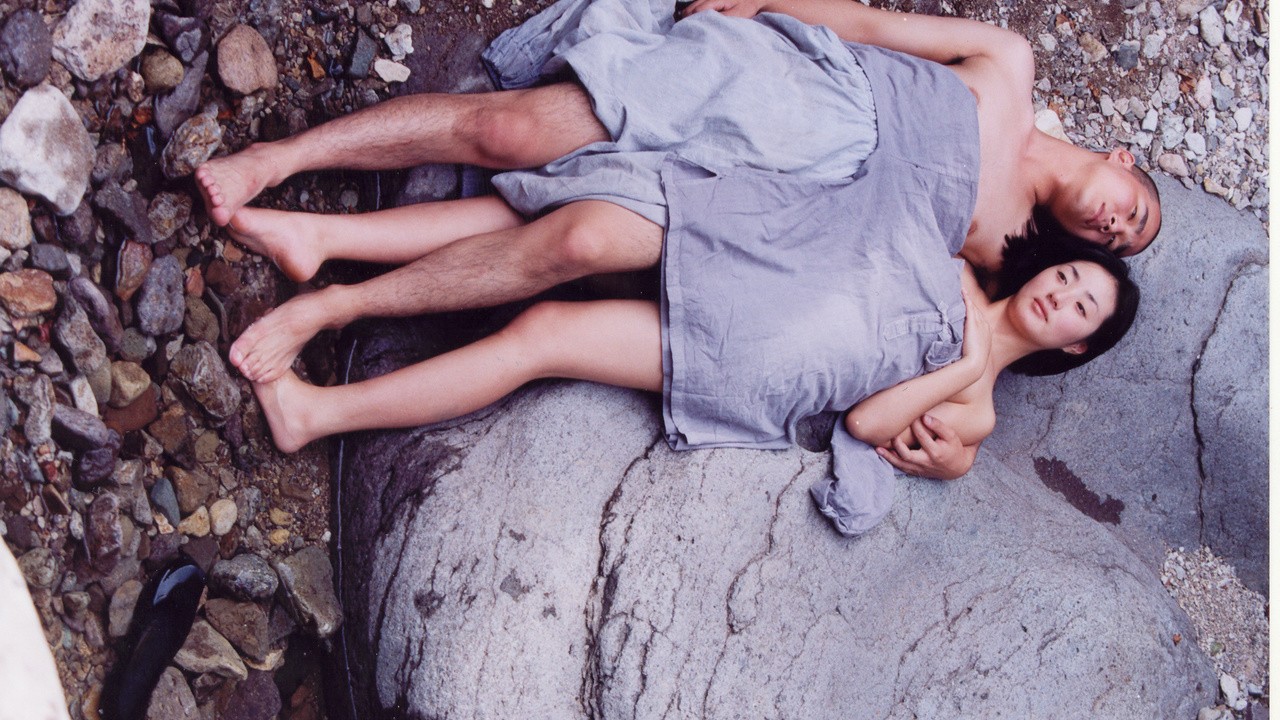
The apprentice (now in his teenage years) encounters a mother and daughter (dressed in modern clothes, indicating that the film takes place in modern times) walking along the forest path, looking for the lake monastery. The apprentice silently greets them and rows them across the lake to the monastery, where it is revealed that the daughter has an unspecified illness (she displays symptoms of a fever) and has been brought to the Buddhist master by her mother, hoping that she will be healed. The master agrees to take in the teenage girl for a time, and the mother leaves. Over the next few days, the apprentice finds himself sexually attracted to the girl, but is too shy to say anything; however, when he finds her sleeping in front of the Buddha statue, he is unable to resist groping her chest. She wakes up and slaps him, and in a guilty panic the apprentice begins to pray incessantly, something his master notes as strange. Touching the apprentice’s shoulder, the girl seems to forgive him. Eventually, the two wander off into the forest alone and have sex. They repeat the act over the next few nights, hiding their relationship from the master, until he discovers them asleep and naked, drifting around the lake in the rowboat. He wakes them up by pulling the plug out of the boat. Rather than expressing anger or disappointment, he merely warns his apprentice that “lust leads to desire for possession, and possession leads to murder”, but does tell him that the girl will have to leave. The apprentice reacts emotionally to this, and in the middle of the night runs away from the monastery in pursuit of the girl, taking the monastery’s Buddha statue with him.

Fall

Many years later, during the Fall, the aging master returns from a supply run to the local village. By chance he glimpses a warrant for the arrest of his former apprentice, wanted for the murder of his wife. Foreseeing the apprentice’s return, he modifies the teenage monk garments by hand, and soon afterward the adult apprentice appears in the spiritual door at the lake’s edge, still full of anger and carrying the bloodstained knife with which he stabbed his wife for having started an affair with another man. Unwilling to go on, he seals his eyes, mouth and nose in a suicide ritual and sits in front of the newly returned Buddha statue, waiting for death. The master discovers him, and beats him ruthlessly, professing that while he may have killed his wife, he will not kill himself so easily. He ties his bloodied apprentice to the ceiling and sets a candle to slowly burn through the rope, then begins painting “Heart Sutra” on one side of the monastery deck, by dipping his cat’s tail into a bowl of black ink. The apprentice eventually falls, and beginning his repentance, cuts his hair off and starts carving the Chinese characters out of the wood. As he carves and the master paints, two detectives arrive at the monastery and try to arrest the apprentice, but the master asks them to let him finish his task. The apprentice continues without stopping, and collapses into sleep immediately upon finishing. Seemingly influenced by the soothing presence of the master, the detectives help the old monk paint his apprentice’s carvings in orange, green, blue and purple. The apprentice finally wakes up, and is taken away by the detectives. After they leave, the master, knowing he is at his end, builds a pyre in the rowboat. He seals his ears, eyes, nose and mouth with paper in the same suicide ritual and meditates as he is suffocated and burned to death. One can see his tears in the paper seals as flames engulf him.

Winter

The middle-aged apprentice returns to the frozen lake and to his former home, which has been drifting uninhabited for years. He finds his master’s clothes, laid out just before his death, and digs his master’s remains, his teeth only, out of the frozen rowboat. He carves a statue of Buddha out of ice, wraps his master’s teeth in red cloth, and sets them in the statue under a waterfall. He finds a book of choreographic meditative stances, and begins to train and exercise in the freezing weather. Eventually, a woman comes to the monastery with her baby son and a shawl wrapped around her face. She leaves her son and flees in the night, but as she runs across the frozen lake she stumbles into the hole dug by the monk. He finds her body the next day, and he removes her from the water to look at her face. He ties the monastery’s large, circular stone to his body and retrieves another statue from the monastery before climbing to the summit of the tallest surrounding mountain. As he climbs, he reflects upon the fish, the frog, and the snake. He prays at the summit, and leaves the statue overlooking the monastery.

…and Spring

Finally, returning to “Spring”, the cycle is completed: the new master lives in the monastery with the abandoned baby, now his apprentice. The boy is shown to torment a tortoise and, wandering into the rocky hills, echoes his predecessor, forcing stones into the mouths of a fish, frog and snake. –Wikipedia

Director

Original

Kim Ki-duk

One of the most controversial Korean directors, Kim Ki-duk is a self-taught filmmaker who prides himself on his outsider status, openly setting himself apart from contemporaries like Hong Sang-soo and Lee Chang-dong, who he considers too intellectual. Kim’s films have drawn vitriol for their subject matter and praise for their technique, and he has often been compared to his predecessor Kim Ki-young, who was also self-taught and whose films bear a much less brutal, but equally eccentric, personal stamp. Born in a mountainous village, Kim moved with his family to Seoul at the age of nine. During his teenage years he dropped out of school and worked in factories, and at the age of 20, he began a five-year stint in the marines, the toughest and most demanding branch of the Korean military. These early experiences would inspire the gritty milieu and dim view of human relationships that characterize his films. A painter since childhood, Kim went to France in 1990, where he studied art and… read more

Wall

Displaying 4 of 35 wall posts.
Picture of Keldon

Keldon

17Apr13

Made me want to be back in rural Korea more than anything else.

Picture of Gylfi

Gylfi

22Mar13

What goes around, comes around...

sashmere likes this

Picture of Christoffer

Christoffer

21Jan13

I think this is a meditation on life, worth watching.

Bárbara likes this

Picture of William Low

William Low

7Jan13

The coming-of-age,the temptation,the fall,the cleansing,and full circle. A masterpiece of spiritual journey through the universal language.

Related Films

Fans

Displaying 5 of 1915 fans.

Lists

Displaying 5 of 419 lists.

Reviews

Displaying 4 of 6

Liberazione dal dolore.

By cathika on September 2, 2012

Cercare di capire cosa “prende” alla visione di questo film è difficile… Intanto le immagini, implacabili di pura bellezza, sono un elemento essenziale all’incorporamento estetico vissuto dallo spettatore…  read review

Formellement sublime

By hubertg​uillaud on February 21, 2012

Le film de Kim Ki-Duk en impose bien sûr par sa beauté formelle, sublimée par le passage des saisons autour d’un paysage unique. Ce conte bouddhiste sur le temps qui passe tisse en écho paysage et…  read review

Spring, Summer, Fall, Winter... and Spring

By Jon on August 3, 2011

Rolling water. Fish. Mist. Doorways. Serpents. Stones. These are just some of the magisterial sights of Kim Ki-duk’s serene, contemplative filmic fable, in which otherwise ordinary products of nature…  read review

Las puertas del templo

By shadowa​ndryu on May 18, 2010

Cada película de Kim Ki Duk, las cuales realiza de manera casi instantánea año tras año, hace parte de una secuencia que no ha encontrado su punto culminante proveniente de sus obsesiones, causadas…  read review

Forum

Displaying 1 discussion topic.

Spring, Summer, Fall, Winter, & Spring

5 posts by 5 people almost 3 years ago