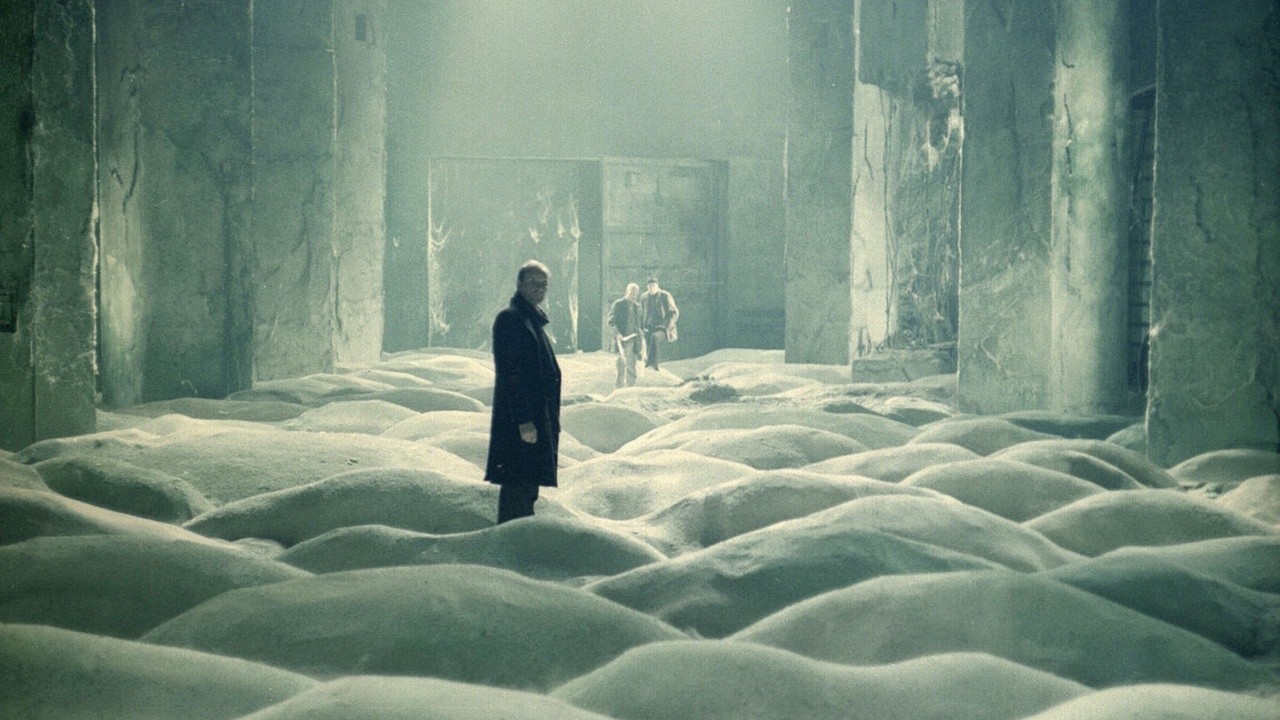
One of Andrei Tarkovsky’s (Solaris, The Sacrifice) most acclaimed films, Stalker is an unforgettable film experience that evokes the spiritual lucidity of Carl Dreyer and the unbridled imagination of Phillip K. Dick. Since its release in 1979, Stalker has inspired filmmakers as diverse as David Lynch and Steven Spielberg and ensnared audiences in a labyrinth of striking imagery revealing the familiar in the strange, the poetic in the disturbing and the mythic in the mordant.
In the near future, an unseen alien force has taken possession of an area of Russian wilderness that authorities have dubbed The Zone. The only thing known for sure about the region is that few who enter it ever return. Led by a Stalker, one of a small group of outlaws able to safely navigate the Zone, a renegade scientist and a cynical, burnt-out writer penetrate the dangers outside in search of the power and transcendence rumored to exist inside. The Stalker longs to un-do a mysterious physical transformation the Zone has performed on his young daughter. The scientist will risk anything to see that reason triumphs over faith. The writer seeks a germ of inspiration that the crumbling and corrupt world beyond the Zone no longer provides.
Together, these three men become desperate pilgrims walking a desolate trail leading to one of the most enigmatic and tantalizing endings in the history of cinema. A haunting and honest meditation on the intersection of science, feeling, and faith, Stalker is both profoundly unsettling and deeply moving. –Kino Video
One of the most important artists of the second half of the twentieth century, Tarkovsky was one of the few unqualified masters in the history of film. While he certainly wasn’t the only great director of his generation of Soviet filmmakers, he was, like Eisenstein was to an earlier generation, its most renowned and most influential.
The son of artists- actress Maria Ivanovna and poet Arseni Tarkovski— he studied both Arabic and geology before turning to film. He enrolled at VGIK in 1959, directed the acclaimed short The Steamroller and the Violin in 1960 and won the Golden Lion at the Venice International Film Festival for his first feature, Ivan’s Childhood, in 1962. By the time he completed his second feature, Andrei Rublev, he was regarded by many as “a poet of the cinema” – and by the Soviet censors as dangerously esoteric. Unreleased in the Soviet Union until 1971 (and then only in a truncated version), Andrei Rublev was seen first at international festivals and widely… read more
Tarkovski ci regala un'ambiziosa,raffinata e stimolante allegoria sulla sete di conoscenza e sulla paura della stessa.Nella sua essenza è abbastanza bergmaniano, poichè un viaggio fisico diventa un pretesto per un viaggio spirituale,attraverso le ansie,i desideri e i dubbi dell'intera umanità.Il tutto viene realizzato mediante stupendi scenari e grandiose riflessioni filosofiche,fino al memorabile finale che delizia.
Odd how one of the most beautiful movies ever made killed a bunch of people...
I've learned and experienced things since the first time I've watched "Stalker". Now that I have rewatched it again today, there are visual pieces and interpretations of dialogue that are new pearls for me. I'm also still curious as to how some scenes are shot
This week we highlight a unique film journal, a couple of recent Q&As and a review of a new book on Andrei Tarkovsky’s Stalker.
On the occasion of what would have been Andrei Tarkovsky’s 80th birthday, Adrian Curry looks back on the best posters for his films.
With the recent passing of screenwriter Tonino Guerra and all the discussion of Geoff Dyer’s Zona, he’s been on our minds lately.
Also: The forgotten work of Spanish director Manuel Mur Oti and another Letter from an Unknown Woman.
Also: Free Korean films in New York, first reviews of Geoff Dyer’s Zona and more.
Also: Incite Journal of Experimental Media, David C Stone, the International Documentary Association nominees and more.
Paper Soldier, dealing as it does with the early days of the Soviet space program (post-Sputnik, pre-manned flight) stands as a sort
In the September 2006 issue of Film Comment, writer-director-critic Paul Schrader wrote a 16-page history/defense of film canons that ended
Andrei Tarkovsky, in my opinion, invented a new language for visual composition within filmmaking and is one of my main career influences. Tied with Sergei Eisenstein, he remains one of the greatest… read review
Tarkovsky explores the deepest recesses of human soul on the waves of Artemiev’s soundtrack. Every step, every breath, every word is full of meaning. The struggle between the most powerful forces inside… read review
Alguna vez, Andrei Tarkovsky afirmó:
“Al poeta le basta con mostrar un fragmento de un objeto para dar la imagen de un conjunto coherente…un dedo de un pie que sale de un zapato es suficiente para… read review
Stalker, wich is for me Tarkovsky’s finest work and one of the most challenging and beautiful movie ever created, is practically perfect in every way. Not only the symbolism is as strong as any of… read review