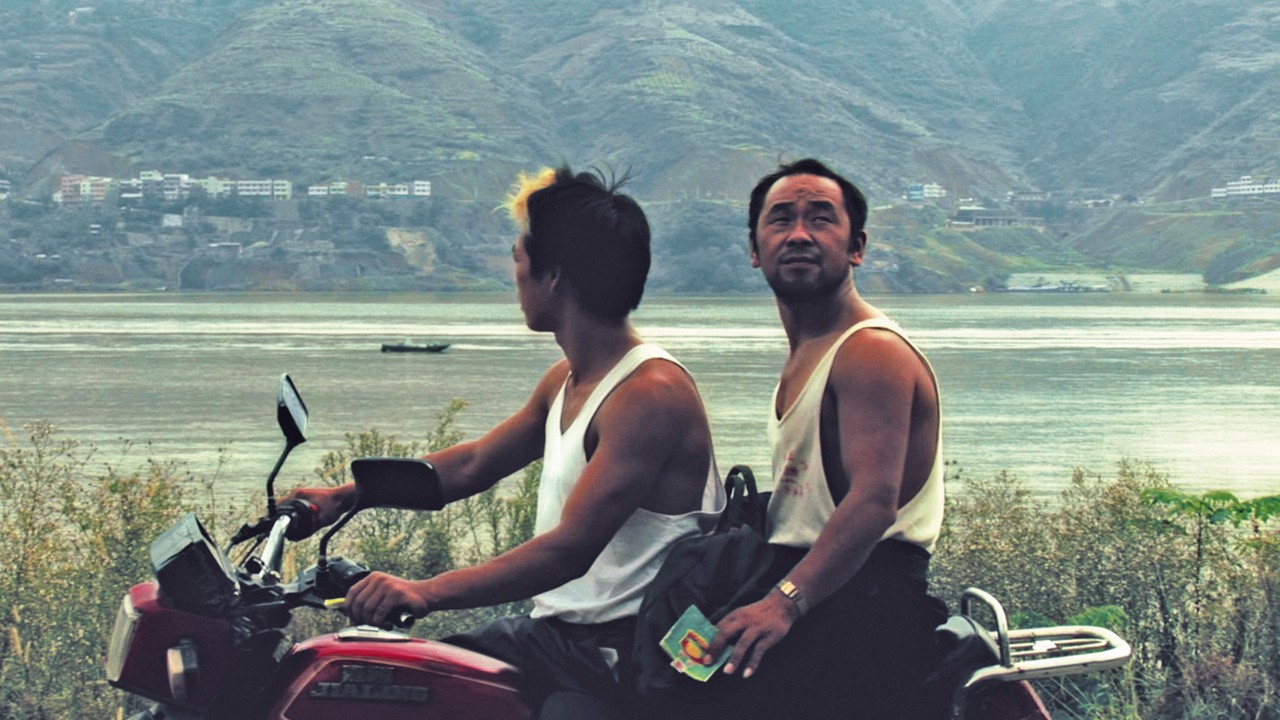
Coalminer Han Sanming comes from Fengyang in Shanxi to the Three Gorges town Fengjie to look for his ex-wife whom he has not seen for 16 years. The couple meet on the bank of the Yangtze River and vow to remarry. Nurse Shen Hong also comes to Fengjie from Taiyuan in Shanxi to look for her husband who has not been home for two years. The couple embrace each other and waltz under the imposing Three Gorges dam, but feel they are so apart and decide to have a divorce. The old township has been submerged, while a new town has to be built. Life persists in the Three Gorges – what should be taken up is taken up, what should be cast off is cast off. —IMDB
Early Work
While a student at the Beijing Film Academy, Jia would make three short films to hone his skills. The first, a ten minute short documentary on tourists in Tiananmen Square entitled One Day in Beijing, was made in 1994 on self-raised funds. Though Jia has referred to his first directorial effort as inconsequential and “naive”, he also described the short day and half shoot as “excitement…difficult to express in words.” But it was Jia’s second directorial effort, the short film Xiao Shan Going Home (1995), that would bring him to the attention of the film world. It was a film that helped establish Jia’s style and thematic interests and, in Jia’s words, was a film that “truly marks the beginning of my career as a filmmaker.” Xiao Shan would eventually to screen abroad where it won a top prize at the 1997 Hong Kong Independent Short Film & Video Awards. More significantly, the film’s success brought Jia in contact with cinematographer Yu Lik-wai and… read more
Jia Zhang Ke is an artist composing atmospheres and simulating metaphors about worlds that converge in full (un) meeting. Which photographic drawings, a Chinese village in the midst of destruction there is beauty emerging from collapsing walls, rusty metal, the uninhabited spaces, places that echo through history and nostalgia perennial in its last inhabitants.
Jia Zhang Ke es un artista componiendo las atmósferas y simulando metáforas sobre mundos que se convergen y personajes en pleno (des)encuentro. Cuales planos fotográficos, un pueblo chino en medio de su destrucción haya una belleza que emerge de las paredes derrumbadas, del metal oxidado, de los espacios deshabitados, lugares que hacen eco a través de su historia y una nostalgia perenne en sus últimos habitantes.
A self described homage to King Hu and Chang Cheh reveals itself to be strongly rooted in the consistency and strength of Jia’s film world.
Jia Zhangke: A Retrospective opens at MoMA on Friday and runs through March 20. To mark the occasion, dGenerate Films presents "The Age of
If you're going to talk about cinema at present, even if you're not talking very thoroughly, it's inevitable that Yu Lik-wai's work, if not
There's a house in Fish Eyes, and a mirror which is later broken and reused, a somewhat junky motorcycle, a strangely new guitar, an underused
Each of the Notebook's writers were given the opportunity to submit their ten favorite films of 2008 given at least a week's theatrical run
Still Life, is, in its discreet way, another dystopian fable, dealing with the end of civilisation. The film is set in the last days of a 2000 year old city, Fengjie, over an unclear period of a time… read review
While this movie had a ponderous feel, it actually moves at a brisk pace shepherded along by all of the walking that its main characters do. There are some lovely shots of the region and of small details… read review
Independent Chinese filmmaker Jia Zhang-ke’s fifth film – and his second that’s passed the Chinese censors – contrasts a poetic, lyrical technique with the harsh realities of everyday life in China… read review
Jia Zhang Ke is a very interesting director of a kind I haven’t seen since Antonioni. The story and characters are molded to a certain mood the filmmaker creates. Where the sounds and vistas of the… read review