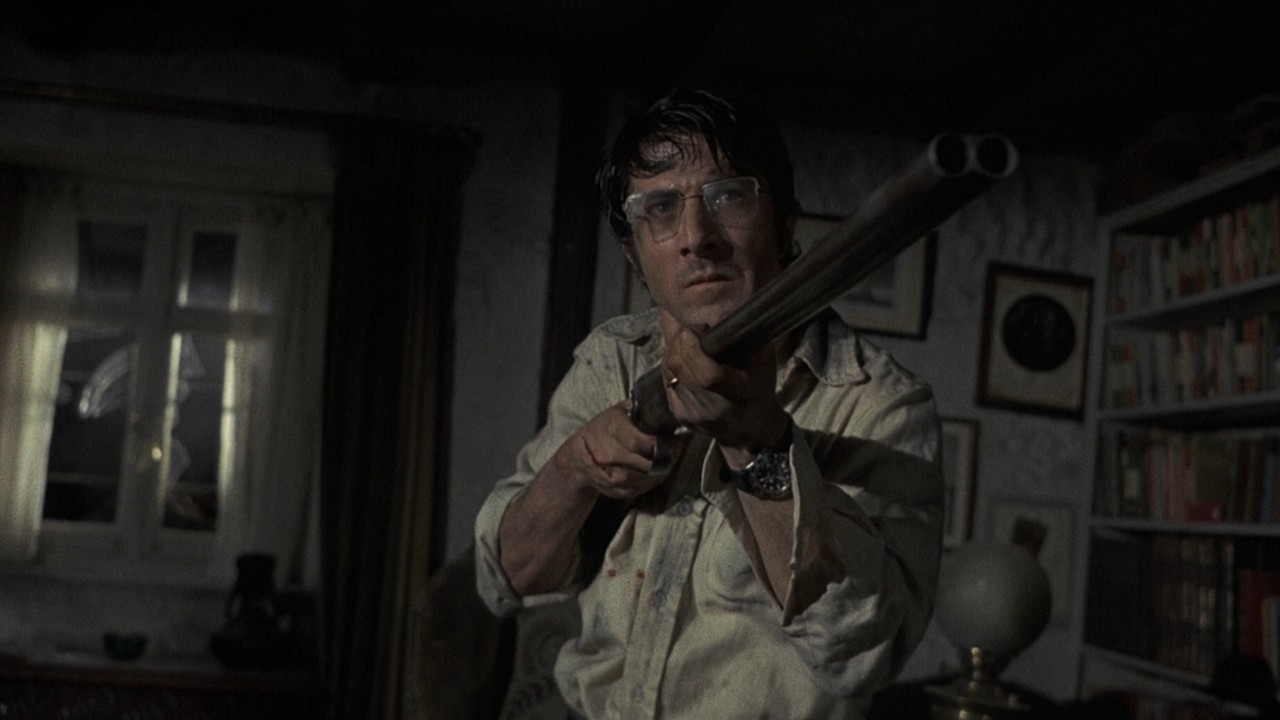
A young American mathematician, David Sumner (Dustin Hoffman), and his English wife, Amy (Susan George), move to a Cornish village, seeking the quiet life. But beneath the seemingly peaceful isolation of the pastoral village lies a savagery and violence that threatens to destroy the couple, culminating in a brutal test of Sumner’s manhood and a bloody battle to the death. One of the most controversial films ever made, Sam Peckinpah’s Straw Dogs is a harrowing and masterful investigation of masculinity and the nature of violence. —The Criterion Collection
“If they move”, hisses stern-eyed William Holden, “kill ’em”. So begins The Wild Bunch (1969), Sam Peckinpah’s bloody, high-body-count eulogy to the mythologized Old West. “Pouring new wine into the bottle of the Western, Peckinpah explodes the bottle”, observed critic Pauline Kael. That exploding bottle also christened the director with the nickname that would forever define his films and reputation: “Bloody Sam”.
David Samuel Peckinpah was born and grew up in Fresno, California, when it was still a sleepy town. Young Sam was a loner. The child’s greatest influence was grandfather Denver Church Peckinpah, a judge, congressman and one of the best shots in the Sierra Nevadas. Sam served in the Marine Corps during World War II but – to his disappointment – did not see combat. He married Marie Selland in Las Vegas in 1947 and enrolled as a theater graduate student at the University of Southern California the next year.
After drifting through several jobs—including a stint… read more
Since the first frame of picture, it is clear that Peckinpah is painting an "macho" work. It is only when Hoffman's character is eaten by the savage and animal world from that village that--in Peckinpah's point of view--he can be a true man, a man of family, who can take care of himself and of his wife--who's, on the other hand, is some one totally dependent; almost an animatron. But still, a heck of a picture.
Sam Peckinpah's film became the victim of massive misunderstanding upon its release in 1971, though in the decades since, its reputation has been rehabilitated somewhat by those who recognized that it isn't a misogynistic call for machismo in the form of violence but rather a tightly wound thriller where all the characters, even the theoretical heroes, behave as hypocrites by wanting to have everything both ways.
Goodman’s screenplays include Straw Dogs, Logan’s Run, Eyes of Laura Mars and the 1975 Farewell, My Lovely.
Rod Lurie’s remake presents an opportunity to revisit the controversy kicked up by Peckinpah’s original.
I think people miss the point of this film. Movies, by nature, are made and produced and marketed to entertain a wide audience of people. Movies tend to wrap up plot points nice and neat, and send… read review
I was ready to give up on Peckinpah. After watching, about three years ago, The Wild Bunch, and then, almost two years ago, The Getaway, and finding myself unappreciative of both… read review
Sob o domínio do mêdo, título no Brasil desse suspense onde Dustin Hoffman está ótimo.
Assisti esse filme nos anos 80’ e comprei o dvd pois tenho colecionado a filmografia de Dustin Hoffman de… read review