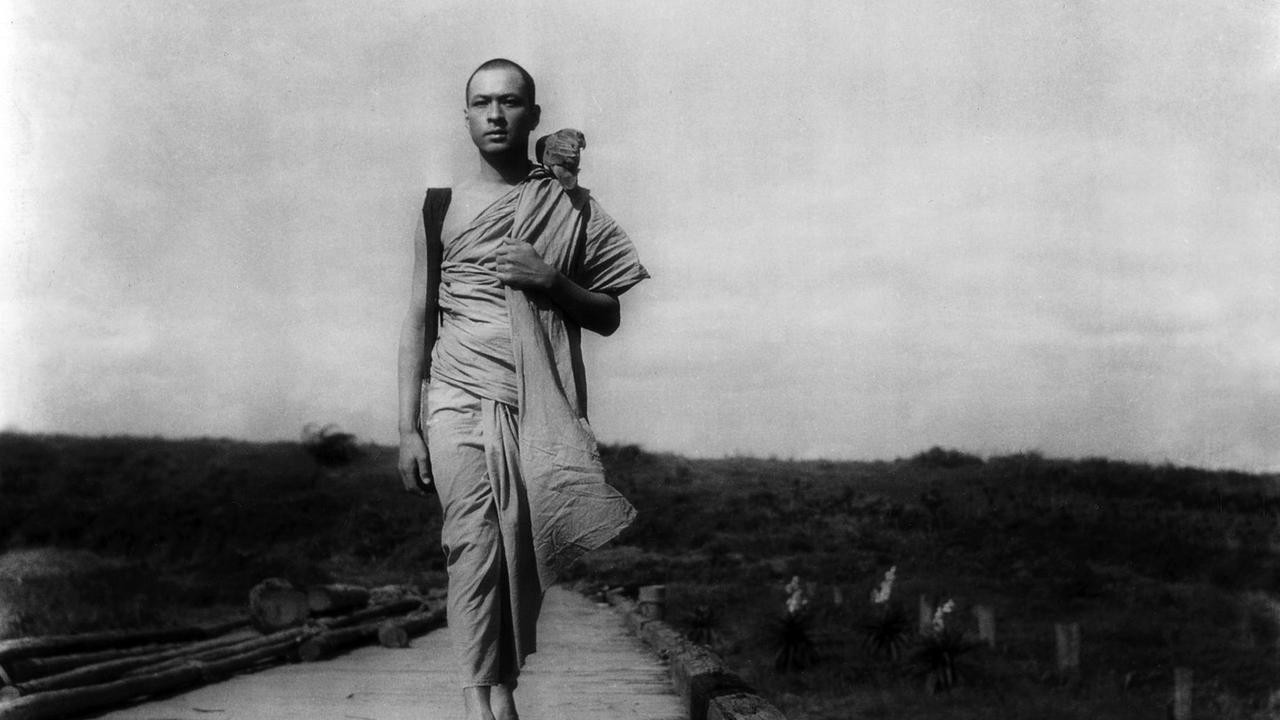
An Imperial Japanese Army regiment surrenders to British forces in Burma at the close of World War II and finds harmony through song. A private, thought to be dead, disguises himself as a Buddhist monk and stumbles upon spiritual enlightenment. Magnificently shot in hushed black and white, Kon Ichikawa’s The Burmese Harp is an eloquent meditation on beauty coexisting with death and remains one of Japanese cinema’s most overwhelming antiwar statements, both tender and brutal in its grappling with Japan’s wartime legacy. —The Criterion Collection
Born on November 20, 1915, in Ujiyamada, Mie Prefecture, Ichikawa first gained western recognition during the 1950s and 60s with several bleak films, particularly two acclaimed antiwar films, The Burmese Harp and Fires on the Plain.
Ichikawa began his career as a cartoonist, and collaborated with his wife, screenwriter Natto WADA, until 1965. His films are generally regarded as dark and bleak, interspersed with sparks of humanity, and he often intertwines comedy and tragedy within the same story. He also has a flair for technical expertise, irony, detachment, and a drive for realism across all genres. After Akira KUROSAWA’s departure, no other Japanese director has come close to Ichikawa’s level of recognition, the power of his films, and commercial success.
Ichikawa passed away on February 13, 2008. At age 91 (2006), he was still active as a director, completing a feature-length film, The Inugamis, and directing one segment of the Japanese fantasy, Ten Nights of Dream… read more
One of Ichikawa's greatest films strikes a delicate balance between the depiction of the horrors of war and the sentiment of its aftermath when the defeated Japanese soldiers are waiting to be repatriated back home. One of the soldiers is given the task of persuading a regiment to surrender but when this mission fails he decides to don the robes of a Buddhist monk and bury the numerous war dead. A humanist classic...
Kon Ichikawa’s The Burmese Harp is not only among the greatest anti-war movies ever made, it is also one of the most beautiful, heartbreaking, and, ultimately, uplifting movies ever made. Visually… read review