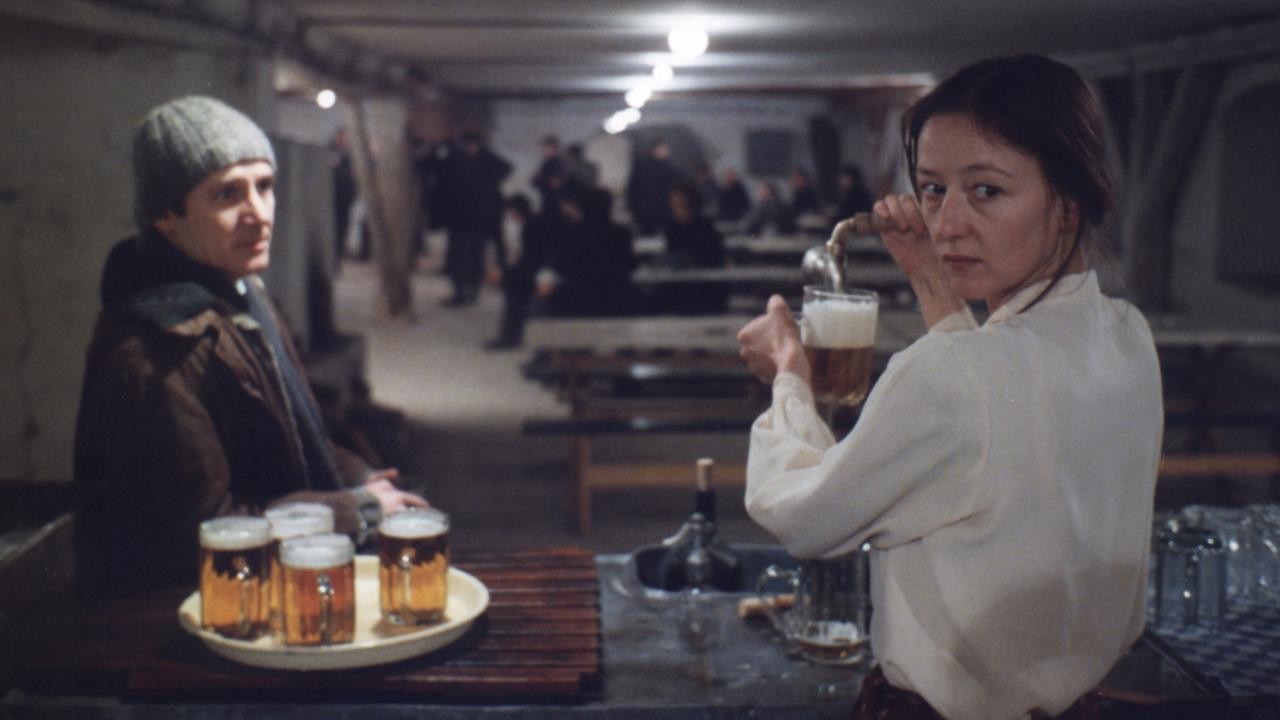
Michael Haneke’s film of Franz Kafka’s The Castle pairs one of the most influential voices in 20th century literature with one of the most visionary filmmakers of the new millennium. A film as complex, vivid, and “intriguing” (New York Times) as Orson Welles’ The Trial, The Castle is both an ingenious, perversely faithful interpretation of the master of alienation’s novel, and a worthy companion to The Piano Teacher, Caché and other films from the darkest leading light of contemporary cinema.
A land surveyor identified simply as K is summoned to a remote mountain village by the local government, known as (and housed in) “the castle.” Unable to convince underlings of the legitimacy of his position, he tries to take his case to castle officials. But the more K struggles to gain entrance, the more obstructive the village’s provincial bureaucracy becomes. As the absurdity of K’s circumstances and the depth and intricacy of the castle’s hold on the villagers grows, Haneke masterfully evokes Kafka’s vision of a dystopian society hobbled by paperwork and bled dry by conformism and convolution. Using an expert cast headed by Haneke regulars Ulrich Mühe (The Lives of Others, Funny Games_) and Susanne Lothar (_The Piano Teacher), and beautifully austere, Rembrandt-like visuals, Haneke transforms Kafka’s unfinished novel into a potent, enigmatic, and complete film experience that is truly Kafkaesque. —Kino
Cheerfully wishing his audience a “disturbing evening” at a London retrospective of his films, director Michael Haneke insists that he is an optimist at heart, despite all of the relentlessly bleak carnage and deeply disturbing imagery so vividly painted and seared into the mind of anyone who has had the uncomfortable experience of viewing his work.
Practically born into show business, to an actress mother and director father, in Munich in March 1942, Haneke spent his early years in a working class suburb of Vienna before an early attempt at fame as an actor and pianist. Failing to achieve early success, Haneke attended the University of Vienna to study philosophy and psychology, and became a film critic and stage director before making his eventual debut as a television director with After Liverpool in 1973. Setting in motion a television career specializing in literary adaptations and small screen films, Haneke would work successfully in that medium until his feature debut… read more
Not my favorite Haneke flick, but still well-acted and beautifully shot (as always). This was Haneke's last time doing made-for-TV films while making theatrical films, THE CASTLE remains a transcendental mystery simliar to Welles' THE TRIAL.
Disappointing. Haneke's 'Das Schloss' was somewhat dull; it was a faithful & quality realization of the book, but at the end of the film I thought "one might as well just read the book, why bother with the film?". It was not a "cinematic experience", a big difference here with what Kubrick does when he adapts novels to the screen.