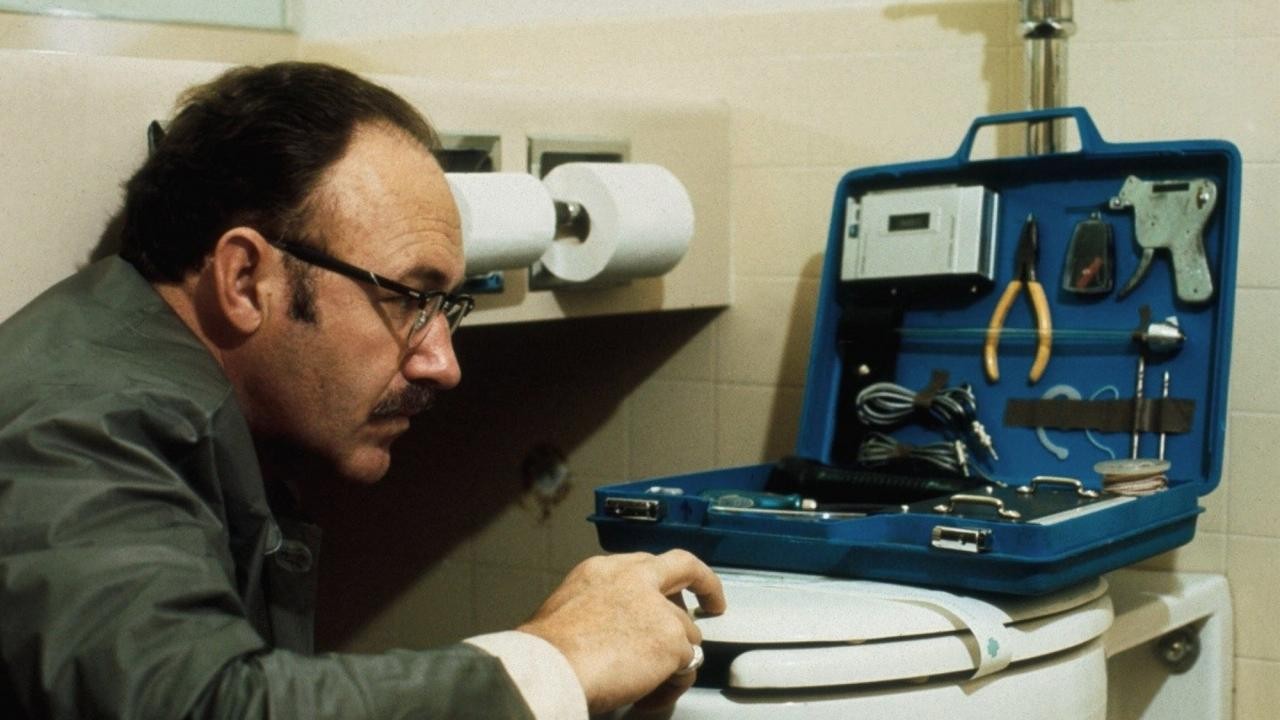
This low-budget conspiracy thriller was written, produced and released by director Francis Ford Coppola before and during the Wategate era — a time of heightened concern over the violation of civil liberties. Its claustrophobic themes of the invasion of privacy, alienation, guilt, voyeurism, justified paranoia, unprincipled corporate power and personal responsibility effectively responded to growing, ominous 20th century threats of eavesdropping to personal freedom. Harry Caul is an odd fish in his personal life, but reigns supreme at his chosen occupation as a surveillance expert. Haunted by the death of three people as a result of his work, he discovers while covering a seemingly routine case of marital infidelity that he has become the victim of his own technological profession and intrigue. Naturally big business is behind it all, developing eavesdropping equipment of staggering complexity and efficiency in an elaborate attempt to record anything ever said by anybody at any time, all in the name of financial gain. The film, which subtly posits that technology has gotten out of control, failed at the box office on release, but the continuing relevance of its central issues has kept it alive with cinema lovers everywhere and made it an acknowledged masterpiece of the genre. —Siff
He was born in 1939 in Detroit, USA, but he grew up in a New York suburb in a creative, supportive Italian-American family. His father was a composer and musician Carmine Coppola. His mother had been an actress. Francis Ford Coppola graduated with a degree in drama from Hofstra University, and did graduate work at UCLA in filmmaking. He was training as assistant with filmmaker Roger Corman, working in such capacities as soundman, dialogue director, associate producer and, eventually, director of Dementia 13 (1963), Coppola’s first feature film. During the next four years, Coppola was involved in a variety of script collaborations, including writing an adaptation of This Property is Condemned, by Tennessee Williams (with Fred Coe and Edith Sommer), and screenplays for Is Paris Burning?, and Patton, the film for which Coppola won a Best Adapted Screenplay Academy Award. In 1966, Coppola’s 2nd film brought him critical acclaim and a Master of Fine Arts degree. In 1969, Coppola and George… read more
Well crafted look into a fascinating world.As always,Gene Hackman is excellent as a complex,lonely man who is brilliant at his profession. The pacing and great supporting performances keep us riveted.
Terrific paranoia thriller follows obsessively private wiretapper Hackman getting way too involved in one of his cases. Not nearly as showy as the other Coppola classics, but just as deserving of the acclaim for the flawless and incredibly smart execution of such a bizarre subject matter. Unforgettable ending sequence is bound to stay with you far longer than the rest of the movie, but it's a full length success.
watched it 3 times in one week, the best charecter study i've ever seen due to it's balance of atmosphere, pacing a pure cinema, another coppola masterpiece
Also: Thanksgiving movie scenes, top 50 films ever, vintage posters exhibition, Eraserhead set photos, DVDs and more.
Francis Ford Coppola turned 70 this month, which would have been reason enough to resurrect this incredible poster for his little-known 1969
Francis Ford Coppola’s choice of production sandwiched between his two ’70’s Godfather epics, ‘The Conversation’, is in many ways just as satisfying as either of those magnificent films, and speaks… read review
A slowly unraveling thriller that reveals more and more with each new scene and all leads up to the stunning, haunting finale. I thought it was really ingenious the way that Coppola revealed more about… read review