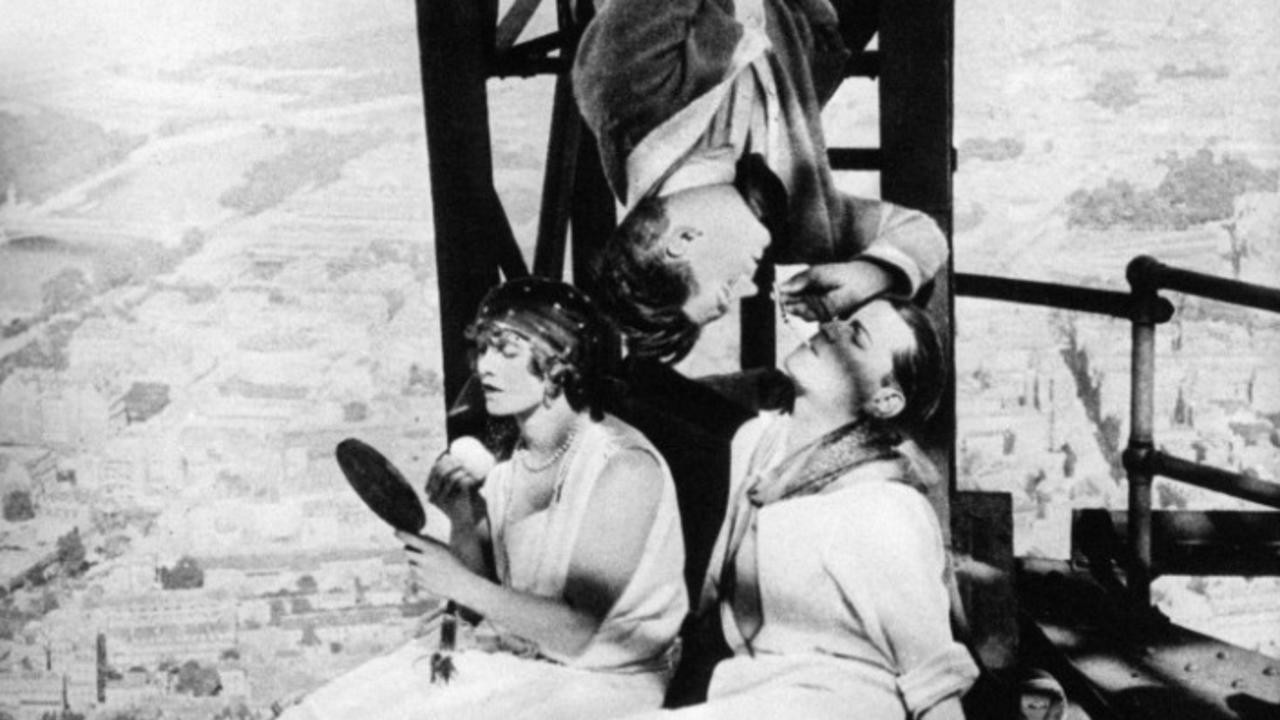
The Crazy Ray (Paris qui Dort) was a wild Rene Clair daydream which he deftly translated into his very first directorial effort. Deliberately invoking the early “chase” films which distinguished the French cinema, Clair weaves an improbable tale of a genially looney scientist who utilizes a magic ray (an effect created with stop-motion photography) on the unsuspecting citizens of Paris. The ray causes its victims to freeze in bizarre and often embarrassing positions. Those not affected by the ray take the opportunity to lift everything that isn’t nailed down. Clair’s original director’s cut of The Crazy Ray ran a brisk thirty minutes. Unfortunately, several foreign distributors decided to pad the picture out with arbitrary and pointless cutaway shots; while watching one of these “improved” versions late in life, Clair muttered “I don’t know where the hell that came from.” —IMDb
Born under the name of René Chomette in 1898, René Clair René Clair started life as a journalist and then turned to the cinema in 1920. At first an actor and assistant director, he started making films with Paris qui dort and Entr’acte (1924), a pearl of the surrealist cinema.
Commercial success and critical acclaim came with the brilliant farce comedy, An Italian Straw Hat (1927) followed by his famous early musical talkies, Le Million (1931) and A nous la liberté (1932). He continued his career in Hollywood during the war and came back to France to make the films of his mature years, Le Silence est d’or (1947) et Les Grandes manœuvres (1955). René Clair was elected to the Académie Française in 1960 and died in 1981. —Octuor de France
Clair plays around with ideas of isolation and class through the bending of time in this characteristically charming and witty film. Along the way, the filmmaker explores the lackadaisical boredom of youth. The scenes in, around, under and along the edges of the Eiffel Tower are still thrilling decades removed.