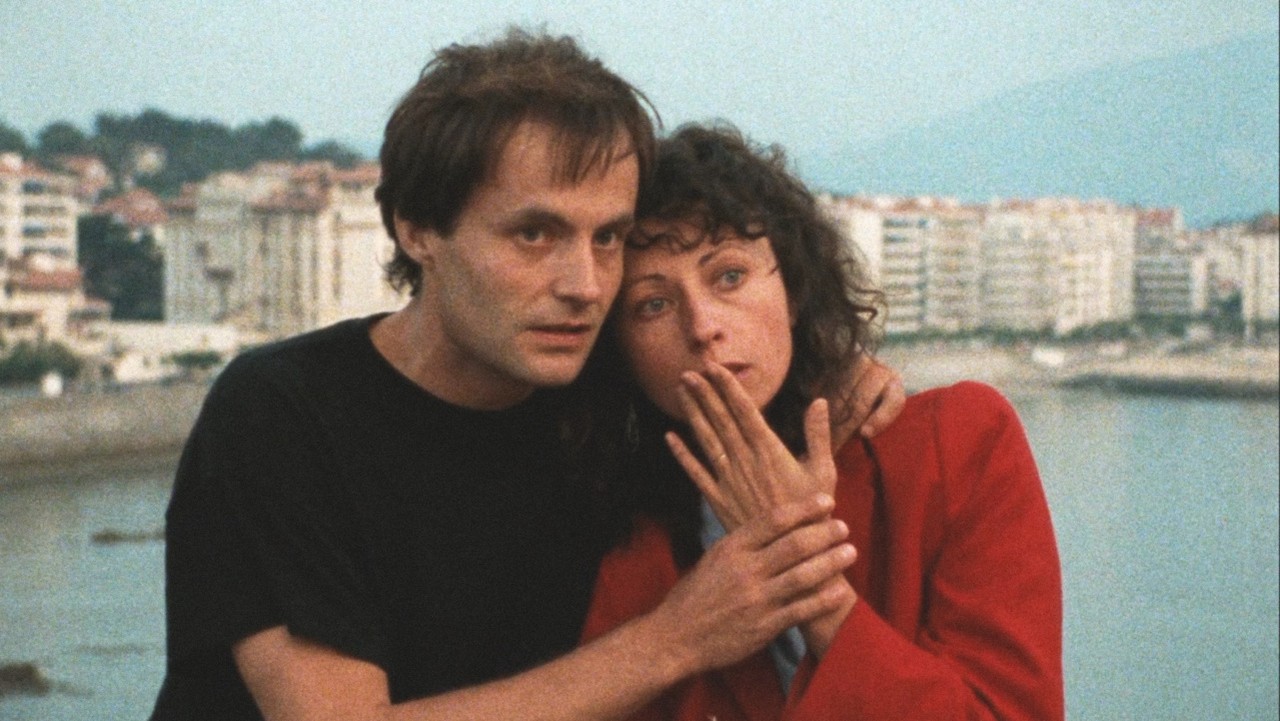
Delphine’s traveling companion cancels two weeks before her holiday, so Delphine, a Parisian secretary, is at loose ends. She doesn’t want to travel by herself, but has no boyfriend and seems unable to meet new people. A friend takes her to Cherbourg; after a few days there, the weepy and self-pitying Delphine goes back to Paris. She tries the Alps, but returns the same day. Next, it’s the beach: once there, she chats with an outgoing Swede, a party girl, and a friendship seems to bud; then, suddenly, Delphine bolts, heading back to Paris. As she waits at the Biarritz train station, a young man catches her eye; perhaps a sunset and the sun’s green ray await –IMDb
The most subtle and traditional of the many luminaries launched to prominence as a member of the French New Wave, Eric Rohmer is also among the movement’s most consistent and enduring talents. Basing his work upon antecedents in literature as much as those in the cinema, Rohmer made his name crafting talky, feather-light romantic comedies and chamber dramas distinguished by economical camerawork, a warmly ironic tone, an affection for youth, and a fascination with place and time. His intensely personal private life — according to legend, not even his own mother knew he was an internationally acclaimed, albeit pseudonymously named, filmmaker — has stood in direct contrast to the emotional openness of his movies, which, in intimate and illuminating detail, explore the limitless entanglements, disappointments, and possibilities facing contemporary relationships.
Born Jean-Marie Maurice Scherer on December 1, 1920, in Nancy, France, Rohmer later relocated to Paris, where he worked variously… read more
Veramente l'ospite perfetto questa Delphine. Ammazza che palle. Uno dei personaggi più irittanti mai visti al cinema (anche perchè la vita è piena di Delphine, le incontri in ufficio, nei corsi di lingua, negli appartamenti di Monti). Nondimeno è un film meraviglioso, specie la parte di Biarritz. La Riviere sembra Amanda Sandrelli + PJ Harvey. Un incrocio strano. Tu nunca has visto el rayo verde, diceva sr, Chinarro.
Marie Rivière, j'ai récemment vu le film Le Rayon vert. Votre interprétation de celui-ci est fabuleux, sublime. Vous êtes l'air du film, aussi clair que la mer ♥
The main character seems to be irritated with life and all the living things(she's vegetarian and lives like a herb) I have no problem with this but the paths that lead her to the green ray, thus life (the play cards found, the elderly people's talkings and the shop which is shown as a sign) is entirely ridiculous.
Is there anyone who didn't leave the theatre feeling like they saw Delphine in themselves
A previously unpublished article by French New Wave critic and filmmaker Luc Moullet on the cinema of Eric Rohmer.
Crystallizing various facets of his Comédies et Proverbes cycle while radically departing from others, the diaristic 1986 beauty Le
"Though Éric Rohmer's breakthrough film stateside was the lustrous black-and-white, winter-set My Night at Maud's (1969), the New Wave
The Film Society of Lincoln Center is touting The Sign of Rohmer, opening this afternoon with a screening of Eric Rohmer's debut feature
"Eric Rohmer, a pioneer of the French New Wave which transformed cinema in the 1960s," reports Reuters. "He was 89." As in the barrage of
For more reviews or discussions on films, film culture and others, visit AUDITOIRE: Exploring World… read review
Breathtaking. Absolutely breathtaking. Eric Rohmer’s “Le Rayon” Vert is impeccably shot with beautiful, realistic dialogue. In the film, the main character Delphine (Marie Rivière) is a French woman… read review
And I like Ozu, just not more than Kurosawa or Mizoguchi. For those of you who do, watch this movie. For those of you like me, here is the review:
Eric Rohmer’s “The Green Ray”
Cancel… read review
This was the first Rohmer I saw and I was fascinated by every single moment, each edit, each cut, the shade of the colours and the movements of these wonderful actors. THE GREEN RAY is a film about… read review