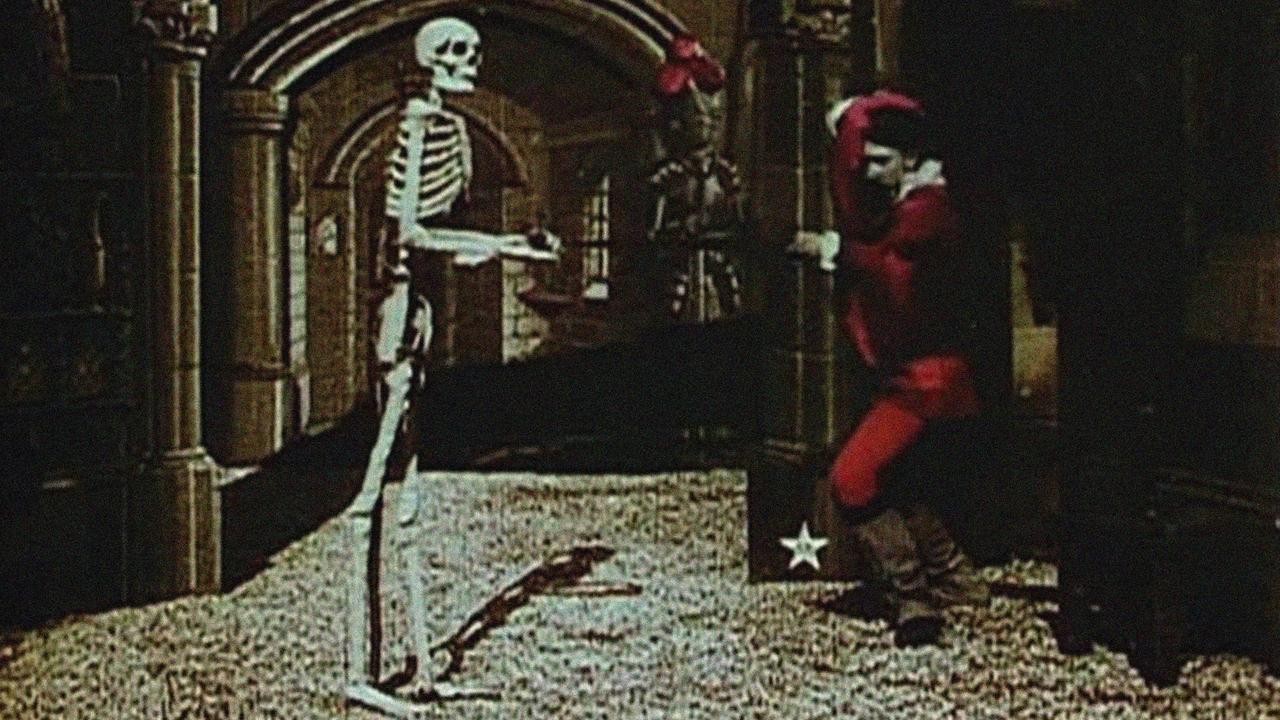
Moving into his second year of film production, Georges Méliès was still enraptured by the possibilities of the simple jump-cut, which is used here to cause ghosts, skeletons and other sinister beings to appear and disappear at the director’s whim, much to the bewilderment of the film’s hapless protagonist – who seems to be either a nightwatchman taking over a shift or a man taking a bet from a friend that he won’t last a full night in the haunted castle. Sadly, the film’s abrupt and inconclusive ending, as well as its relative brevity (it’s about 25 second shorter than the other Méliès films of the period) suggest that as much as the final third may have been lost, but there’s more than enough going on in the footage that remains to retain attention. —Filmjournal.net
Georges Méliès (December 8, 1861 – January 21, 1938), full name Marie-Georges-Jean Méliès, was a French filmmaker famous for leading many technical and narrative developments in the earliest cinema. He was very innovative in the use of special effects. He accidentally discovered the stop trick, or substitution, in 1896, and was one of the first filmmakers to use multiple exposures, time-lapse photography, dissolves, and hand-painted color in his films. Because of his ability to seemingly manipulate and transform reality through cinematography, Méliès is sometimes referred to as the “Cinemagician.”
Méliès was born in Paris, where his family manufactured shoes. He had two older brothers, Henri and Gaston. Before making films, he was a stage magician at the Theatre Robert-Houdin. In 1895, he became interested in film after seeing a demonstration of the Lumière brothers’ camera. In 1897, he established a studio on a rooftop property in Montreuil. Actors performed in front of a painted… read more
The ending was such a bad choice! But maybe that's why it's so pleasant;)) The numerous leitmotifs, the pantomime, the exaggerated gestures... Still, I think Melies opened the way toward what later proved to be the infinite choices to use the shadow and window light.
French film pioneer Georges Méliès (“The House of the Devil” & “A Nightmare”) continues to showcase the jump cut in a film that carries on in the same vein as his previous outings but to lesser… read review