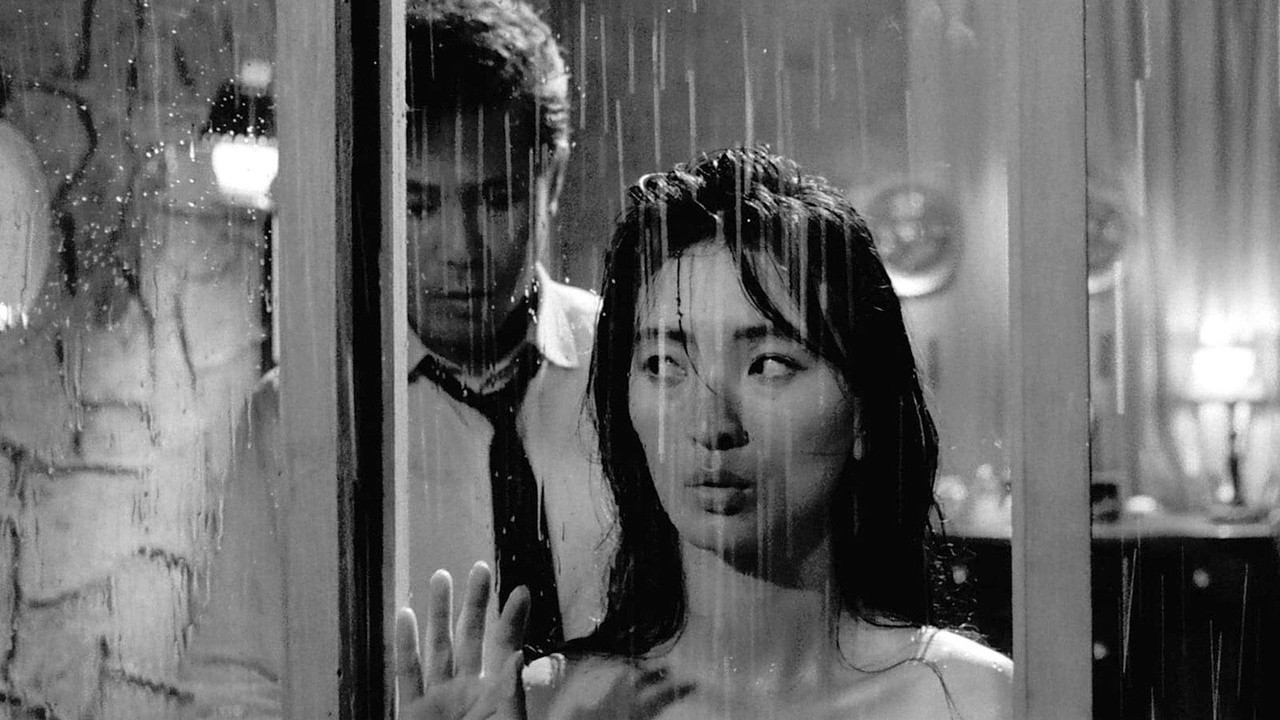
Kim Ki-young’s Hanyo, or The Housemaid, is one of the true classics of South Korean cinema, and when I finally had the opportunity to see the picture, I was startled. That this intensely, even passionately claustrophobic film is known only to the most devoted film lovers in the west is one of the great accidents of film history. I’m proud that the World Cinema Foundation is participating in the restoration and preservation of this remarkable picture. I am eager for more people to get to know and love The Housemaid. —Martin Scorsese, February 2008
In the film, the composer sleeps with his housemaid while his wife is gone to her parents’ house; he loses everything to the housemaid with personality disorders. Viewers of the film said that the story could sufficiently occur in reality; at that time, many such incidents occurred. Many households could afford to hire housemaids for low costs; but housewives were worried about such situations at the back of their minds. I made a set for the two-story house, which I thought to be a miniature of the world. I made all accessories and furniture for the film on my own, and especially I worked hard on lighting. Viewers of the film praised the beautiful scenes, and asked me what was the secret; however, I did not readily give the answer. —Kim Ki-Young
NOTES ON THE RESTORATION
Hanyo (The Housemaid) has been restored digitally by the Korean Film Archive (KOFA) with the support of the World Cinema Foundation. The original negative of the film was found in 1982 with two missing reels, 5 and 8. In 1990 an original release print with hand-written English subtitles was found and used to complete the copy. This surviving print was highly damaged, and the English subtitles occupied almost half of the frame area. The long and complex restoration process has involved the use of a special subtitle-removal software and included flicker and grain reduction, scratch and dust removal, color grading.
Kim Ki-young (October 1, 1922 – February 5, 1998) was a South Korean film director, known for his intensely psychosexual and melodramatic horror films, often focusing on the psychology of their female characters. Kim was born in Seoul during the Japanese occupation, raised in Pyongyang and spent time in Japan, where he became interested in theater and cinema. In Korea after the end of World War II, he studied dentistry while becoming involved in the theater. During the Korean War, he made propaganda films for the United States Information Service. In 1955, he used discarded American equipment to produce his first two films. With the success of these two films Kim formed his own production company and produced popular melodramas for the rest of the decade.
Kim Ki-young’s first expression of his mature style was in his The Housemaid (1960), which featured a powerful femme fatale character. It is widely considered to be one of the best Korean films of all time. After a “Golden Age”… read more
This little-known classic is a dark and twisted melodrama that shows a stable family unit torn apart by the machinations of a predatory housemaid. The director gradually builds up the tension until the startling conclusion and then pulls the rug out from under the viewer with a denouement that boldly breaks the fourth wall. The editing and camerawork are exemplary, as is the stunning photography. Highly recommended..
Absolutely brilliant! It's not as weird as Io Island, but it's just as good. Kim Ki-young's vision here reminds me a lot of Sam Fuller's 60s work like Shock Corridor and The Naked Kiss, but he goes above and beyond. By the end it just feels so choking and claustrophobic that I felt like I couldn't breathe myself. The ending, however, is a bit odd. The cheekiness of it recalls what Lang did with The Woman in the Window, but it's the only flaw in what is otherwise one hell of a ride. I can't wait to delve into Ki-young's even wilder works.
A claustrophobic descent into madness and revenge with an unexpected final twist. Lee Eun-shim's one and only film role is this one as the young housemaid. It says something that her performance is still talked about a half century later. The cinematography is top notch. My first viewing of Hanyo, by the way, was right here on Mubi when it was available free of charge some time ago.
"Arguably the strongest American debut feature of the 90s, Todd Haynes's Poison — aptly billed as telling 'three tales of transgression
"It's been half a century since Kim Ki-young's The Housemaid forever changed the course of Korean cinema," writes Lee Hyo-won in the Korea
A few previews are already in. At In Contention, Kristopher Tapley lists ten big budget roll-outs he's looking forward to in 2010; the New
This is where it all began ! Urban hysteria, claustrophobia , alienation, lack of human connect, individual anxieties , decay of family values owing to the pressures exerted by an ever increasing materialistic… read review
A finer definition of claustrophobia there could not be! Much of the closed-in feeling here is due to the care taken creating the sets. They are truly amazing. How on earth did someone work all this… read review
Plutôt intéressé par le très bon cinéma coréen actuel, je n’avais jamais eu l’occasion de me pencher sur un film coréen de cette époque.
Ce film de 1960 fut donc une totale découverte. Le “sauvetage”… read review
… It is the first word that me passes for the head after stopping seeing this film, I do not remember a history like that, so provocative, striking, and the fact that he is already 50 years old there… read review