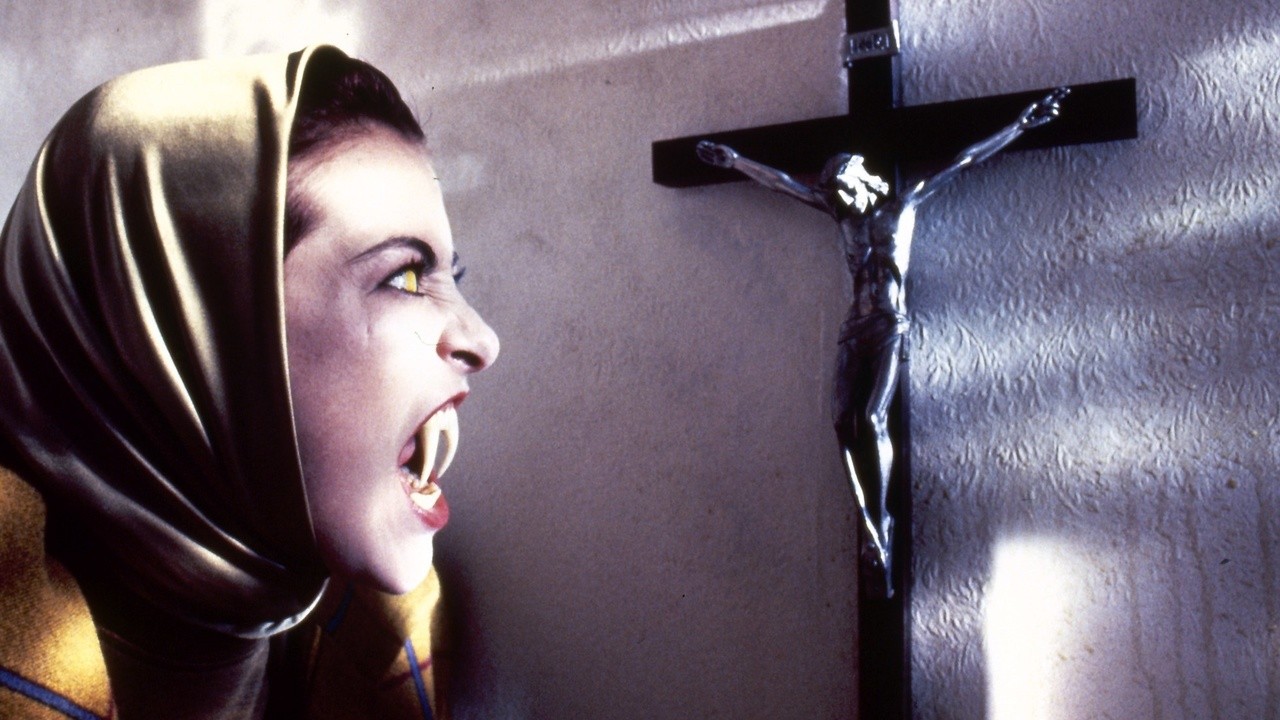
Ken Russell’s Lair of the White Worm uses Dracula author Bram Stoker’s final novel as the basic springboard into a surreal and dark-humored tale concerning a bizarre cult and a series of sacrificial murders in honor of an ancient pagan god. When archeologist Angus Flint (Peter Capaladi) discovers the mysterious scull of an undiscovered beast, further investigation reveals a bizarre myth concerning a medieval knight slaying a fearsome dragon. Soon making the acquaintance of Lord James D’Ampton (Hugh Grant), the conquering knight’s descendant, Flint begins to learn of local lore surrounding the creature and soon discovers that, throughout the years, many unexplained disappearances have haunted the local populace. With all trails leading back to the elegant mansion of mysterious recluse Lady Sylvia Marsh (Amanda Donohoe), Lord D’Ampton makes Marsh’s acquaintance amidst growing speculation that the strangely seductive siren may have something to do with a rash of recent disappearances. As Flint and D’Ampton’s stories begin to strangely intersect, a surreal and horrific journey into the lair of an ancient god may hold they key to an age-old mystery.
British director Ken Russell started out training for a naval career, but after wartime RAF and merchant navy service he switched goals and went into ballet. Supplementing his dancing income as an actor and still photographer, Russell put together a handful of amateur films in the 50s before being hired as a staff director by the BBC. Russell made a name for himself (albeit a name not always spoken in reverence) during the first half of the ‘60s by directing a series of iconoclastic TV dramatizations of the lives of famous composers and dancers. And if he felt that the facts were getting in the way of his story, he’d make up his own — frequently bordering on the libelous. If he had any respect for the famous persons whose lives he probed, it was secondary to his fascination with revealing all warts and open wounds.
A film director since 1963, Russell burst into the international consciousness with 1969’s Women in Love, a hothouse version of the D.H. Lawrence novel. No director… read more
Beguiling, but daft, this has the makings of a decent English horror combining a sense of sexual menace and the unease that the English countryside can conjure. Unfortunately, either through budgetary constraints or directorial caprice, the film veers off into a half-assed spoof with some risible moments - the dream on the plane - which have a certain charm, but not worthy of a major filmic talent playing around.
The British director was 84.