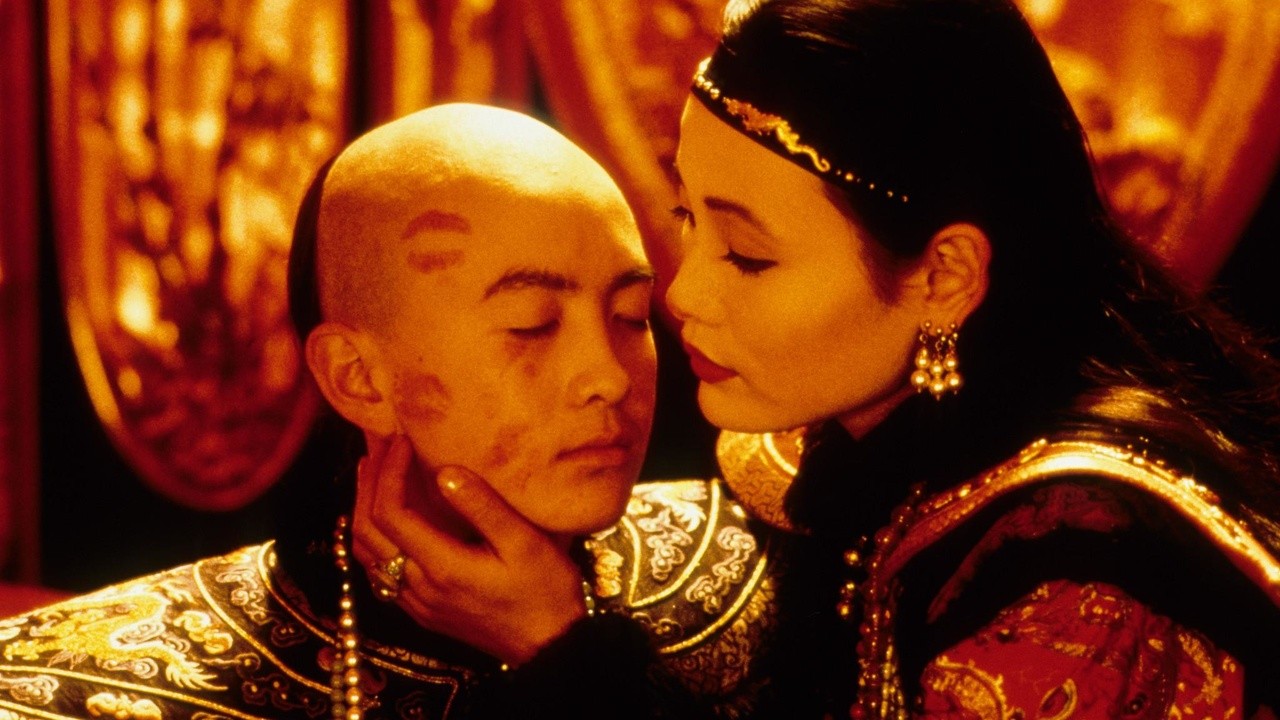
Bernardo Bertolucci’s The Last Emperor won nine Academy Awards, unexpectedly sweeping every category in which it was nominated—quite a feat for a challenging, multilayered epic directed by an Italian and starring an international cast. Yet the power and scope of the film was, and remains, undeniable—the life of Emperor Pu Yi, who took the throne at age three, in 1908, before witnessing decades of cultural and political upheaval, within and without the walls of the Forbidden City. Recreating Ching dynasty China with astonishing detail and unparalleled craftsmanship by cinematographer Vittorio Storaro and production designer Ferdinando Scarfiotti, The Last Emperor is also an intimate character study of one man reconciling personal responsibility and political legacy. —The Criterion Collection
Bernardo Bertolucci proved to be Italian cinema’s great prodigy, making his debut The Grim Reaper at the age of 22, and Before the Revolution at the age of 24; achievements comparable to Orson Welles directing Citizen Kane at the age of 25. He was born in Parma in 1940. He initially followed the footsteps of his father Attilio, a noted poet and critic. His poetry received prizes at competitions and a collection of his work was published while he was still a teenager. But his attention was already diverted to the cinema, especially after viewing Godard’s Breathless. His planned transition from poetry to cinema found an accomplice in fellow poet Pier Paolo Pasolini. A family friend, he regarded Bertolucci as a kindred spirit and tasked him as his assistant on his landmark debut, Accattone. The experience, described by Bertolucci as witnessing “the invention of the cinema” further ignited his own ambitions.
The Grim Reaper was based on a story by Pasolini but the resulting film displayed… read more
Tragedy of a ridiculous man: genealogical snafu in the upheaval of novecento, much less child ruler. Bertolucci finds affinity in the ornate aesthetics of the Forbidden City, and the political intrigue of Republican China. Sumptuous, if a contingent blend of pathos + bathos: the former in the titular study; the other exacerbated by the English language, which but deigns the ersatz production. The tragedy remains most fecund in its elegiac rumination, to which the flashback device accentuates. An engaging canvas, in all its splendor and irony.
This movie redefined the filmic potential of long, billowy cloths and blankets.
A propulsive survey of scores focusing on the thriller: procedurals, bank heists, neo-noirs, spy films, giallos, and sci-fi mind-games.
A look at the later work of the great Polish designer Waldemar Swierzy.
Also: Syrian filmmaker Nidal Hassan arrested. The death and afterlife of film. Bertolucci’s Last Emperor in 3D.
The Last Emperor is an incredibly moving Film about the young emperor of China, Puyi. It follows Puyi throughout his reign, and his entire life, and is portrayed wonderfully by the four different Actors… read review
While the technical aspects of the film are outstanding (cinematography, art direction, costumes etc), the story itself fell flat. The running time is long but there really was not much the director… read review
The grandeur of Storaro’s compositions and the epic story magnificently told by Bertolucci never quite made up for the fact that I just plain didn’t like the main character. I imagine that it is historically… read review
I really Really wanted to like this film a lot more but the grandness that i was expecting to see was not there. The forbidden city felt smaller than a hollywood studio set and i was generally confused… read review