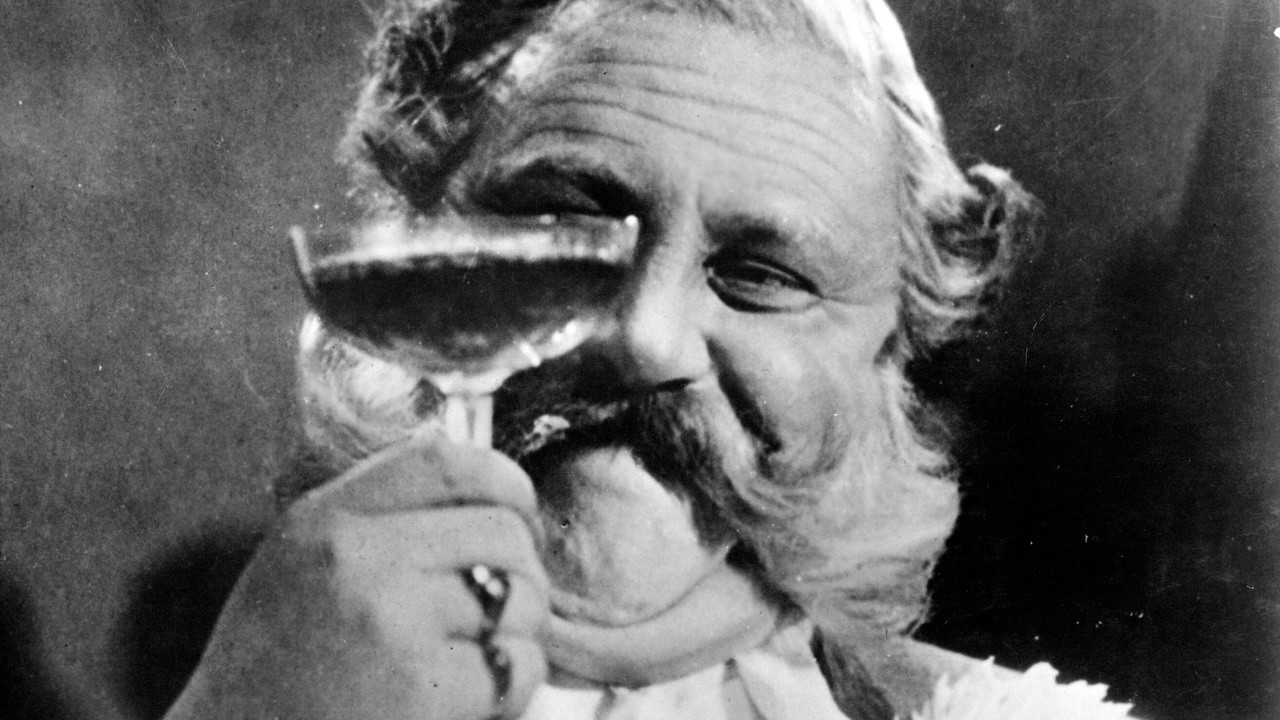
A landmark work in the history of the cinema, Der letzte Mann represents a breakthrough on a number of fronts. Firstly, it introduced a method of purely visual storytelling in which all intertitles and dialogue were jettisoned, setting the stage for a seamless interaction between film-world and viewer. Secondly, it put to use a panoply of technical innovations that continue to point distinct ways forward for cinematic expression nearly a century later. It guides the silent cinema’s melodramatic brio to its lowest abject abyss — before disposing of the tragic arc altogether. The lesson in all this? That a film can be anything it wants to be… but only Der letzte Mann (and a few unforgettable others) were lucky enough to issue forth into the world under the brilliant command of master director F. W. Murnau.
His film depicts the tale of an elderly hotel doorman (played by the inimitable Emil Jannings) whose superiors have come to deem his station as transitory as the revolving doors through which he has ushered guests in and out, day upon day, decade after decade. Reduced to polishing tiles beneath a sink in the gents’ lavatory and towelling the hands of Berlin’s most-vulgar barons, the doorman soon uncovers the ironical underside of old-world hospitality. And then — one day — his fate suddenly changes…
Der letzte Mann (also known as The Last Laugh, although its original title translates to “The Last Man”) inaugurated a new era of mobile camera expression whose handheld aesthetic and sheer plastic fervour predated the various “New Wave” movements of the 1960s and beyond. As the watershed entry in Murnau’s work, its influence can be detected in such later masterpieces as Faust, Sunrise, and Tabu — and in the films of the same Hollywood dream-factory that would offer him a contract shortly after Der letzte Mann’s release. —Eureka Entertainment
To this day German filmmaker F. W. Murnau remains one of the most influential directors of cinema. After studying art and literature history at the University of Heidelberg, he became a student of director Max Reinhardt until serving in World War I as a combat pilot. During a flight, he accidentally strayed into Switzerland and stayed there till the war’s end. He made his directorial debut in 1919 back in Germany; although he made several films over the next three years, most of them have been lost. Murnau first gained international renown with Nosferatu the Vampire in 1922. Unlike others, Murnau filmed this still chilling masterpiece on location. His next film, The Last Laugh (1924), utilized unique camera techniques that later became the basis for mise-en-scene. He continued making German films, notable for their pessimism and pervading sense of doom, until he moved to Hollywood in 1926 to work for Fox studios. His first American film, Sunrise: A Story of Two Humans (1927), is considered… read more
Apart from one studio-imposed instance to set up a climax that divides opinion to this day, Murnau famously foregoes intertitles to tell his simple story of the humiliation of a demoted hotel porter solely through images. With the use of long takes, deep focus photography and fluid camerawork, Murnau's technique astounds. He even makes a success of the finale, turning it into a glorious caricature of a happy ending..
As much as I loved the first 72 minutes of the film, I think I have never hated any ending as much as this one. The camera movement is incredible, using no intertitles is very impressive and I liked Jannings over-the-top acting. Next time that I will watch this great film I will stop after 72 minutes, that should be the real ending !
But then, doesn't he give us an intertitle that in real world the film would have ended there but for studio appeasement he gives Jannings The Last Laugh? So technically for Murnau the film has ended at the point you wanted it to. Within the restrictions of the studio system, I feel Murnau does better than most people could have done. He makes the ending surreal. That's his genius.
I don't get it. All of this because he was demoted from a hotel doorman to a men's room attendant?
As the documentary accompanying the UK DVD release says, 'The Last Laugh is an anti-military parable about the exaggerated importance of uniform", a statement that becomes more apparent when viewed in the greater context of Germany in the 1920s. Though even Murnau joked about the script, saying "everyone knows a washroom attendant makes more money than a doorman". I hope this helps and hope it goes some way to cancelling out the previous commenters silly reaction.
Witnessing Murnau's amazing film technique (for instance: When Jannings gets his demotion letter: the shaky camera to convey his near fainting, the POV camera work) I have to be impressed with him and also be depressed that most narrative filmmaking hasn't progressed that much since then. I don't think Jannings was too over the top given his era's background & the material. The copout ending was only saved by him.
A retrospective of German classics and a showcase of new German talent.
Karl Heinz Martin's Von Morgens Bis Mitternacht (From Morn to Midnight, 1920) comes on like a parody of a German Expressionist classic
Es en “Der Letzte Mann” donde todos los recursos técnicos de Murnau llegan, finalmente, a lugares insospechados. Aca están todas las herramientas que harían del cine, a posteriori, la invención mas… read review