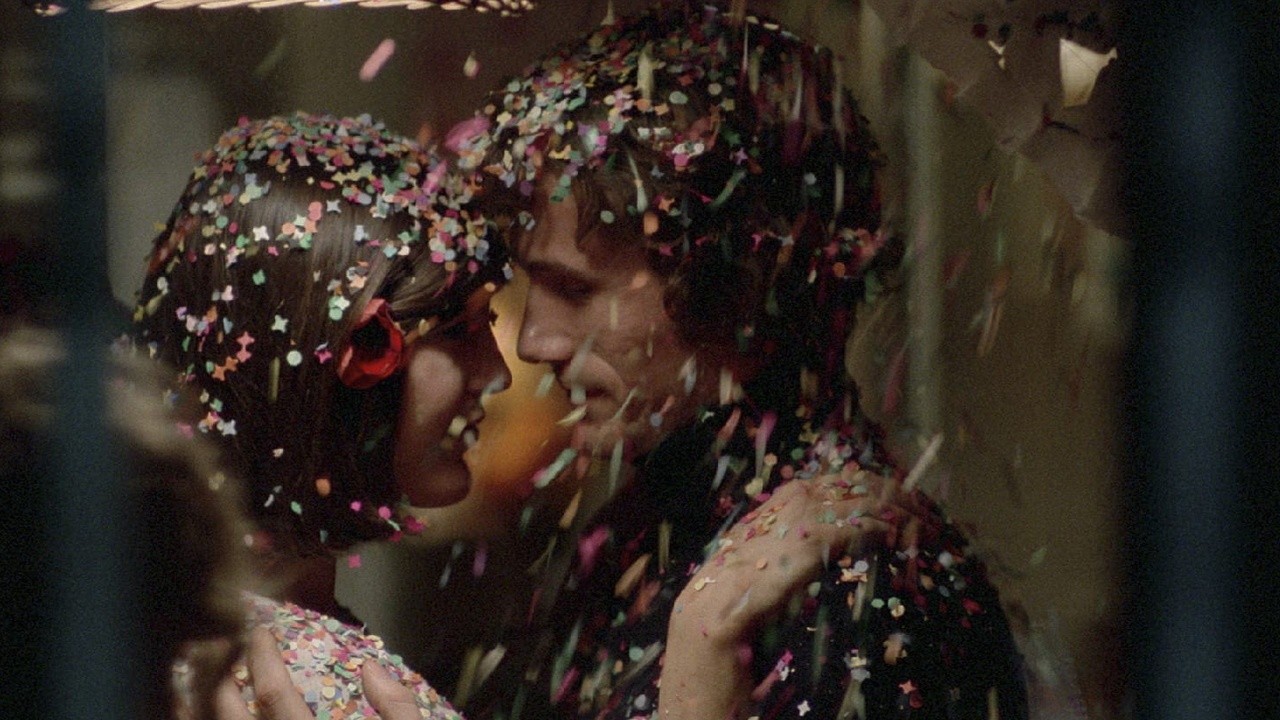
When Katharina Blum spends the night with an alleged terrorist, her quiet, ordered life falls into ruins. Suddenly a suspect, Katharina is subject to a vicious smear campaign by the police and a ruthless tabloid journalist, testing the limits of her dignity and her sanity. Volker Schlöndorff and Margarethe von Trotta’s powerful adaptation of Heinrich Böll’s novel is a stinging commentary on state power, individual freedom, and media manipulation––as relevant today as on the day of its release in 1975. —The Criterion Collection
Volker Schlöndorff (born 31 March 1939 in Wiesbaden, Germany) is a Berlin-based German filmmaker.
He won an Oscar as well as the Palme d’or at the Cannes Film Festival for The Tin Drum (1979), the film version of the novel by Nobel Prize-winning author Günter Grass.
Schlöndorff has adapted many literary works for his movies, including some critically well-received US productions, but he is also engaged in post-war German politics. He served as the chief executive for the UFA studio in Babelsberg. Volker Schlöndorff also teaches film and literature at the European Graduate School in Saas-Fee, Switzerland, where he conducts an Intensive Summer Seminar.
He was married to fellow film director Margarethe von Trotta from 1971 to 1991. —Wikipedia
Margarethe von Trotta (born 21 February 1942, Berlin) is a German film director and a member of the New German Cinema movement.
The child of Elisabeth von Trotta and painter Alfred Roloff, she relocated to Paris in the 1960s, where she worked for film collectives, collaborating on scripts and co-directing short films.
In her early career, von Trotta was an actress, appearing in notable films of directors Fassbinder and Volker Schlöndorff. In 1971, she divorced her first husband to marry Schlöndorff. A few years later she presented her first feature film.
Von Trotta, often featuring prominent female characters, has become the foremost female director working in Germany. She is a Professor of Film at the European Graduate School in Saas-Fee and remains an important personality of German cinema. Von Trotta and Schlöndorff split in 1991. —wikipedia
In meiner kleinen Welt bekam ich nach diesem Film richtig Lust auf Blutiger Freitag, ohne den zu kennen.
The epilogue, featuring a newspaper editor's near-fascist rant about defending 'freedom of speech' and 'diversity of opinions' begs the question: is invading into people's private lives and robbing them of their honour 'freedom of speech'? A brilliant film everyone should see.
A West Germany every bit as police state and surveillance heavy as East Germany. The police invade your private life on the pretext of stopping anarchy or communism (instead of the East's anarchy and capitalism), and the press destroys you individually by using freedom of press (instead of the individual you being destroyed by the lack thereof). This is a very dry and unsubtle satire. --PolarisDiB
The disturbing story of a young woman who is wrongly accused of helping a terrorist and who then becomes a target of vicious attacks by the gutter press marked the directorial debut of von Trotta. This intelligent and menacing film was co-directed by her then-husband Schlondorff and is an angry denunciation of the tactics used by a news-hungry press. Winkler is excellent as the shy young woman whose life is ruined...
She’s been called “narrative cinema’s foremost feminist filmmaker,” but of course, she’s also simply a great director.
The renowned editor worked with Wenders, Syberberg, Schlöndorff, Lemke and Karmakar.
This is New German Cinema at its best. Ah, it’s been a while since I’ve seen such a provocative film. It makes me want to scream at society, and the press who dig up all kinda stuff once they have… read review