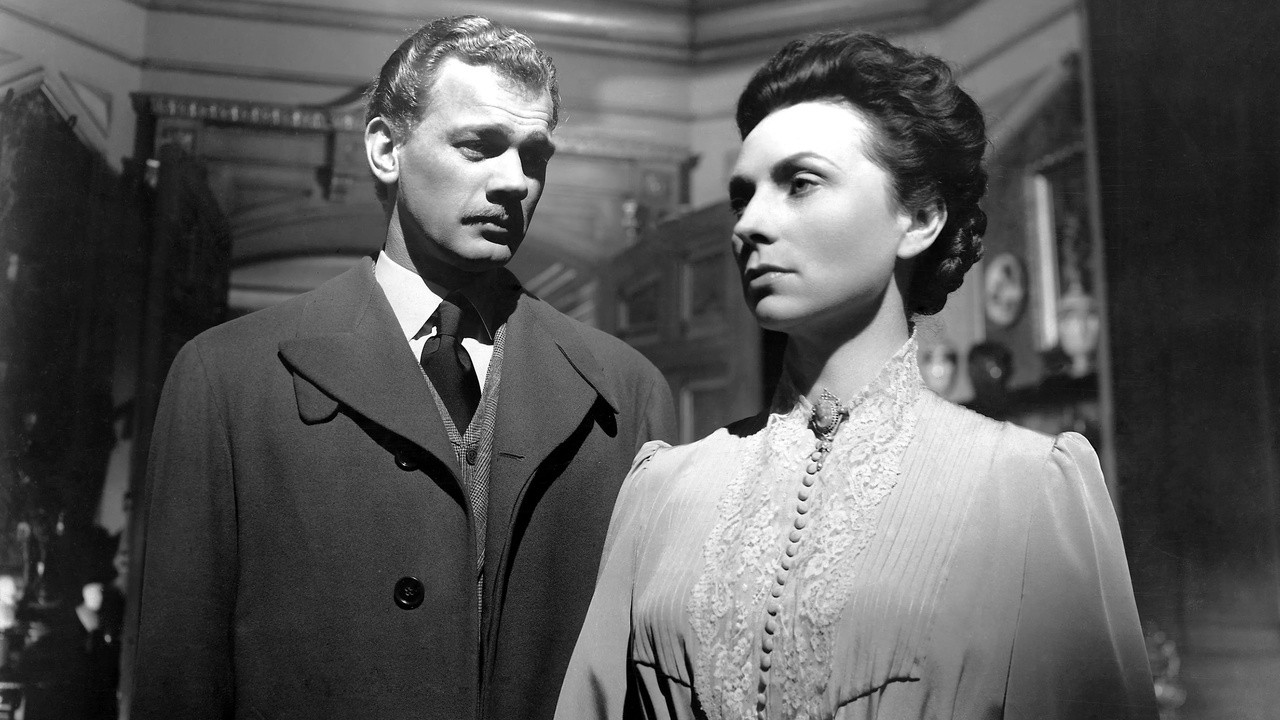
The young, handsome, but somewhat wild Eugene Morgan wants to marry Isabel Amberson, daughter of a rich upper-class family, but she instead marries dull and steady Wilbur Minafer. Their only child, George, grows up a spoiled brat. Years later, Eugene comes back, now a mature widower and a successful automobile maker. After Wilbur dies, Eugene again asks Isabel to marry him, and she is receptive. But George resents the attentions paid to his mother, and he and his wacko aunt Fanny manage to sabotage the romance. A series of disasters befall the Ambersons and George, and he gets his comeuppance in the end. —TCM
The prodigy son of an inventor and a musician, Welles was well-versed in literature at an early age, particularly Shakespeare, and, through the unusual circumstances of his life (both of his parents died by the time he was 12, leaving him with an inheritance and not many family obligations), he found himself free to indulge his numerous interests, which included the theater. He was educated in private schools and traveled the world. He found it tougher to get onto the Broadway stage, and get a job with Katharine Cornell. He later became associated with John Houseman, and, together, the two of them set the New York theater afire during the 1930s with their work for the Federal Theatre Project, which led to the founding of the Mercury Theater. The Mercury Players later graduated to radio, and their 1938 “War of the Worlds” broadcast made history when thousands of listeners mistakenly believed aliens had landed on Earth. In 1940, Hollywood beckoned, and Welles and company went west to… read more
One of the most successful directors of the 1960s, when he became an efficient maker of epic-length pictures, Robert Wise is one of Hollywood’s few popularly recognized filmmakers. He joined RKO in the 1930s as a cutter and eventually became one of the studio’s top editors, working in this capacity on classics such as The Devil and Daniel Webster (1941), Citizen Kane (1941), and The Magnificent Ambersons (1942). He became a director with help from producer Val Lewton, who assigned Wise to finish Curse of the Cat People (1944), a B-movie that had fallen behind schedule, and the resulting picture proved extremely haunting and enduring. Wise later directed The Body Snatcher (1945) for Lewton, but after the producer left RKO, he found himself locked into B-movies. His 1948 psychological Western Blood on The Moon, starring Robert Mitchum, and the acclaimed boxing drama The Set-Up (1949) were the only two important pictures that Wise got to do during his last four years at the studio. Wise… read more
As Quinton said, Style over substance. The good thing about Welles is the way he knows how to substitute the literary stuff with the cinematographic one. I knowWelles disliked to shot "easy" elements, such as deaths, accidents, sex; so I didn't actually felt bad when George had an accident and we didn't "saw" it, since the peaceful yet conclusive scene next, at the hospital fit pretty well.
Wanted to watch again straight after it finished. Will never forgive RKO for losing all the lost footage.
A hundred years from now or in an alternate reality the original version will be found. Until then we have a pretty good movie that, like The Leopard, shows the downfall of aristocracy in a sad sort of way.
A joshing jab at the great auteur in the English adaptation of Red Rackham’s Treasure.
The Bernard Herrmann centennial is the occasion for a two-week, 22-film retrospective.
Also: Michael Sragow semi-retires, ohn Calley dies and Slate binges on Welles and Soderbergh.
1. We usually write about movies we’ve seen, of course, but if you care deeply about film, you know that some of our most intense cinematic
Someone to Remember (1943) is a Robert Siodmak film so obscure even Deborah Lazaroff Alpi, author of the near-definitive R.S. overview Robert
Norman Rockwell, America’s most beloved illustrator, purveyor of sentimental, small-town kitsch, preserver of American pieties, is undergoing
Orson Welles’ sophomore feature is really a chore to sit through. It’s hard to say how much Welles was responsible, or how much was the result of studio mangling – pompous and pretentious, it’s alternately… read review