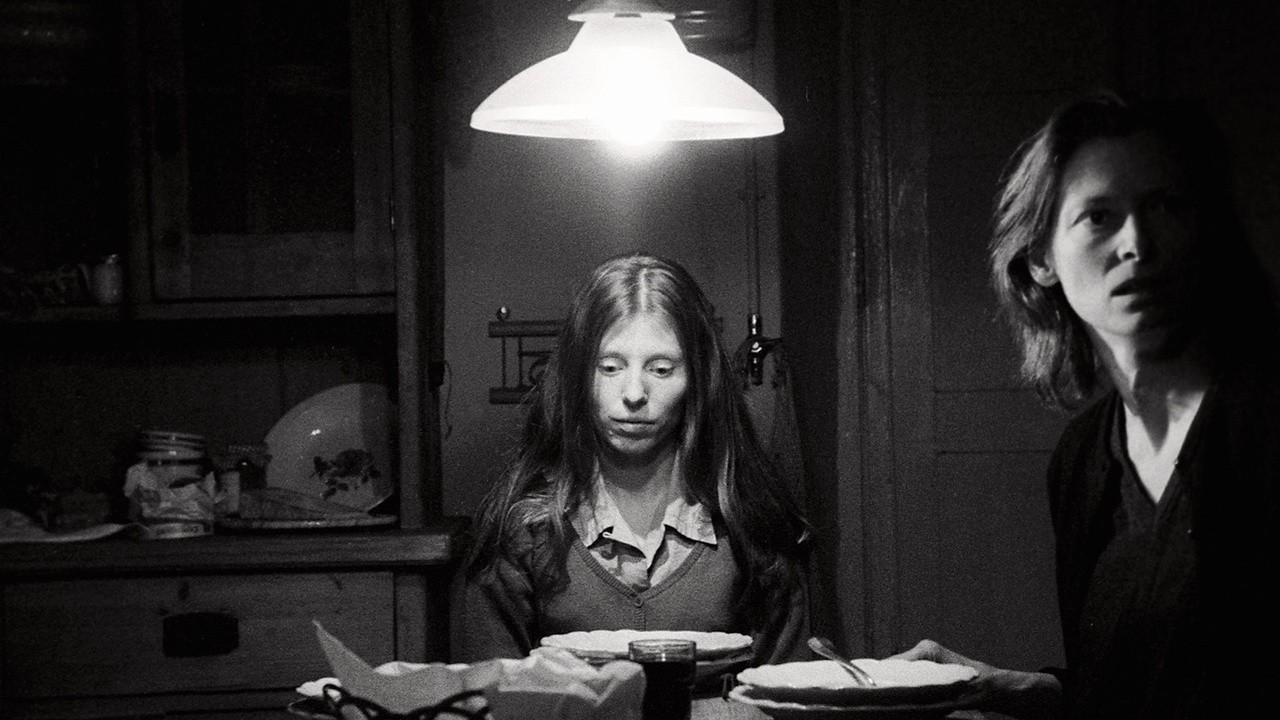
One night Maloin, a switchman at a seaside railway station situated by a ferry harbour, witnesses a terrible event. He is just watching the arrival of the last ferry at night from his control room on top of a high iron traverse from where he can see the whole bay. Suddenly he notices that the first of the disembarking passengers, a tall thin figure (a certain Brown as it will turn out later) leaves the harbour, but not on the usual route: after getting through customs, he goes around the dock and then withdraws into a dark corner, waiting. Opposite him, in front of the ship, another man soon appears and throws a suitcase towards the man on the shore. He goes and picks it up, then waits in an even darker corner for the other man to join him. When he arrives, however, they begin to quarrel and finally, in the course of the vehement fight, due to a hit that turns out to be fatal, the shorter one falls in the water and sinks, clutching the suitcase in his hand. Maloin is watching the scene, astonished. Finally, in a state of fear and shock, he opens the door of his control room, but the sharp and loud creaking sound disturbs and frightens away the murderer. Brown is forced to flee before being able to fish out the suitcase from the water. After the murderer disappears down one of the streets behind the harbour, Maloin cautiously climbs down from his cabin to the shore. When he realises that there is nothing he can do for the victim, he dredges up the suitcase. He takes it up to his control room and opens it: it is packed with money. He is dazzled. He does not go either to call the police or fetch the murderer; he just stares at the pile of money. He simply cannot believe his eyes. Then, after meticulously drying and counting the banknotes, he hides the suitcase in his closet and locks it. At dawn, when his colleague arrives, he acts as if nothing had happened. He returns home on his usual route. Nevertheless, this path is not the same anymore. —IMDb
Born in 1955, Hungarian filmmaker Bela Tarr began making amateur films at the age of 16, later working as caretaker at a national House for Culture and Recreation. His amateur work brought him to the attention of the Bela Balazs Studios (named in honor of the Hungarian cinema theorist), which helped fund Tarr’s 1979 feature debut Family Nest, a work of socialist realism clearly influenced by the work of John Cassavettes. The 1981 piece The Outsider and the following year’s The Prefab People continued in much the same vein, but with a 1982 television adaptation of Macbeth, his work began to change dramatically; comprised of only two shots, the first shot (before the main title) was five minutes long, with the second 67 minutes in length. Not only did Tarr’s visual sensibility move from raw close-ups to more abstract mediums and long shots, but also his philosophical sensibility shifted from grim realism to a more metaphysical outlook similar to that of Andrei Tarkovsky. After 1984’s… read more
Reliably ravishing, and with as glacially portentous an opening as one could possibly wish for, The Man From London is nevertheless the least successful of Tarr's major works, a film in which neither Simenon, nor Krasnahorkai, nor Tarr himself is sounded to his depths. An impeccable exercise in style all the same, with at least one never/always-ending shot -- down the alley in which Henriette works, the boy kicking a soccer ball between the walls, the camera creeping towards the sky -- that burned into this viewer’s memory and seems likely to stay there.
the movie is very, very slow, it sucks the life out of you. watched 20 minutes and gave up.
While his tradmark long takes, B & W shot, & extreme closeups of people looking desolate remain, this is different from earlier Tarr. There's a comparatively easy to follow plot, Noir genre influence,& political subtext. The actor that played the old intimidating guy was great (I was tense whenever he was on screen) as was everybody. Last 20 min was really intense. I don't get people that think this is a minor work.
Also: Theo Angelopoulos, Alberto Lattuada and Jean-Pierre Gorin on DVD.
When word first emerged, seemingly shortly after the dawn of the aughts, of a new Bela Tarr project—to be made, as all of his post-Satantango
I understand that most people hate this film because it moves so slowly. It might actually move slower than any other movie ever made. I don’t care. I LOVE THIS FILM!!! This epic masterpiece reveals… read review