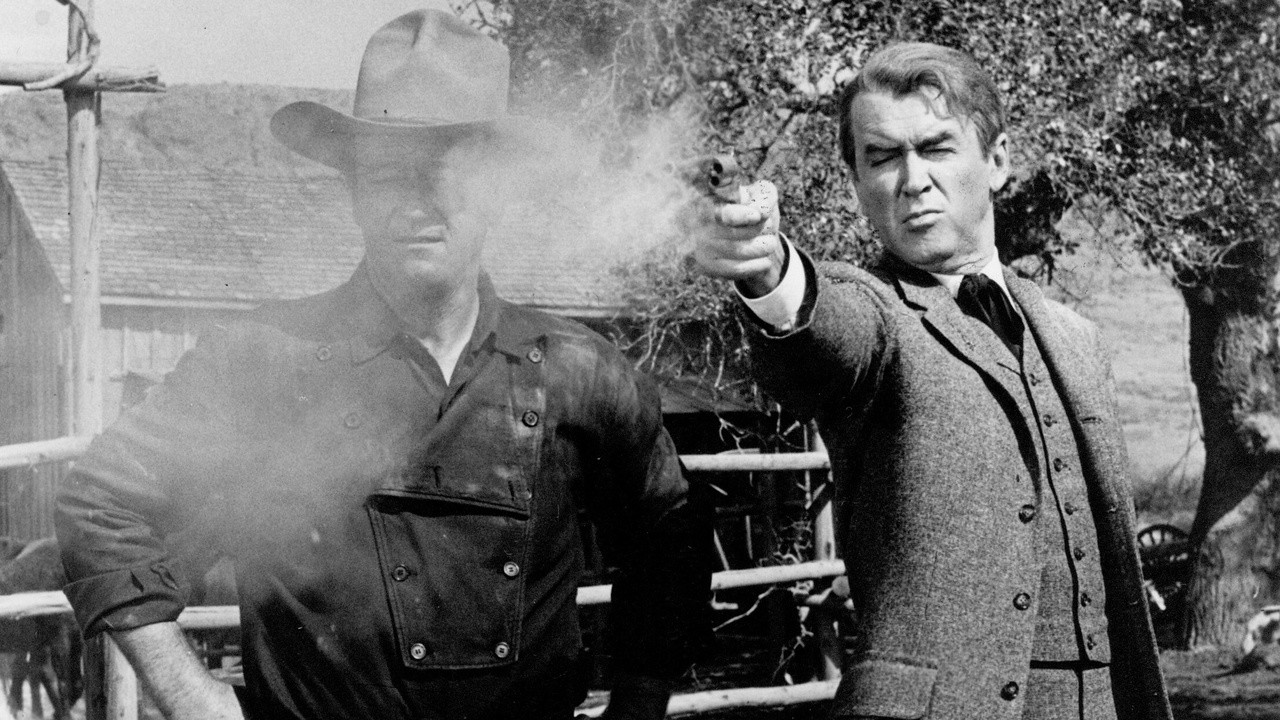
In 1910, Sen. Ranse Stoddard and his wife, Hallie, arrive in the small town of Shinbone to attend the funeral of Tom Doniphon. A reporter questions him about his unannounced appearance, and Ranse tells about his early days as a young lawyer in Shinbone, when he opposed the ruthless rule of Liberty Valance, a notorious gunfighter. The only other two men in the town who were unafraid of the outlaw were Dutton Peabody, a drunken but courageous newspaper editor, and Tom Doniphon, a respected rancher in love with Hallie, who was then a young waitress. Valance became outraged when Ranse was elected delegate to a territorial convention and taunted him into a duel. Hallie knew that Ranse could not handle a gun and pleaded with Tom to save Ranse; but Tom, sick of Ranse’s foolhardy bravery, refused. Late one night, Ranse and Valance faced each other on the darkened main street of the town. Several shots were fired, and although Ranse was wounded, Valance was the one who lay dead. Ranse became known as “the man who shot Liberty Valance” and was nominated to run for Congress. Unable to face a career built on a killing, he decided to refuse the nomination. Tom then appeared and confessed that it was he who, out of love for Hallie, fired from the shadows that night. Tom, in effect, became Ranse’s conscience, the force that carried him to the U. S. Senate and a brilliant career in Washington, while Tom died a pauper. Ranse’s story finished, the reporter decides not to print it because in the old West the legend had become fact. —Turner Classic Movies
Maine-born John Ford (born Sean Aloysius O’Fearna) originally went to Hollywood in the shadow of his older brother, Francis, an actor/writer/director who had worked on Broadway. Originally a laborer, propman’s assistant, and occasional stuntman for his brother, he rose to became an assistant director and supporting actor before turning to directing in 1917. Ford became best known for his Westerns, of which he made dozens through the 1920s, but he didn’t achieve status as a major director until the mid-‘30s, when his films for RKO (The Lost Patrol 1934, The Informer 1935), 20th Century Fox (Young Mr. Lincoln 1939, The Grapes of Wrath 1940), and Walter Wanger (Stagecoach 1939), won over the public, the critics, and earned various Oscars and Academy nominations. His 1940s films included one military-produced documentary co-directed by Ford and cinematographer Gregg Toland, December 7th (1943), which creaks badly today (especially compared with… read more
https://www.facebook.com/motion.picture.317 do visit our page about motion pictures on fb for classics of cinema and great films
A film buff's dream: John Ford. John Wayne. Jimmy Stewart. Lee Marvin. Such a brutal illustration of modernity's struggle and inevitable rise, as well as the evolution of national consciousness. A jewel in John Ford's crown.
This week: two major film magazines unveil their new issues, Adam Nayman reveals why Jaws is the “greatest movie ever made”, and more…
’ But I was so much older then, I’m younger than that now’
Bob Dylan
John Ford was dismissive of filming… read review