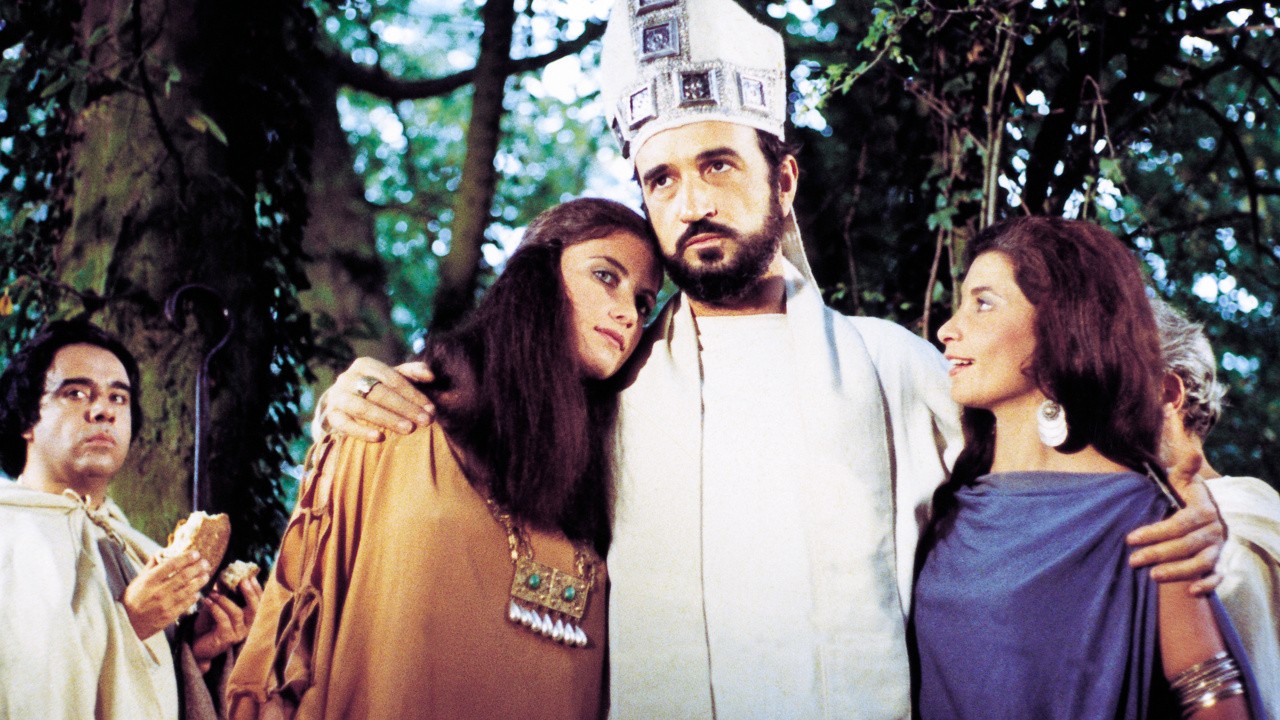
The first of what Luis Buñuel later proclaimed a trilogy (along with The Discreet Charm of the Bourgeoisie and The Phantom of Liberty) about “the search for truth,” The Milky Way (La voie lactee) daringly deconstructs contemporary and traditional views on Catholicism with ribald, rambunctious surreality. Two French beggars, present-day pilgrims en route to Spain’s holy city of Santiago de Compostela, serve as Buñuel’s narrators for an anticlerical history of heresy, told with absurdity and filled with images that rank among Buñuel’s most memorable (stigmatic children, crucified nuns) and hilarious (Jesus considering a good shave). A diabolically entertaining look at the mysteries of fanaticism, The Milky Way remains a hotly debated work from cinema’s greatest skeptic. —The Criterion Collection
Sent off for a Jesuit education by his prosperous Spanish parents, Luis Buñuel went on to attend the University of Madrid, where he first became interested in the burgeoning European film industry. Upon graduating from Paris’ Academie du Cinema, his first movie job was as an assistant to French-based directors Jean Epstein and Mario Nalpas. In partnership with an old friend, Spanish painter/sculptor Salvador Dali, Buñuel put together the three-reel surrealist masterpiece Un Chien Andalou (1928), the film that features dead donkeys on a piano, a razor slashing an eyeball, and other deliberately shocking images that cineastes have either praised or damned for the past seven decades.
Buñuel’s first feature film, L’Age d’Or, was banned from public exhibition almost immediately from the moment of its 1930 premiere; its principal opponents were high-ranking members of the Catholic church, who condemned the film as savagely sacrilegious. After 1932’s Land Without Bread, an uncompromising… read more
A picaresque decimation of religious myth and mythology, fanaticism and piety. Unleashing his characteristic blend of mordant wit and ribald humor, Buñuel strikes a fatal blow on behalf of skeptics, atheists, and so-called heretics everywhere, forever securing his place in the annals of rationality.
At once oblique and instinctively cogent, closing a defining decade in the great director's career––in fact, one of the greatest in any filmmaker's––and preluding what would be the next chapter in his fruitful oeuvre, his self-described trilogy in "the search for truth." The Milky Way––precise; exacting; casually and gleefully profane––is the work of a master in rare form, gallantly exposing the artifice of religious doctrine.
The Milky Way is Bunuel pointing out what catholics actually believe or at least are required to believe to qualify as catholic. That he does it in a sympathetic way, with love for the characters involved… read review