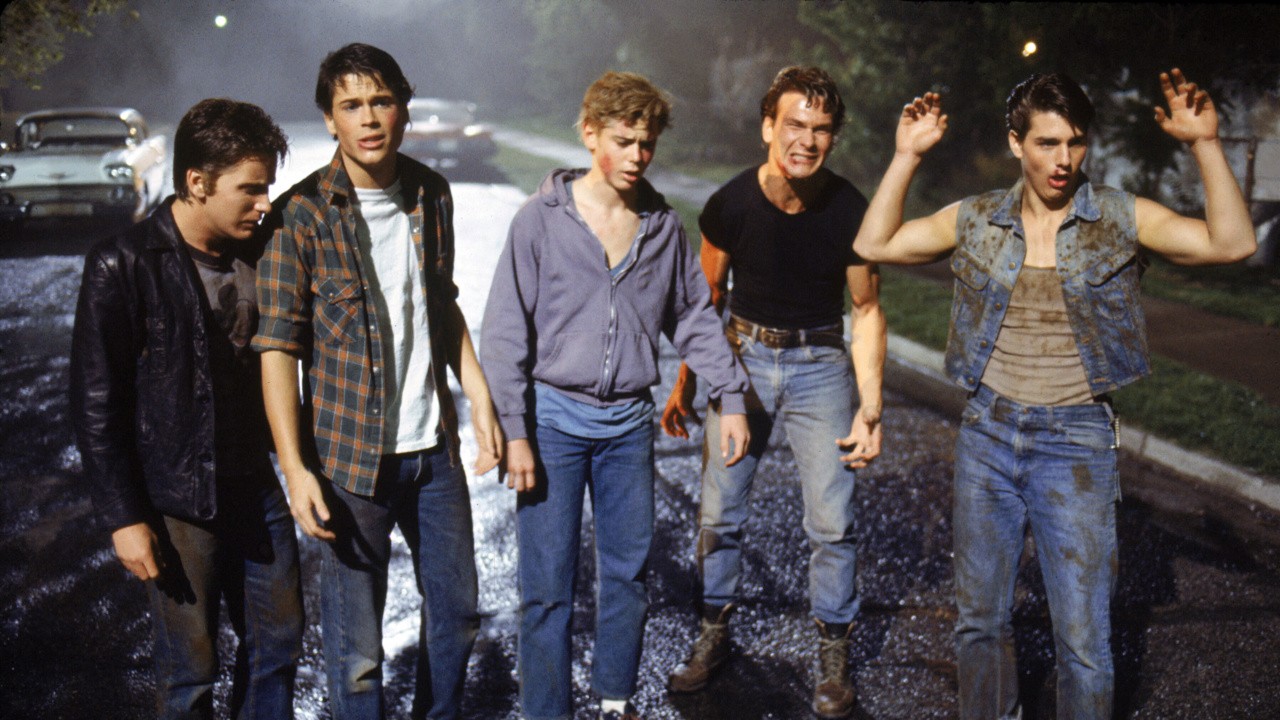
The tension between two groups: The Greasers and The Socials “Socs” puts Ponyboy Curtis and his best friend Johnny Cade in a bad spot. One night at the movies, Ponyboy and Johnny fall in love with Sherri “Cherry” Valance and Marcia – once they get Dally Winston, the toughest and meanest of the Greasers to stop attempting to “score” with the girls. Cherry and Marcia are from the snobbish, popular, and rich group, the Socs. —IMDb
He was born in 1939 in Detroit, USA, but he grew up in a New York suburb in a creative, supportive Italian-American family. His father was a composer and musician Carmine Coppola. His mother had been an actress. Francis Ford Coppola graduated with a degree in drama from Hofstra University, and did graduate work at UCLA in filmmaking. He was training as assistant with filmmaker Roger Corman, working in such capacities as soundman, dialogue director, associate producer and, eventually, director of Dementia 13 (1963), Coppola’s first feature film. During the next four years, Coppola was involved in a variety of script collaborations, including writing an adaptation of This Property is Condemned, by Tennessee Williams (with Fred Coe and Edith Sommer), and screenplays for Is Paris Burning?, and Patton, the film for which Coppola won a Best Adapted Screenplay Academy Award. In 1966, Coppola’s 2nd film brought him critical acclaim and a Master of Fine Arts degree. In 1969, Coppola and George… read more
Watching "The Complete Novel" version of the film made me have a change of heart. What I used to think of as an overtly-sentimental and sappy wannabe rebel film became, with a change of music and extended sequences, an entirely different and much more satisfying picture. That Coppola pays such delicate attention to his visuals, enhancing the small with melodrama, helps play into making it a moving experience.
Coppola’s portrait of adolescent identity never seems to go beyond the abstract, dare I say the superficial in its characterisations. But it has two things working for it: the uncanny assortment of baby-faced, then-Hollywood up-and-comers in its cast, and the unpredictable, albeit restrained form that Coppola conjures up; the variety of stylised music and visual cues more broadly being a stepping stone to the more radical Rumble Fish, I suspect. While none of it builds up to a resonant whole, it remains an intriguing effort, if never quite a successful one.
I remember reading the book and watching the film for my freshman or sophomore year in high school...found it rather too grandiose and fanciful even for my age then. I do prefer Rumble Fish (which I saw, incidentally, on a "sick" day off from school), in both story and style, for it is certainly Coppola's better stab at S.E. Hinton.
When I watched the original version of the film on VHS years ago, I had no response to it. Found it grating and quite cheesy - Coppola's "Gone with the Wind" choice in music annoyingly clashing with the work on hand. When I got around to watching the extended "Complete Novel" version of the film with the alternate soundtrack? The film works in a more beautiful, astute way. It moved me to the core and is now a fave!
Coppola’s talent behind the camera is undeniable. I particularly like Ponyboy’s memoirs at the theater after he sees “the hustler” and the “nothing gold can stay” moment with his partner Johnny.
read review