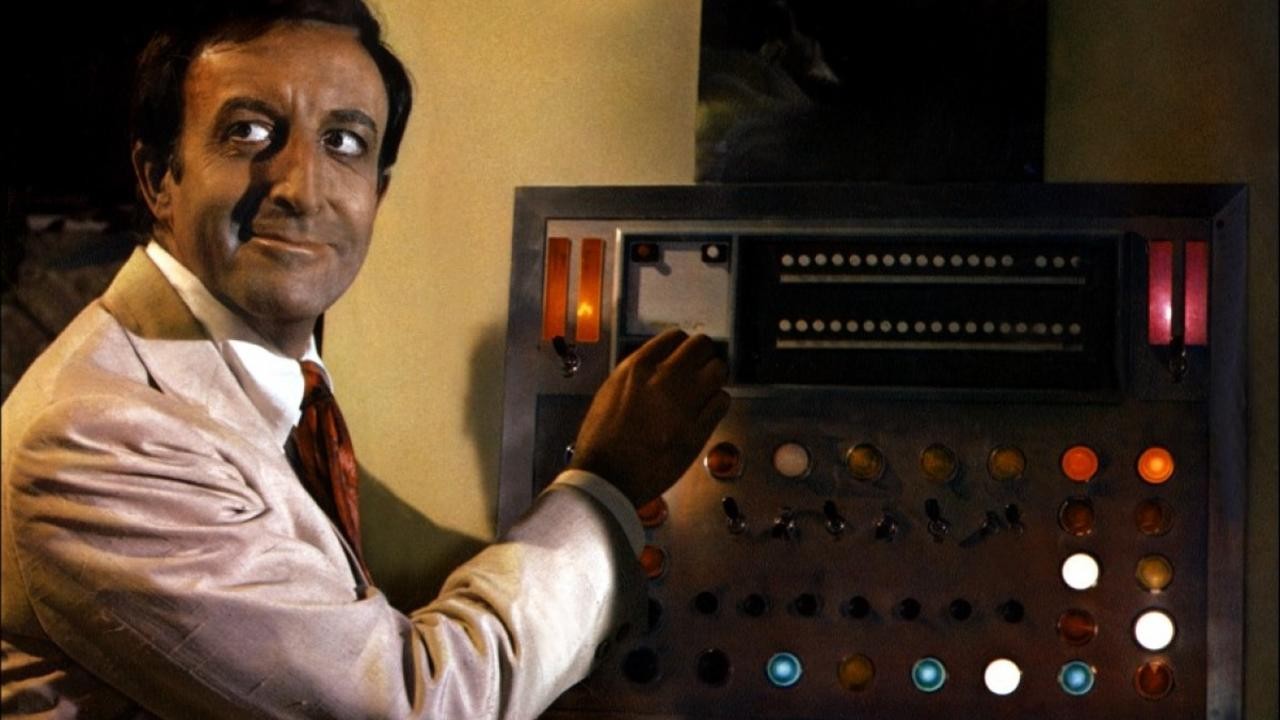
Bakshi is working as an extra in a film but his ability to ruin everything around him causes him to destroy the set that he’s working on. The director is enraged and lets his boss at the studio know that it’s all Bakshi’s fault. The studio boss quickly scrawls Bakshi’s name down on a piece of paper so he can get him fired but is called away before he gets a chance to do it. His secretary asks for the guest list for a party which just happens to be on the same paper where he had written Bakshi’s name. Now Bakshi is getting an invitation to a huge party hosted by the same man who wanted him fired.
The movie can be a little slow to start and the really good laughs don’t start to kick in until Bakshi has arrived for the party. At first he’s the reason behind all the problems for the party guests. He loses his shoe in a little waterfall in the house, plays havoc with a switches that control everything from a loudspeaker to the moving bar and tries to be friends with a bird by feeding him his birdie num nums (my personal favorite joke from the film). You can’t help but feel bad for Bakshi as he seems to annoy the other guests and can’t seem to find anyone that will even speak to him. As the party wears on and the alcohol is flowing freely, it’s the other guests that start to become annoying and causing even more problems than Bakshi ever could have.
Eventually Bakshi finds a friend at the party. Michele Monet is an aspiring actress who shows up with the same director whose film Bakshi had destroyed earlier. Both Monet and Bakshi seem to be out of their element and form a friendship as the only two people at the party who don’t seem to be insane in some way. By the end of the film it’s Bakshi who is in the middle of all the trouble instead of being the one who caused it all. Along the way it’s a hilarious journey of slapstick comedy and subtle jokes. —The-filmreel.com
Blake Edwards’ stepfather’s father J. Gordon Edwards was a silent screen director, and his stepfather Jack McEdwards was a stage director and movie production manager. Blake acted in a number films, beginning with Ten Gentlemen from West Point (1942) and wrote a number of others, beginning with Panhandle (1948) and including six for director Richard Quine. He created the popular TV series “Peter Gunn” (1958), “Mr. Lucky” (1959) and “Dante” (1960). He directed a diverse body of films, from comedies to dramas to war films to westerns, including such pictures as Operation Petticoat (1959), Breakfast at Tiffany’s (1961), Experiment in Terror (1962), Days of Wine and Roses (1962), The Pink Panther (1963) and A Shot in the Dark (1964). After The Great Race (1965) he began fighting with studios. In England he surfaced again with The Return of the Pink Panther (1975), then went back to Hollywood and a real hit, 10 (1979). Victor Victoria (1982) won him French and Italian awards for Best Foreign… read more
so offensive i've never managed to sit through it. can i really be the only person who feels this way??
yeah it's interesting, because a lot of fairly intelligent people give him a pass saying "We did not mind because he spoke the language and something about him was okay in the way that it was okay for Peter Sellers to do it in The Party7. It was affectionate. Peter Sellers loved India and Michael Bates loved India, he spoke Hindi and I think you can just tell. The blacking-up does not become a prop; it’s not part of the joke, it’s just something they have to do because they happen to be the best actors to play the part. When the blacking-up is a prop, and made to look like a joke, like in Curry and Chips for instance, then yes, I object to it, though I love Spike Milligan8. But it is silly blacking-up really." (http://lisa.revues.org/664)
it even showed up in our recent mubi poll of 20 greatest films. and people criticized me for voting it down :\ i told them exactly what i thought, of course :P
I love movies that do not have a plot. This is why I love this one despite the unnecessary gags that have been used only to fill the 99 min, only few times they worked well. The two lonely characters and the drunk waiter had more to follow than what we have seen. And this is the only thing that remains after the movie ends. Gags evaporate.
The exhibition More Than That: Films by Kevin Jerome Everson opens today at the Whitney Museum of American Art in New York and will be on view
In places, Blake Edwards’s 1968 comedy is like a slicker version of Tati’s great “Playtime,” with Peter Sellers’s hapless outsider bumbling his way through an elaborate, expensive Hollywood home with… read review