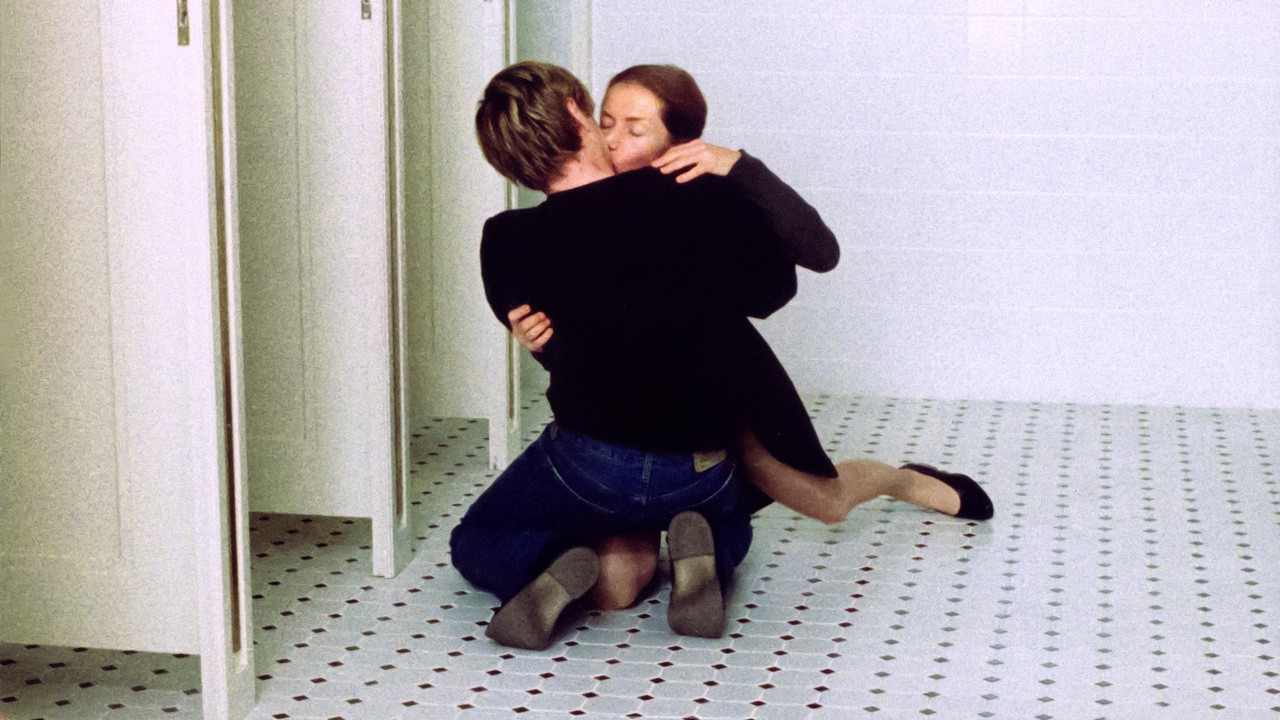
Isabelle Huppert gives a performance of astounding emotional intensity as Erika Kohut, a repressed woman in her late thirties who teaches piano at the Vienna Conservatory and lives with her tyrannical mother (Annie Girardot), with whom she has a volatile love-hate relationship.
But when one of Erika’s students, the handsome and assured Walter Klemmer (Benoît Magimel), attempts to seduce her, the barriers that she has carefully erected around her claustrophobic world are shattered, unleashing a previously inhibited extreme and uncontrollable desire.
Cheerfully wishing his audience a “disturbing evening” at a London retrospective of his films, director Michael Haneke insists that he is an optimist at heart, despite all of the relentlessly bleak carnage and deeply disturbing imagery so vividly painted and seared into the mind of anyone who has had the uncomfortable experience of viewing his work.
Practically born into show business, to an actress mother and director father, in Munich in March 1942, Haneke spent his early years in a working class suburb of Vienna before an early attempt at fame as an actor and pianist. Failing to achieve early success, Haneke attended the University of Vienna to study philosophy and psychology, and became a film critic and stage director before making his eventual debut as a television director with After Liverpool in 1973. Setting in motion a television career specializing in literary adaptations and small screen films, Haneke would work successfully in that medium until his feature debut… read more
Another European arthouse film of-the-'90s, with careful dialogues, long shots and - the usual magic touch - a series of sudden, unexplicable, shocking events QUIETLY happening on the screen. Fact is that your eyes are glued to the things you are watching. And you think, a lot. Almost feeling Haneke smiling in the dark, as he acknowledges how well he is playing with you. Unsettling, disturbing, untolerable as usual.
Haneke's usual misanthropy & reductive fantasy of the Homo Raptor, the everyman who will kill, rape, torture at the clack of the director's clapperboard is attenuated by Huppert's vulnerability & the dialectic of pride vs debasement. I usually find this director's worldview laughably simplistic & repellent (the aesthetics of all men as potential rapists is one thing. What will its politics be?) but this was bearable
I thought that this film was disgusting, but still utterly engrossing. Even though Walter and Erika's relationship was much more intense, it was very easy for me to relate to Erika's pain. I feel like the movie truly captured the emotions involved in superficial infatuations. Despite Erika's pain, it was still difficult to hate Walter. After watching this film I felt I had a better understanding of male perspective.
I hope you dont think all men are like Walter and so his perspective is the male perspective!! I assure you that isnt the case.
Also: New essays up at the Chiseler; and there’s a new book out, Gary Cooper: Enduring Style.
"Annie Girardot, the perky, gravely-voiced actress who became one of France's most acclaimed stars, has died," reports the AP. "She was 79
Michael Haneke is one of the best directors of modern day cinema. He understands how to make films that affect the audience on a deep, humane level like no other auteur. The relationship between the… read review
The Piano Teacher is probably my favorite Haneke film, but really doesn’t say much since this is the third film by him that I have seen. Regardless, Haneke is certainly an interesting figure in contemporary… read review
I always used to think Haneke’s films were unpleasant until I encountered this film. This one was also disturbing like his other films, but I found it much easier to sympathise with the main character… read review