MUBI brings you a great new film every day.  Start your 7-day free trial today!
Watch a new film every day for $4.99.
Try MUBI for FREE.
 

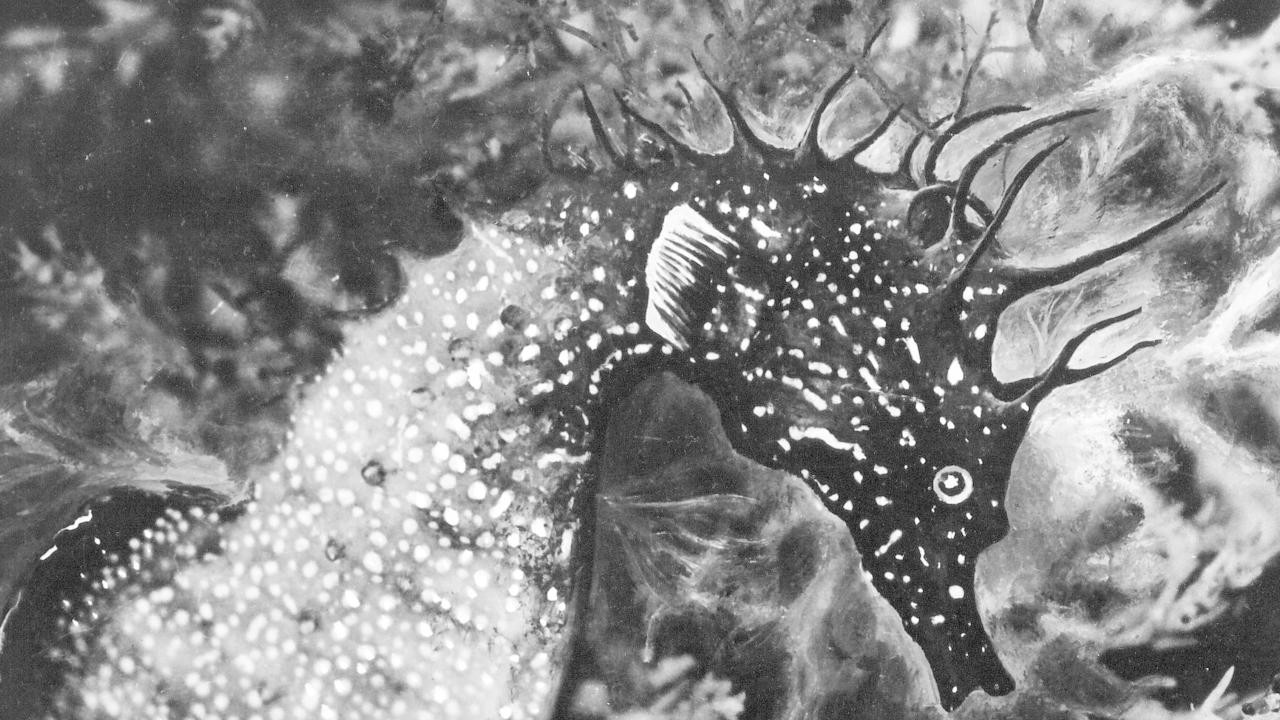
The Sea Horse

L'hippocampe ou “cheval marin”

France

1934

14 Min
Black and White
French
  • Currently 4.3/5 Stars.
  • 1
  • 2
  • 3
  • 4
  • 5

   |   

DIR Jean Painlevé

PROD Jean Painlevé

DP André Raymond

MUSIC Darius Milhaud

Synopsis

The sea horse is the only vertical fish. The male sea horse has a pouch into which the female lays her eggs and which surrounds these with a network of arterioles and veins which feeds the embryos. After approximately thirty days, the male undergoes a genuine form of childbirth, with contractions of the pouch to expel the embryos. – I did my first underwater filming with a small waterproof box which could hold a 35 mm camera. It was called a “Seven” because the film was seven meters long. So we only had a few seconds time before we needed to resurface to reload the camera. – This took place at Arcachon. The crew of the station turned the wheel which sent air down to the mask of the diving suit I was wearing. The goggles were pressing onto my eyes, which, at a given depth, triggers an acceleration of the heart by oculo-cardiac reflex. But what bothered me most was that at one point I was no longer getting any air. I rose hurriedly to the surface, only to find the two seamen quarreling about the pace at which the wheel should be turned. —JP

Director

Original

Jean Painlevé

Jean Painlevé (20 November 1902 – 2 July 1989) was a film director, actor, translator, animator, critic and theorist. He was the son of mathematician and twice prime-minister of France, Paul Painlevé.

Painlevé first came to the cinema as an actor, alongside Michel Simon, and also as assistant director in the René Sti unfinished film L’inconnue des six jours (The Unknown Woman of Six Days), 1926. (Later, he would appear as “chief ant handler” in Luis Buñuel’s Un Chien Andalou, 1928). Soon, he was shooting his own films, starting with L’œuf d’épinoche : de la fécondation à l’éclosion, 1927.

Painlevé sometimes scored the music and background sounds for his films, such as in Les Oursins, where the collage of noise is a homage to Edgar Varese.

In order to shoot scenes underwater, Painlevé encased his camera in a custom designed waterproof box, fitted with a glass plate which allowed the camera’s lens to reach through. Understandably… read more

Wall

Displaying 1 wall posts.
Picture of Erik Villasenor

Erik Villasenor

20Apr10

a fantastic and visually stunning "avant garde" short film. Painleve is always great and this is probably my second favorite film from him.

Omer Syed likes this

Related Films

Fans

Displaying 5 of 70 fans.

Lists

Displaying 5 of 21 lists.

Reviews

No reviews yet — Write the first

Forum

Displaying 0 discussion topics.