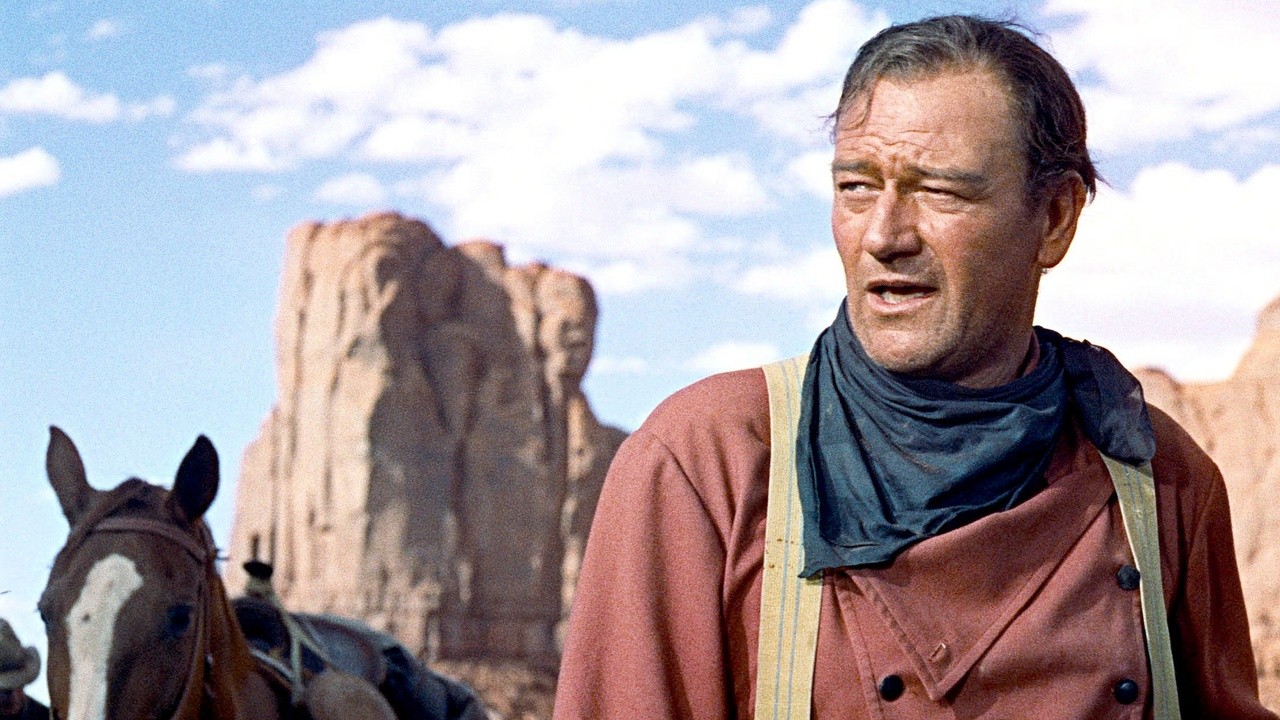
During Ethan’s stay with the family, a group of Comanches attacks the Edwards ranch, killing the family members who were home, except Aaron’s two daughters who are kidnapped. Here the story really begins: from this point, the film follows Ethan, Martin, and several other men, including Lucy’s boyfriend Brad Jorgensen, the Rev. Samuel Clayton, and a group of Texas Rangers, as they set out to find the kidnapped girls. As the search stretches from weeks to months and finally years, most of the men abandon the cause—except for Ethan and Martin. Along the way they learn that a chief named Scar was responsible for the raid, though they find out only Debbie has survived early on. Ethan pushes on relentlessly following their trail, aiming to kill Debbie and her captor, Chief Scar, for violating her; declaring that once Comanches capture a white girl, she is no longer white. Despite Ethan’s protests that he wants to continue the search alone, Martin tags along with him for years, because Martin knows that he will have to protect Debbie from Ethan if she is ever found. Therefore, although partners, Ethan and Martin are destined to become enemies once the search is finished. —DVDverdict.com
Maine-born John Ford (born Sean Aloysius O’Fearna) originally went to Hollywood in the shadow of his older brother, Francis, an actor/writer/director who had worked on Broadway. Originally a laborer, propman’s assistant, and occasional stuntman for his brother, he rose to became an assistant director and supporting actor before turning to directing in 1917. Ford became best known for his Westerns, of which he made dozens through the 1920s, but he didn’t achieve status as a major director until the mid-‘30s, when his films for RKO (The Lost Patrol 1934, The Informer 1935), 20th Century Fox (Young Mr. Lincoln 1939, The Grapes of Wrath 1940), and Walter Wanger (Stagecoach 1939), won over the public, the critics, and earned various Oscars and Academy nominations. His 1940s films included one military-produced documentary co-directed by Ford and cinematographer Gregg Toland, December 7th (1943), which creaks badly today (especially compared with… read more
From the spirited opening shot, the white orthodox household of the West - Wayne, the conservative stalwart, his hegemony shattered, by the women, by the indigenes. Pungent ideals, but swiftly numbened by the sheer mellifluence of Ford’s frame. Beyond Hollywood iconography: a majestic panorama of design and detail, the masculine mantle reduced to but a spiteful, quivering pulp; melodrama be damned - a pre-eminent, ironic tragedy in motion. “That’ll be the day…” Masterpiece, verily.
A film about a country with no path, a country living in a false idea of morality, a country of cowboys and indians, a country that lives its present through an idea of future without the pillars of the past. It might be light-hearted at moments, but the cynicism will for ever be haunting.
I greatly admire the scenic beauty jazz, but the screenplay was far from revelatory or even interesting. It's a great concept with historical precedent, but the lack of any kind of contemplation into the wherefores of Ethan's racism and the "suddenness" of his conversion, along with the bewildering lack of focus on the dilemma of debbie's made for a less deep plot than the setup promised.
A couple of crowd-funding projects to check out, new trailers from Baumbach, Coppola, Malick and Whedon, Orson Welles’ Sketch Book & more.
The British magazine unveils the results of their 2012 poll of the greatest films of all time.
Digital projection is replacing 35mm film as the industry standard, and revival houses and museums may soon follow suit. Why should we care?
Taken together, the two Agneepath films—one from 1990, other other 2012—reveal a world in between, quite literally.
For this year’s incarnation of the Alamo Drafthouse Rolling Roadshow, someone had the excellent idea of commissioning the artist formerly
The Searchers 1956
The prestigious film journal Sight and Sound has nominated this film as one of the 10 best films in the world 3 times since 1953, a poll based on the most… read review
Beautifully filmed, including several iconic Western cinema images and, of course, the always photogenic Monument Valley and Natalie Wood. John Wayne does a great job playing a character who is unrelentingly… read review
There’s a reason it’s considered the greatest American Western, it’s without a doubt one of the greatest movies ever made in my opinion. It showcases everything that makes John Ford revolutionist he… read review

John Milius said that the western has an honesty… read review