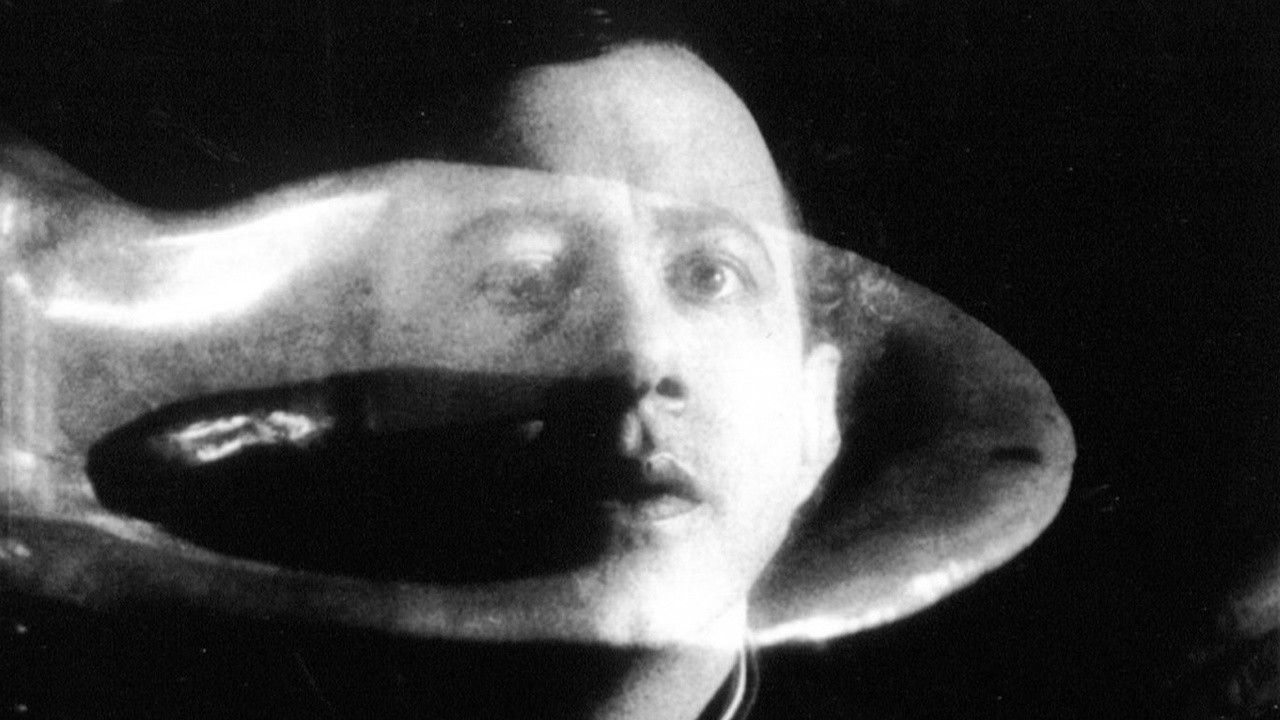
A clergyman experiences a bizarre sequence of fantasies that torment him and test his faith to the limit. He has fallen for a beautiful woman, the wife of a proud general, and this obsession provokes image after image in his increasingly heated brain. He sees himself kill the general; he sees himself chase after the beautiful woman. The dream becomes ever more fantastic and terrifying, until, at its climax, the clergyman seizes a giant shell and thirstily drains its contents… —filmsdefrance.com
Germaine Dulac (17 November 1882, Amiens, France – 20 July 1942, Paris) was a French film director and early film theorist. Famously, she directed The Seashell and the Clergyman (1928), based on a scenario by Antonin Artaud. This film has been credited as the first surrealist film, released shortly before Un Chien Andalou (1929) by Luis Buñuel and Salvador Dalí. However, other scholars, including Ephraim Katz, consider her an Impressionist filmmaker.
In 1920, at the height of the film Avant-Garde movement, its only female member Germaine Dulac released her tenth film La Belle Dame Sans Merci, which she wrote in collaboration with her friend Irene Hillel-Erlanger, a surrealist poet also known as Claude Lorey. In Hillel-Erlanger’s words La Belle Dame Sans Merci is “une histoire comme il y en a dans la vie de chacun de nous… riche de ces chocs et mouvements intimes qui bouleversent les coeurs et les ames”. This definition is evocative of melodrama… read more
Besides 'Un Chien Andalou' one of the great surrealistic movies which has been made in the 20s. Great images with some extraordinary visual effects.
This film deserves to be held in the same regard as Un Chien Andalou. A great early surrealist short.
"The film follows the erotic hallucinations of a priest lusting after the wife of a general." Speaks for itself :)
"The film is so cryptic as to be almost meaningless. If there is a meaning, it is doubtless objectionable." British Board of Film Censors, 1928
Germaine Dulac is possibly best known for the British film censor's verdict on her 1928 experimental-surreal freak-out The Seashell and the