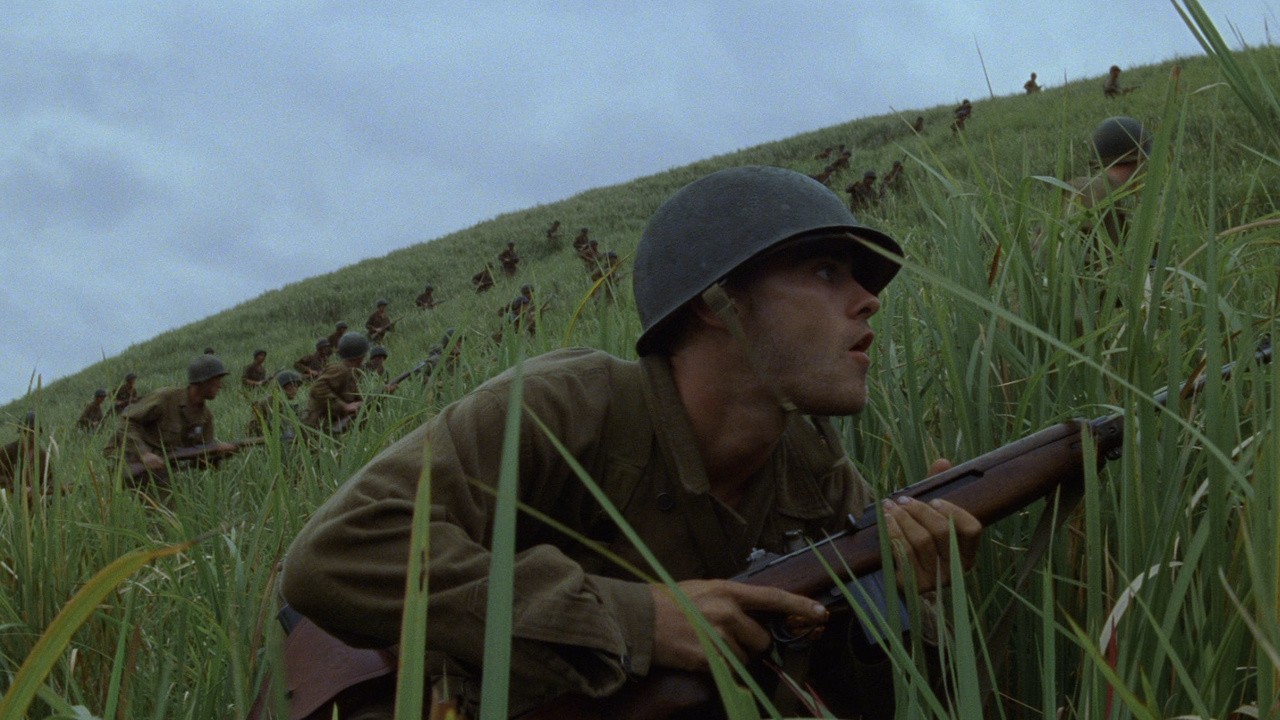
After directing two of the most extraordinary movies of the 1970s, Badlands and Days of Heaven, American artist Terrence Malick disappeared from the film world for twenty years, only to resurface in 1998 with this visionary adaptation of James Jones’s 1962 novel about the World War II battle for Guadalcanal. A big-budget, spectacularly mounted epic, The Thin Red Line is also one of the most deeply philosophical films ever released by a major Hollywood studio, a thought-provoking meditation on man, nature, and violence. Featuring a cast of contemporary cinema’s finest actors—Sean Penn, Jim Caviezel, Nick Nolte, Elias Koteas, and Woody Harrelson among them—The Thin Red Line is a kaleidoscopic evocation of the experience of combat that ranks as one of the greatest war films ever produced. —The Criterion Collection
Terrence Malick is one of the great enigmas of contemporary filmmaking, a shadowy figure whose towering reputation rests almost entirely on a pair of near-perfect features released a generation ago. A visual stylist beyond compare, Malick emerged during the golden era of 1970s American movie-making, bringing to the screen a dreamlike, ethereal beauty countered by elliptical, ironic storytelling; resonant and mythic, his films illuminated themes of love and death with rare mastery, their indelible images distinguished by economy and precision. Born in Waco, TX, on November 30, 1943, Malick spent many of his formative summers working as a farmhand, an experience upon which he would draw extensively in his films. Upon graduating from Harvard with a degree in philosophy, he entered Magdalen College in Oxford as a Rhodes scholar, but exited prior to completing his final thesis. On returning to the U.S., he became a freelance journalist, with his byline appearing in such publications as Life… read more
Questo grande male, da dove viene? Come ha fatto a contaminare il mondo? Da quale seme, da quale radice si è sviluppato? Chi è l'artefice di tutto questo, chi ci sta uccidendo, chi ci sta derubando della vita e della luce prendendosi beffa di noi, mostrandoci quello che avremmo potuto conoscere? La nostra rovina è di sollievo alla terra? Aiuta l'erba a crescere, il sole a splendere? Questa ombra oscura anche te? Tu hai mai attraversato questo buio?
Heaven and Hell. "This great evil - where’s it come from? How’d it steal into the world? What seed, what root did it grow from? Who’s doing this? Who’s killing us? Robbing us of life and light, mocking us with the sight of what we might have known? Does our ruin benefit the earth? Does it help the grass to grow and the sun to shine? Is this darkness in you too?"
I think this was Malick's film to shine at the Oscars. It should have beat out Shakespeare in Love (obviously) and Saving Private Ryan to the awards. But what does the AMPAS know right
A rediscovered interview, a new issue, a fresh round of lists of the best of 2011.
On the occasion of its video release.
In The Tree of Life, we know that Brad Pitt’s unnamed, self-styled paterfamilias is a light smoker not because it’s ever said or
Updated through 5/24. "Each Terrence Malick film concerns a lost or squandered Eden," writes Michael Joshua Rowin in the LA Weekly: "the
"Terrence Malick's epic war-film daydream The Thin Red Line (1998) is already out on DVD, but it is being reissued this week from The Criterion
This is in fact the most hideously beautiful thing I have ever seen. Terrence Malik is an artist with the camera and this film has the biggest contrast between breathtaking visuals and the horrors… read review
At the core of The Thin Red Line are the devestating and emotionally charged performances of the all-star ensemble cast with Sean Penn, Nick Nolte and Jim Caviezel standing out in particular. The physically… read review
Pure, unfiltered, raw emotion. That is what’s front and center in Terrence Malick’s adaptation of James Jones’s autobiographical novel The Thin Red Line. The term itself may describe a thinly spread… read review