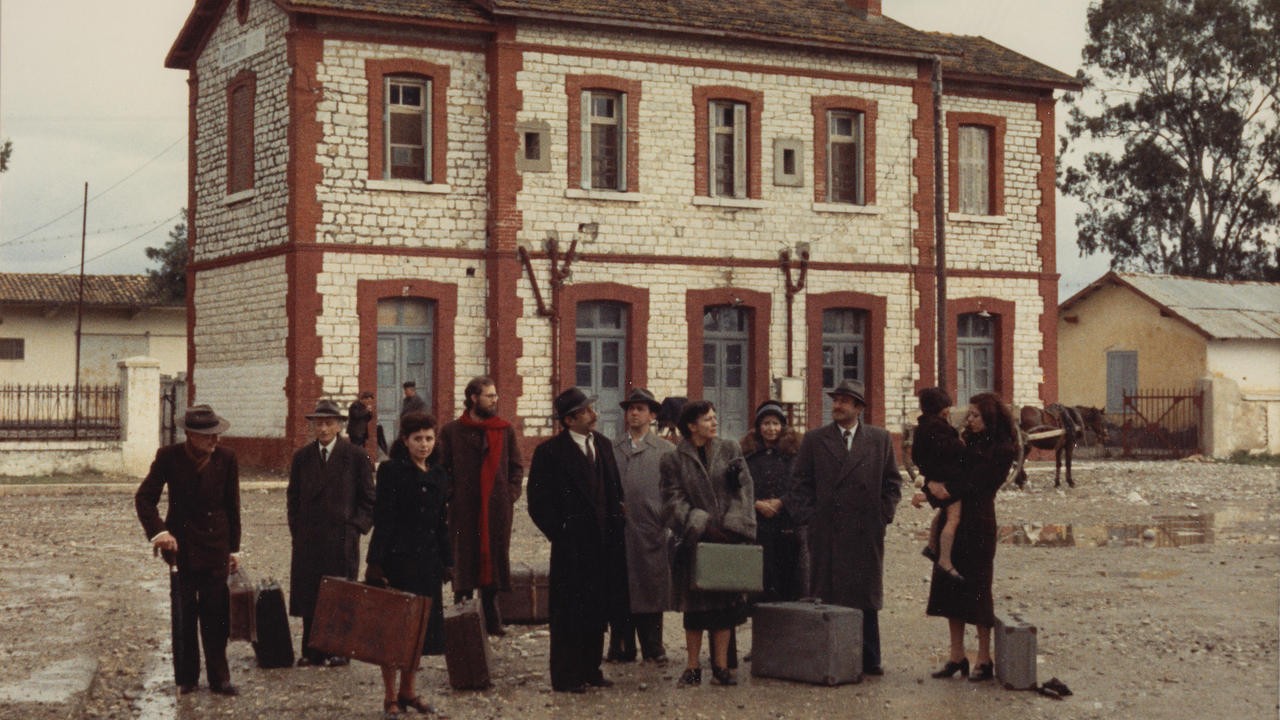
The Travelling Players is a film of epic proportions. The action takes place during the years 1939-52 and is seen as a series of individual, often inexplicable events or tableaux, commentated by monologues, by slogans written on the walls, or by songs. It reveals the period’s turbulent history while focusing on a travelling company of actors who spend those fourteen years wandering through provinces, cities and villages, performing, in increasingly threadbare circumstances, a 19th century pastoral melodrama, Persiadis’ Golfo the Shepherdess. They never get to finish the play and the tranquil sheep painted on their back cloth gaze down upon generations of anguish and bloodshed. The passage of history reverberates in individual incidents or is summarized in symbols. These sad, shabby, often hungry folk, whose relationship is based on the family of the House of Atreus, are of varying political hues – from active collaborators with the Nazis (Aegisthus), to opportunists (Chrysothemis), to centrist Greek patriots (Agamemnon), to the apolitical (Clytemnestra), to left-wing idealists (Electra), to communist guerillas (Orestes). And they fill these roles as much as they do the mythic ones of wandering general, faithless wife, betrayer or vengeful son. As they travel amid the constant wartime convulsions, they begin, unconsciously, to enact parallels to Aeschylus’ tragic cycle. —trigon-film
Theo Angelopoulos began to study law in Athens but broke up his studies to go to the Sorbonne in Paris in order to study literature. When he had finished his studies, he wanted to attend the School of Cinema at Paris but decided instead to go back to Greece. There he worked as a journalist and critic for the newspaper “Demokratiki Allaghi” until it was banned by the military after a coup d’état. Now unemployed, he decided to make his first movie, Anaparastasi (1970). Internationally successful was his trilogy about the history of Greece from 1930 to 1970 consisting of Meres tou ’36 (1972), O thiasos (1975), and Oi kynigoi (1977). After the end of the dictatorship in Greece, Angelopoulos went to Italy, where he worked with RAI (and more money). His movies then became less political. —IMDb
Work of art, pure joy. The mysterious quality this exceptional film possesses is what I loved the most. It's almost as if the ghosts of the past (the travelling players and the other townspeople) are walking through history that has already happened. But don't think of it as a difficult or inaccessible film, just let it speak for itself and you will be transfixed on the screen in amazement. Very highly recommended.
This is a 3.5 hour movie. Yet I can see it with the same excitement as the first time. And cry like I cried the first time.
The swiftest four hours since Gone With the Wind! And less opaque than I thought. Theo A. makes constructing the national epic look easy.
His career spanned four decades and, in 1998, he won the Palme d’Or for Eternity and a Day.