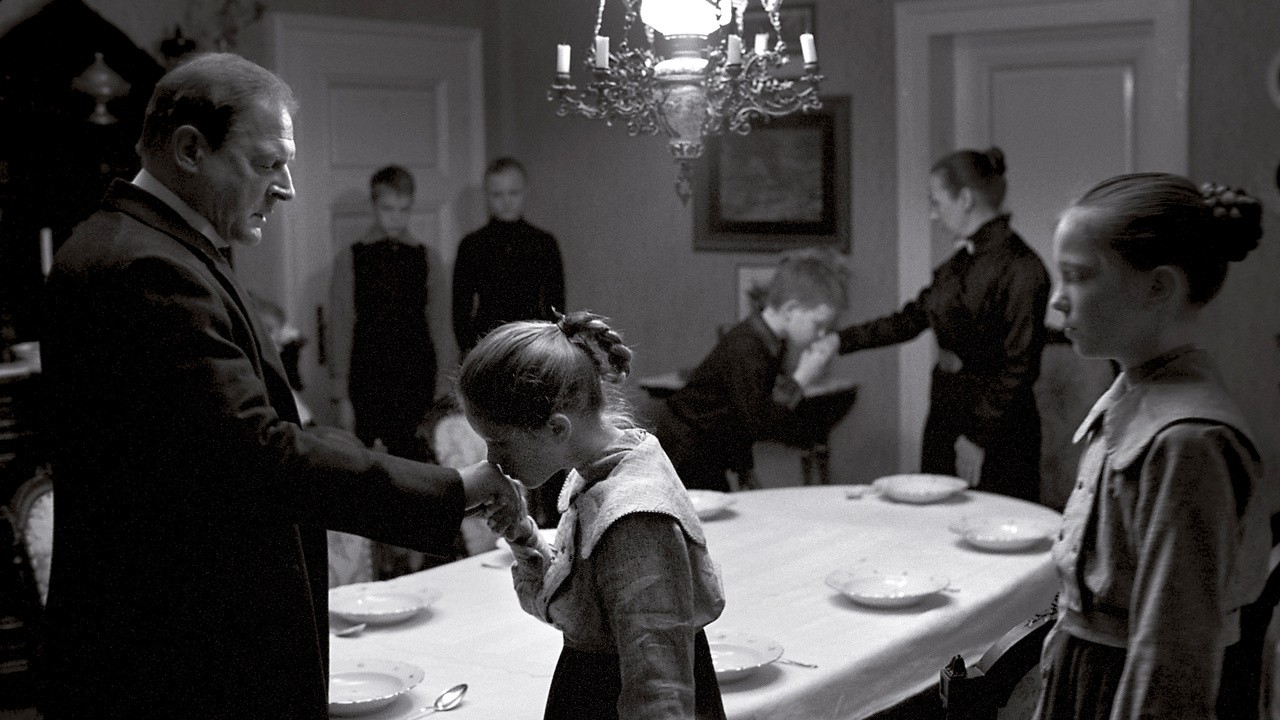
A village in Protestant northern Germany. 1913-1914. On the eve of World War I. The story of the children and teenagers of a choir run by the village schoolteacher, and their families: the baron, the steward, the pastor, the doctor, the midwife, the tenant farmers. Strange accidents occur and gradually take on the character of a punishment ritual. Who is behind it all? —Cannes Film Festival
Cheerfully wishing his audience a “disturbing evening” at a London retrospective of his films, director Michael Haneke insists that he is an optimist at heart, despite all of the relentlessly bleak carnage and deeply disturbing imagery so vividly painted and seared into the mind of anyone who has had the uncomfortable experience of viewing his work.
Practically born into show business, to an actress mother and director father, in Munich in March 1942, Haneke spent his early years in a working class suburb of Vienna before an early attempt at fame as an actor and pianist. Failing to achieve early success, Haneke attended the University of Vienna to study philosophy and psychology, and became a film critic and stage director before making his eventual debut as a television director with After Liverpool in 1973. Setting in motion a television career specializing in literary adaptations and small screen films, Haneke would work successfully in that medium until his feature debut… read more
I decided to watch The White Ribbon after I rewatched The Piano Teacher. And now I question my own sanity for watching two Haneke’s movies in a day (and enjoy it!).
Una obra densa, no sólo por su metraje sino por la ambición del director en mostrar todo un microcosmos, y con sumo detalle además, lo cual hace que uno pueda pensar, a la salida del cine, que esto podría haber durado cuatro horas, o más. La violencia de los adultos desencadena más violencia. Lo extraño es sacado fuera. ¿Fue esto el origen de la maldad suprema de años después? Excelente fotografía.
Haneke decide di esplorare la vita di un microcosmo e metterne in piazza la grettezza,il bigottismo,la rigidità morale e soprattutto la violenza (che è ancora più cruda e forte perchè spesso viene celata).Il villaggio viene assunto a simbolo di una società prossima a far germogliare i semi di quel nazismo che spazzerà via tutto.Un bianco e nero monumentale,interni cupi ed esterni mozzafiato,dialoghi crudi.Grandioso.
There's always something so similar between all the great photographs and great films.
His next film, Amour, with Jean-Louis Trintignant, Emmanuelle Riva and Isabelle Huppert, will likely premiere in Cannes.
This summer certainly hasn't lacked for reading material. In last month alone, we've seen new issues of Film Comment (in which Paul Brunick
It's a busy Wednesday between Christmas and New Year's, with film journals posting new issues, a handful of films opening in theaters and
Selections from the November/December 2009 issue of Film Comment have been posted along with a few online exclusives, among them, the full
Here in Germany, where The White Ribbon has been in theaters for a couple of weeks now, Michael Haneke was on television last night. There
"As is the case with several films in this year's New York Film Festival, Michael Haneke's The White Ribbon exemplifies the pleasures and
The Coen brothers may command the best line of the Toronto Film Festival—“Accept the mystery”—but just like von Trier’s faux-infamous “chaos
The full and proper name is The Times BFI 53rd London Film Festival and it opens on October 14 with Fantastic Mr Fox. As that's only
Since premiering in Cannes, where it won the Palme d'Or, Michael Haneke's The White Ribbon has been on a roll. Headed to the Toronto and New
Michael Haneke’s The White Ribbon.
A dark portrait of life in a small Protestant village in rural Germany, Haneke describes his film as revealing ‘the origin of every type of terrorism, be it of political or religious nature’. Shot… read review
English Title: The White Ribbon
Original Title: Das weisse Band – Eine deutsche Kindergeschichte
Year: 2009
Country: Germany, Austria, France, Italy
Language: German, Italian Polish… read review
el rigor del cine de haneke en su expresión más acabada. se entiende la renuencia de las distribuidoras en méxico para exhibirla. haneke usa la cámara como un carnicero su machete destazador. la experiencia… read review