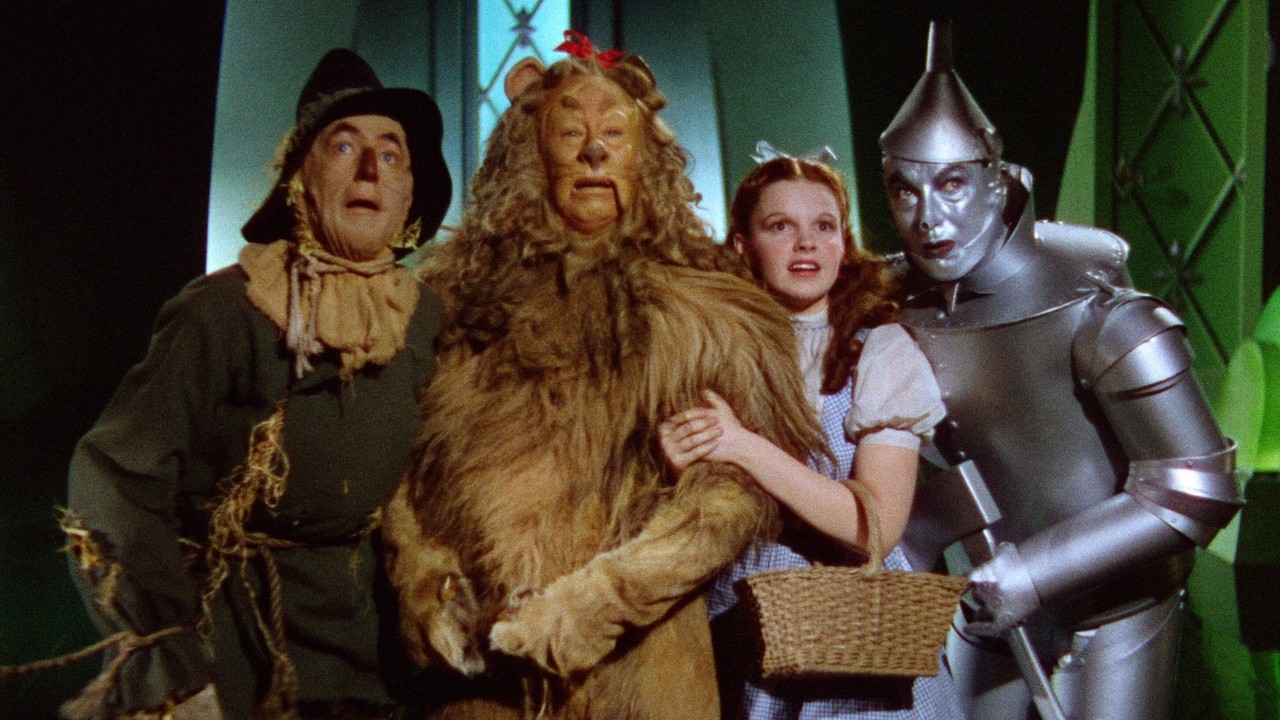
When a nasty neighbor tries to have her dog put to sleep, Dorothy takes her dog Toto, to run away. A cyclone appears and carries her to the magical land of Oz. Wishing to return, she begins to travel to the Emerald City where a great wizard lives. On her way she meets a Scarecrow who needs a brain, a Tin Man who wants a heart, and a Cowardly Lion who desperately needs courage. They all hope the Wizard of Oz will help them, before the Wicked Witch of the West catches up with them. –IMDb
Victor Fleming entered motion pictures as a combination driver and stunt man at the Flying A studio in Santa Barbara, California, in 1912, following a series of jobs that included bicycle mechanic, taxi driver, auto mechanic (He also did a little racing on the side), chauffeur and auto salesman. Allan Dwan took credit for hiring him after he repaired Dwan’s car, but Fleming’s real conduit was his actor pal Marshall Neilan, whom he had met as a chauffeur.
After two years with Flying A, Fleming joined Neilan at Kalem, making the early Ham and Bud comedies, and in 1915, he joined the Douglas Fairbanks unit at Triangle, where he worked under Dwan and John Emerson. His first picture there was The Habit of Happiness, and he was one of several cameramen who worked on D.W. Griffith’s Intolerance in 1916. By the outbreak of World War I, Fleming was Fairbanks’ supervisory cameraman at ArtCraft Pictures. After Signal Corps service that included serving as President Woodrow Wilson’s personal… read more
The great San Francisco earthquake and fire of 1906 was a tragedy for Mervyn Leroy. While he and his father managed to survive, they lost everything they had. To make money, Leroy sold newspapers and entered talent contests as a singer. When he enter vaudeville, his act was LeRoy and Cooper – Two Kids and a Piano. After the act broke up, he contacted his cousin, Jesse L. Lasky, and went to work in Hollywood. He worked in costumes, the film lab and as a camera assistant before becoming a comedy gag writer and part-time actor in silent films. His next step was as a director, and he turned out his first effort, No Place to Go (1927), before scoring his first unqualified hit with Harold Teen (1928). Earning $1,000 per week by the end of that year, he was nicknamed “The Boy Wonder” of Warners, where his pictures were profitable lightweights. His motto, to paraphrase Shakespeare, was “Good stories make good movies.” LeRoy rounded out the decade assigned to more lightweights, such as Naughty… read more
King Wallis Vidor (February 8, 1894 – November 1, 1982) was an acclaimed American film director whose career spanned nearly seven decades.
He was born in Galveston, Texas, where he survived the great Galveston Hurricane of 1900. His grandfather, Charles Vidor, was a refugee of the Hungarian Revolution of 1848 who settled in Galveston in the early 1850s.
A freelance newsreel cameraman and cinema projectionist, he made his debut as a director in 1913 with Hurricane in Galveston. In Hollywood from 1915, he worked on a variety of film-related jobs before directing a feature film, The Turn in the Road, in 1919. A successful mounting of Peg o’ My Heart in 1922 got him a long term contract with Goldwyn Studios, later to be absorbed into MGM. Three years later he made The Big Parade, among the most acclaimed war films of the silent era, and a tremendous commercial success. This success established him as one of MGM’s top studio directors for the next decade. In 1928, Vidor received… read more
It makes me nostalgic for my childhood, but I'm still old enough to realise just how bad it is. Just because something is rendered 'timeless' culturally and played during holidays, this does not mean that it's actually worth remembering.
It's actually a fairly dreadful movie. The dialogue is cheesy, everyone over-acts and it's all very moral, sentimental and kitsch. I liked it as a child but now that I'm a young adult, I've started to see just how terrible it is. Some part of me thinks that if this were a little different or perhaps critically panned, nobody would respect it or view it as 'timeless'.
a 8/10, my first time viewing is exhilarating! my review: http://lasttimeisawdotcom.wordpress.com/2013/04/14/last-film-i-saw-the-wizard-of-oz/
Also: New Offscreen, the NYT’s fall movies package, Otis Ferguson — and remembering Frances Bay.
Title: The Wizard of Oz
Year: 1939
Country: USA
Language: English
Genre: Adventure, Family, Musical
Director: Victor Fleming
Writers:
Noel Langley
Florence Ryerson… read review
On any level you care to look at it, this is an amazing film. Occasionally the Hollywood dream factory came through with something that more than justified its existence and this is one such example… read review
It is believed to by the most-watched film ever made, and the reason for that is the irresistable feeling that there seems to be magic imprinted onto every frame of the film. It is perhaps the first… read review
“Toto, I’ve a feeling we’re not in Kansas anymore.”
Watch how after Dorothy slaps The Cowardly Lion and he starts blubbering—Judy Garland can barely keep a straight face. Neither can we. Close… read review