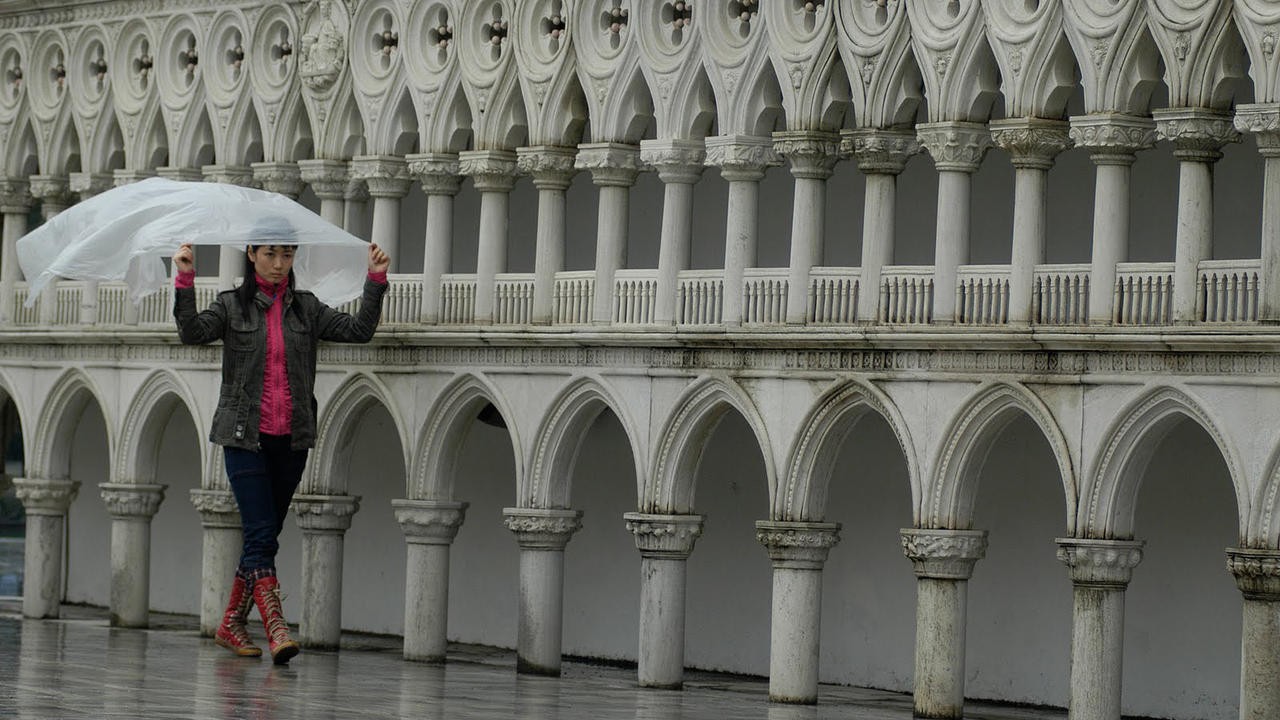
The World is the first film by award-winning director Jia Zhangke to be approved by the Chinese government. Tao is living out her dreams at the World Park, where visitors can see famous international monuments without ever leaving Beijing. The pretty young dancer and her friends perform daily in lavish theme park shows among replicas of the Taj Mahal, the Eiffel Tower, St Mark’s Square, Big Ben and the Pyramids. Tao and her boyfriend, park security guard Taisheng, moved to the big city from the northern provinces a few years ago. Now their relationship has reached a crossroads. Taisheng becomes attracted to Qun, a fashion designer he meets on a trip back home, while Tao finds escape in child-like flights of fancy when faced with what is expected of her as a woman. The couple’s friends are going through similar problems. Xiaowei questions her future with irresponsible boyfriend Niu. Meanwhile, Youyou uses romance to the advantage of her professional ambitions.
Not everyone who comes to Beijing with high hopes can land a job. Many, like manual laborer Erxiao, only experience a much harsher reality. But despite the fun and magic of the theme park, even the World Park’s microcosm of young Chinese are vulnerable to change. For Tao and those around her, there will be marriage and break-ups, loyalty and infidelity, joy and tragedy. A bittersweet and poignant picture of contemporary Chinese youth, beautifully shot in the most unusual of settings.
Wang Hongwei (‘Xiao Wu’, ‘Platform’) and Han sanming (‘Platform’, ‘Still Life’) play smaller parts here, and help linking the film to Jia’s former and later works.
Early Work
While a student at the Beijing Film Academy, Jia would make three short films to hone his skills. The first, a ten minute short documentary on tourists in Tiananmen Square entitled One Day in Beijing, was made in 1994 on self-raised funds. Though Jia has referred to his first directorial effort as inconsequential and “naive”, he also described the short day and half shoot as “excitement…difficult to express in words.” But it was Jia’s second directorial effort, the short film Xiao Shan Going Home (1995), that would bring him to the attention of the film world. It was a film that helped establish Jia’s style and thematic interests and, in Jia’s words, was a film that “truly marks the beginning of my career as a filmmaker.” Xiao Shan would eventually to screen abroad where it won a top prize at the 1997 Hong Kong Independent Short Film & Video Awards. More significantly, the film’s success brought Jia in contact with cinematographer Yu Lik-wai and… read more
What a strangely beautiful movie. I found it very hard to follow the story lines, and I was often bored (what a superficial complaint!) but some beautiful moments.
I really really struggled to engage in this film. Although a few scenes were filled with quite some possibilities, I failed to really be pulled in by the characters and issues. I felt truly like I was watching a foreign film in the sense that I felt I was outside of the world in which this film made sense. The trailer caught my attention, and the concept appealing, but I was left lost wandering it's frames.
If you're going to talk about cinema at present, even if you're not talking very thoroughly, it's inevitable that Yu Lik-wai's work, if not
China’s impressive economic growth has lead to concern from some Americans. But Atlantic Monthly’s James Fallows, who has been living in China for the past several years, likes to point out… read review
The Cinematheque Ontario recently selected three Zhang-ke Jia films for inclusion in their Best of the Decade programme: Platform, Still Life and The World… read review