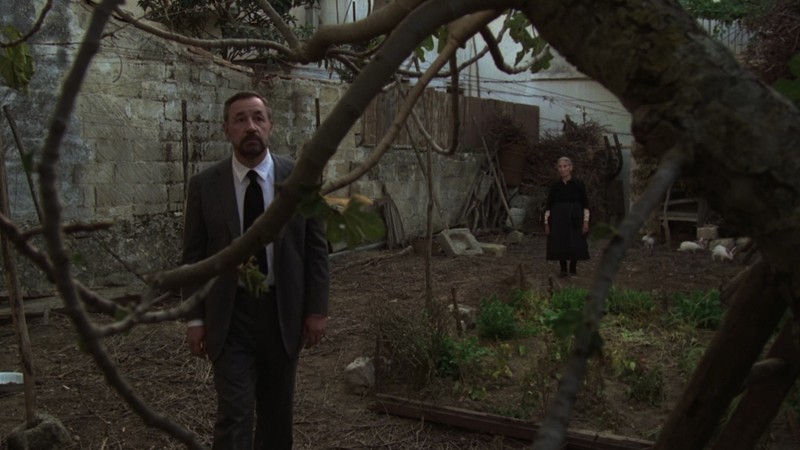
The films of Francesco Rosi stand as an urgent riposte to any proposal of aesthetic puritanism as a sine qua non of engaged filmmaking. From Salvatore Giuliano to Illustrious Corpses and Chronicle of a Death Foretold, he uses a mobilisation of the aesthetic potential of the cinema not to decorate his tales of corruption, complicity, and death, but to illuminate and interrogate the reverberations these events cause. If one quality were to be isolated as especially distinctive and characteristic it would have to be the sense of intellectual passion, of direction propelled by an impassioned sense of inquiry. This can be true in a quite literal way in Salvatore Giuliano, in which any “suspense” accruing to Giuliano’s death is put aside in favour of a search for another kind of knowledge; and The Mattei Affair, in which the soundtrack amasses evidence that is presented virtually in opposition to the images before us; or, in a more metaphoric sense, Christ Stopped at Eboli, which represents… read more
The films of Francesco Rosi stand as an urgent riposte to any proposal of aesthetic puritanism as a sine qua non of engaged filmmaking. From Salvatore Giuliano to Illustrious Corpses and Chronicle of a Death Foretold, he uses a mobilisation of the aesthetic potential of the cinema not to decorate his tales of corruption, complicity, and death, but to illuminate and interrogate the reverberations these events cause. If one quality were to be isolated as especially distinctive and characteristic it would have to be the sense of intellectual passion, of direction propelled by an impassioned sense of inquiry. This can be true in a quite literal way in Salvatore Giuliano, in which any “suspense” accruing to Giuliano’s death is put aside in favour of a search for another kind of knowledge; and The Mattei Affair, in which the soundtrack amasses evidence that is presented virtually in opposition to the images before us; or, in a more metaphoric sense, Christ Stopped at Eboli, which represents an inquiry into the social conditions of the South of Italy.
Rosi traces the evolution of his style to his early experience as an assistant on Rosselini’s Terra Trema, where he learnt the value of immediacy, improvisation, and the use of nonprofessional performers. It was a mode of filmmaking that suited the exploration of concerns found within a particular current in Italian thought. It finds expression in the writings of Carlo Levi and Leonardo Sciascia, both of whom deal with the issue of the South and both of whose work Rosi has adapted for the screen, along with, latterly, that of Primo Levi. It is a current that also finds political expression in the work of Antonio Gamsci. Rosi’s films are perhaps above all the films of an industrialising Italy, the Italy of Fiat, that exists dialectically with that of the peasant South.
Throughout his work there is an abiding interest in the social conditions in which individuals live their lives and their expression at the public or civic level, licit or illicit. Concern with organised crime and its social roots—though free from any taint of sociologizing—appears as a major thread through films as diverse as Salvatore Giuliano, Hands over the City, The Mattei Affair, Lucky Luciano, and Chronicle of a Death Foretold. Although Rosi uses the appurtenances of the thriller or the gangster film (in Lucky Luciano, for instance), his interests, as Michel Ciment has pointed out, are not at all with whodunnit but with what the crime reveals about the social context of individual lives. Lucky Luciano, for example, is not (unlike The Godfather) in the business of creating monsters but of creating a way of understanding the men who are thus mythologised. It is a tribute to Rosi’s virtuosity and commitment that the trajectory he describes is not a whit less exciting.
He may examine the mesh of the individual and his context from the point-of-view of the public sphere (Illustrious Corpses) or the private (Three Brothers or Christ Stopped at Eboli). The issue might be the ruthless mechanics of market forces in Hands over the City, or the process whereby the Mafia is set in place in The Mattel Affair. But above all Rosi remains a pre-eminent craftsman of the cinema in his acute and responsive relationship with his regular or occasional collaborators, especially with his cinematographers and musicians.
Of recent films, Forget Palermo was criticised for superficiality and some awkwardness in its casting of James Belushi. Rosi argues that its initially touristical mode was part of its point. The film follows an American “man of power” to his Sicilian roots. His honeymoon trip cannot be innocent of political implications and the tangled web of drugs and finance is meticulously revealed.
Neapolitan Diary was a more personal exploration of the same theme, taking Rosi himself back to the city of his birth and back to the location for Hands over the City. It is harsh and lucid, but never without hope of change, not even in bleak interviews with school-aged drug dealers. The South, urges Rosi, is not other than Italy but the place where the nation’s problems outcrop most painfully. Primo Levi’s The Truce, the subject of Rosi’s most recent film, follows the homeward journey of a mixed group of Auschwitz prisoners. In it Rosi has said he sees a foreshadowing of the tensions that have frighteningly emerged in Europe since the fall of the Wall.
If his most recent films may be less wholly satisfying than, say, the urgent definitiveness of Hands over the City, or less rigorously aesthetic than Illustrious Corpses, they still reveal a rare and vital intellectual commitment to cinema as a platform for debate and testimony—a form, he has said, of active participation in public life.—VERINA GLAESSNER