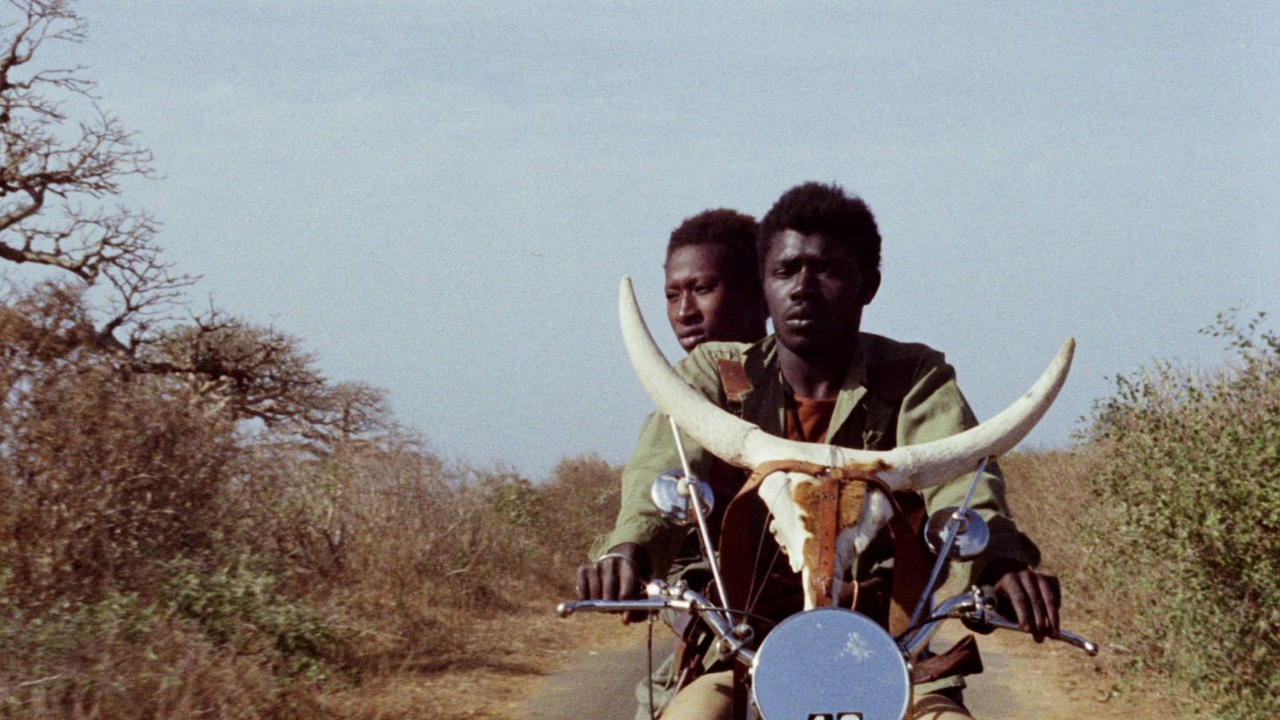
The story of Touki Bouki goes back centuries: men have always set out for new lands where they believe time never stops… Only few adventurers seem to make it, but that has never stopped anyone… Djibril left his country with the dream of finding success and solace in Europe. He soon discovered, however, the cruelty of life. While his dream fell apart little by little Djibril found he was unable to leave “Europe”, his host country. That was when returning to Africa became the real dream for him. Ending his days in Africa was a dream he would never fulfill. “Touki Bouki” is a prophetic film. Its portrayal of 1973 Senegalese society is not too different from today’s reality. Hundreds of young Africans die every day at the Strait of Gibraltar trying to reach Europe (Melilla and Ceuta). Who has never heard of that before? All their hardships find their voice in Djibril’s film: the young nomads who think they can cross the desert ocean and find their own lucky star and happiness but are disappointed by the human cruelty they encounter. Touki Bouki is a beautiful, upsetting and unexpected film that makes us question ourselves.What a pleasure and what an achievement for Martin Scorsese’s Foundation to give Djibril Diop Mambéty a second life. To all those who support cinema: bravo!" —Souleymane Cissé, May 2008
NOTES ON THE RESTORATION
Touki Bouki has been digitally restored at 2K resolution using the original 35 mm camera and sound negatives provided by the director’s son Teemour Diop Mambéty and preserved at the GTC in Paris. Digital restoration brought the film’s original chromatic elements to light. At the end of the digital process a new 35 mm internegative was produced.
The son of a Muslim cleric and member of the Lebou tribe, Djibril Diop Mambéty was born near Senegal’s capital city of Dakar in Colobane, a town featured prominently in some of his films. Mambéty’s interest in cinema began with theater. Having graduated from acting school in Senegal, Mambéty worked as a stage actor at the Daniel Sorano National Theater in Dakar until he was expelled for disciplinary reasons. In 1969, at age 24, without any formal training in filmmaking, Mambéty directed and produced his first short film, Contras’ City (City of Contrasts). The following year Mambéty made another short, Badou Boy, which won the Silver Tanit award at the 1970 Carthage Film Festival in Tunisia.
Mambéty’s technically sophisticated and richly symbolic first feature-length film, Touki Bouki (1973), received the International Critics Award at Cannes Film Festival and won the Special Jury Award at the Moscow Film Festival, bringing the Senegalese director international attention and acclaim… read more
Strange movie. It's very deliberate and deadpan, but also full of absurd, colorful flair. There were moments of brilliance here that I really enjoyed, and some bizarre humor, but I felt somehow disconnected. I just wasn't able to get swept up in it. I had a similar experience watching Divine Intervention, a movie which borrows many elements from this one. Still, I would definitely recommend it. Looking forward to seeing Mambety's Hyenas.
Could only watch two minutes of it before the cow was slaughtered. There should be some warning about this kind of thing on MUBI.
Touki Bouki is what differ what cinema can do as art comparing to literature, music and painting. Because when cinema is not only about story, it’s also about choices. Choosing which scenes should… read review
Completely nonsensical Senegalese new-wave masterpiece. And yes, that makes more sense than the film itself.
The images are amazing, and presumably, representative of Northern Africa – though… read review
¡qué buena película! su narración tradicional pero nada convencional en términos cinematográficos, su edición alocada, la mezcla de tiempos y de fantasías con realidades, el uso del color y de la música… read review
Shocking, confusing, irritating and entertaining. Unfortunately the subtitles are out of sync but the editing made the movie harder to follow for me more than the dialog. I am not certain how the synopsis… read review