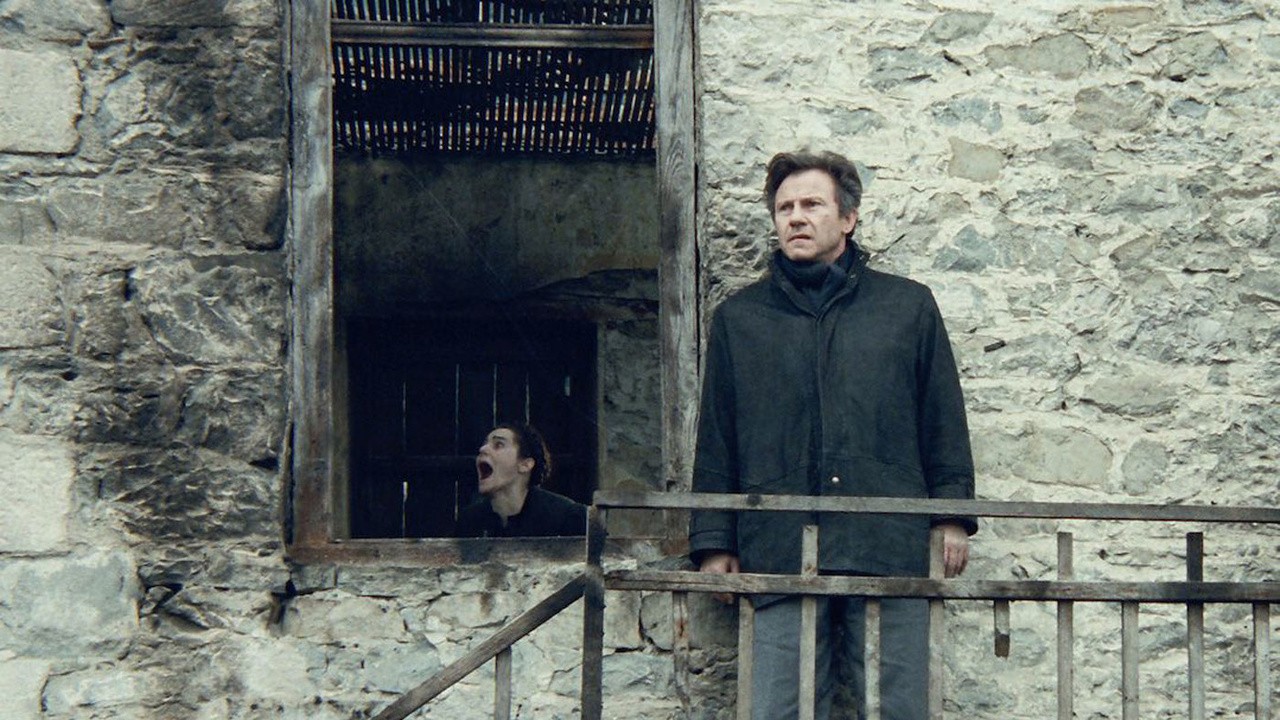
A Greek-American filmmaker, known simply as «A», returns to his home town in northern Greece for a screening of his latest controversial film. His real reason for coming back, however, is to track down three long-missing reels of film by Greece’s pioneering Manakis brothers who in the early years of cinema travelled through the Balkans, ignoring national and ethnic strife and recording ordinary people, especially craftsmen, on film. Their images, he believes, hold the key to lost innocence and essential truth, to an understanding of Balkan history Thus he embarks on a search that takes him across the war-torn Balkans, a landscape of spectral figures and broken dreams, right to the heart of darkness: a damaged film archive in Sarajevo where his quest ends. Like a latter-day Ulysses he finds his «Ithaca», the missing, undeveloped film and is at last united with the work of the Manakis brothers… his gaze communes with theirs and another journey begins. —theoangelopoulos.com
Theo Angelopoulos began to study law in Athens but broke up his studies to go to the Sorbonne in Paris in order to study literature. When he had finished his studies, he wanted to attend the School of Cinema at Paris but decided instead to go back to Greece. There he worked as a journalist and critic for the newspaper “Demokratiki Allaghi” until it was banned by the military after a coup d’état. Now unemployed, he decided to make his first movie, Anaparastasi (1970). Internationally successful was his trilogy about the history of Greece from 1930 to 1970 consisting of Meres tou ’36 (1972), O thiasos (1975), and Oi kynigoi (1977). After the end of the dictatorship in Greece, Angelopoulos went to Italy, where he worked with RAI (and more money). His movies then became less political. —IMDb
Fun fact about Ulysses Gaze: Harvey fell asleep watching his first Angelopoulos film - in front of Theo!! According to Keitel, the story goes that he was sent the script for Ulysses Gaze but didn't know much about Angelopoulos and hadn't seen one of his films, which is quite understandable given the fact that he had only had one film released officially in the U.S at the time.
Anyway, he agreed to it but Angelopoulos insisted that he see one of his films first, so he flew to the U.S to organise a private screening. Harvey claims that he fell asleep during the film and his partner at the time nudged him about she realised. Theo apparently smiled at him, and Harvey supposedly turned around and said 'ok, i'll do the movie', despite not having seen one of his films in full. haha
Modern man’s search for his home, his innocence, through cinema: an ethereal reverie, as much a worldly reflection (secular displacement; borderless languish) and the moving image’s lasting mystique, as witnessed first-hand in Angelopoulos’ reverential odyssey. Magisterial landscapes, whose effects otherwise are staved by a certain boorishness, on the part of Keitel, et al and the move to English language, in its socio-political dissertation - to which the transcendent canvas fortuitously ameliorates. By itinerant end, who knows if he found it?
how much nudity is there in this film, I ask because I have purchased this and am planning to watch with my Dad, just to confirm that the viewing isn't too awkward (cough Taxi Driver porn theatre scene cough)
Primarily remembered for his work with Bergman and Tarkovsky, Josephson was also a director himself as well as a novelist and playwright.
His career spanned four decades and, in 1998, he won the Palme d’Or for Eternity and a Day.