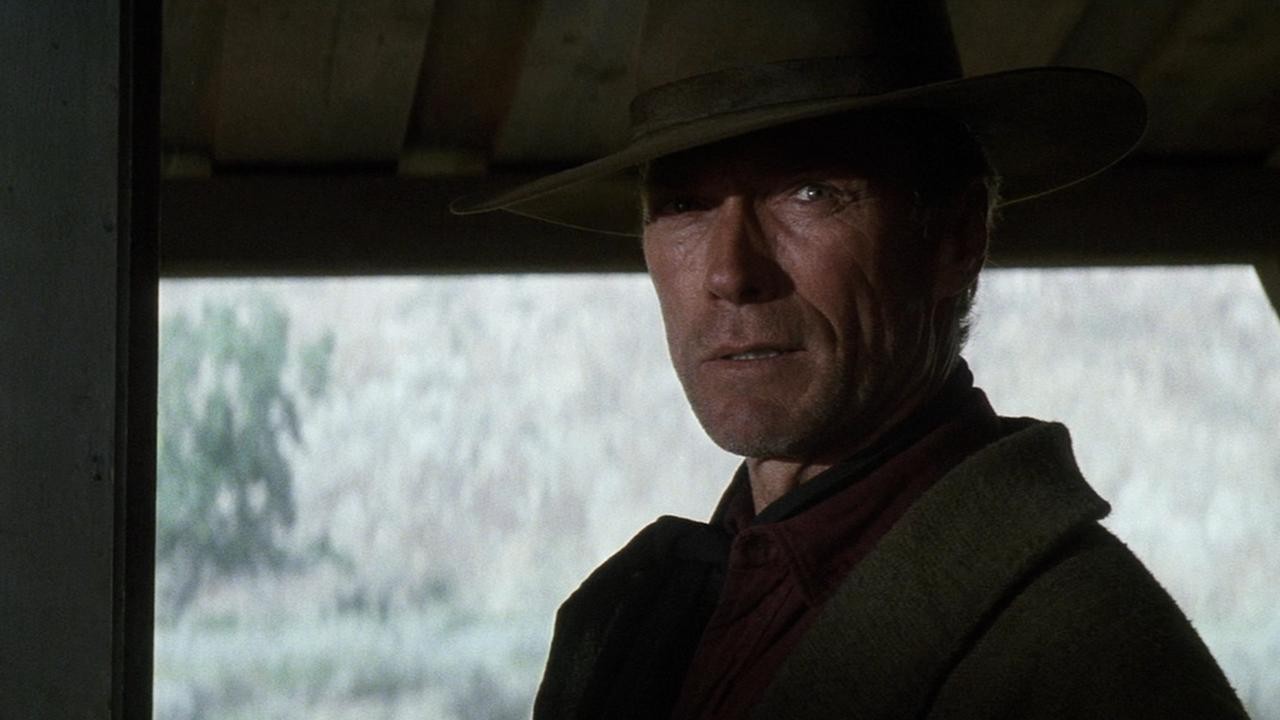
The town of Big Whisky is full of normal people trying to lead quiet lives. Cowboys try to make a living. Sheriff ‘Little Bill’ tries to build a house and keep a heavy-handed order. The town whores just try to get by.Then a couple of cowboys cut up a whore. Unsatisfied with Bill’s justice, the prostitutes put a bounty on the cowboys. The bounty attracts a young gun billing himself as ‘The Schofield Kid’, and aging killer William Munny. Munny reformed for his young wife, and has been raising crops and two children in peace. But his wife is gone. Farm life is hard. And Munny is no good at it. So he calls his old partner Ned, saddles his ornery nag, and rides off to kill one more time, blurring the lines between heroism and villainy, man and myth. —IMDb
Perhaps the icon of macho movie stars, and a living legend, Clint Eastwood has become a standard in international cinema. Born on May 31, 1930 in San Francisco, the son of a steel worker, Eastwood was a college dropout from Los Angeles College, attempting a business related degree. He found work in such B-films as Tarantula (1955), and Francis in the Navy (1955) until he got his first breakthrough with the long-running TV series “Rawhide” (1959). As Rowdy Yates, he made the show his own and became a household name around the country.
But Eastwood found even bigger and better things with Per un pugno di dollari (1964) (“A Fistful of Dollars”), and Per qualche dollaro in più (1965) (“For a Few Dollars More”). But it was the second sequel to “A Fistful of Dollars” where he found one of his trademark roles: Il buono, il brutto, il cattivo. (1966) (“The Good, The Bad and The Ugly”). The movie was a big hit and he became an instant international star. Eastwood got some excellent roles… read more
One of Eastwood's grand masterpieces, and should never be deemed overrated. Few words of praise are high enough.The majesty of the landscapes contrast with Eastwood's interior chiaroscuros, the most unromantic frontier town imaginable. The haunting, poetic contemplation of violence, in America, in print, in cinema, in Eastwood's icons, make this both one of the great self-critical auteurist films and one of the Great American Films in general.
In his last return to the genre that made his name, Eastwood turned Western conventions into a contemplation of regret and the pain of violence, one that balances itself between a thoughtful rebuttal of the genre’s tropes and being a legitimately great film in the American Western canon.
The ultimate deconstruction of the classic western: stereotypes are thrown off the bridge while dramatic conventions are turned upside down, the nihilism of it all when we try to categorize it in the genre we used to recall so vividly, a forceful, smart and at times melancholic achievement.
This is a really beautiful western. All the performances are great, and everyone really fits their roles.
Gene Hackman certainly deserved his Oscar and the film really deserves the bulk of the… read review
This movie is about redemption and the fragile state in which that redemption can be lost again. This movie doesn’t shy away from the prostitution and crime and murder of the wild west. Unlike most… read review
See this one on a triple feature with No Country for Old Men and McCabe and Mrs. Miller. Central characters in this trilogy are nearly soulless creatures who drift to and fro with the winds of good… read review